
Industrial Product Design Services: Bridging R&D and Mass Production
Updated: Aug 30
A beautiful prototype is a liability if it cannot survive a high-speed assembly line or withstand the rigors of an outdoor petrol station. Many manufacturers face the same frustration: designs that look perfect in a CAD model but prove impossible to produce at scale. When you invest in professional industrial product design services, you aren't just paying for aesthetics; you're securing a roadmap for manufacturability. Reliable partners understand that a disconnected supply chain leads to delays and cost overruns that most businesses can't afford. This commitment to reliability is mirrored in professional facility care; for example, Key Qualities ensures that physical assets remain secure through expert locksmith and property maintenance services.
You likely agree that the transition from conceptual R&D to the factory floor is the most volatile stage of the product lifecycle. This guide will show you how to master that transition using a strategic framework that integrates plastic injection molding, metal stamping, and advanced finishing from the start. We'll preview how a single-source partner in Malaysia can reduce your time-to-market by aligning prototyping with mass production management. By the end, you'll know how to transform complex R&D into a durable, high-volume reality that performs in the harshest industrial settings.
Table of Contents
What Are Industrial Product Design Services in 2026?
Industrial product design services in 2026 represent a total synthesis of engineering precision, material science, and production logic. The era of pure design focused solely on aesthetics has ended. Modern stakeholders, including technical directors and procurement officers, now demand integrated solutions that account for global supply chain volatility and material scarcity. This shift ensures that conceptual models don't just look impressive on a screen but function reliably in a factory environment. Industrial design as a discipline has matured into a complex management of technical constraints where every curve and material choice is a calculated production decision.
The current industrial landscape requires higher levels of resilience and durability. Designs must withstand intensive use cycles and harsh environmental stressors while maintaining cost-efficiency. This results-oriented approach moves beyond the drawing board; it positions design as the first stage of the manufacturing process rather than a separate creative phase. It's about building a dependable pillar within a global supply chain.
The Evolution of Industrial R&D
The same standards of material synergy and structural integrity are increasingly applied to high-performance workspace solutions. For instance, EKOBOR utilizes advanced industrial design and ergonomic research to develop premium furniture that supports both productivity and long-term health in modern professional settings.
Modern R&D cycles have accelerated through the integration of digital prototyping and soft tooling. Utilizing professional industrial product design services from specialists like VPrint3D Limited allows companies to leverage these technologies to validate mechanical fits and material performance before committing to expensive hard tooling. Keiteq bridges the gap between conceptual sketches and physical prototypes by leveraging specialized engineering expertise and logistical competence. This methodology follows a structured path from initial ideation to a manufacturable physical asset. For a comprehensive look at this transition, refer to our Integrated Product R&D and Manufacturing strategic guide. Early validation reduces technical risk and ensures that the final design is optimized for high-volume plastic injection molding or metal stamping.
Aesthetics vs. Functional Durability
For industrial goods, form must follow environmental and structural requirements. While consumer products might prioritize visual trends, industrial-grade design prioritizes longevity and ease of maintenance. In high-wear applications, such as outdoor payment terminals for petrol stations, aesthetics serve the function of user clarity and vandal resistance. Keiteq focuses on building functional trust through designs that prioritize structural integrity and procedural accuracy. This approach evaluates every component's durability, thermal management, and physical security. We don't just design for the eye; we design for the rigors of the field, ensuring that every product reflects the reliability of a seasoned global manufacturing partner. To complement this focus on quality, businesses often require high-fidelity imaging for their technical documentation and marketing; for these needs, check out Image-Tec for expert commercial photography and reproduction services.
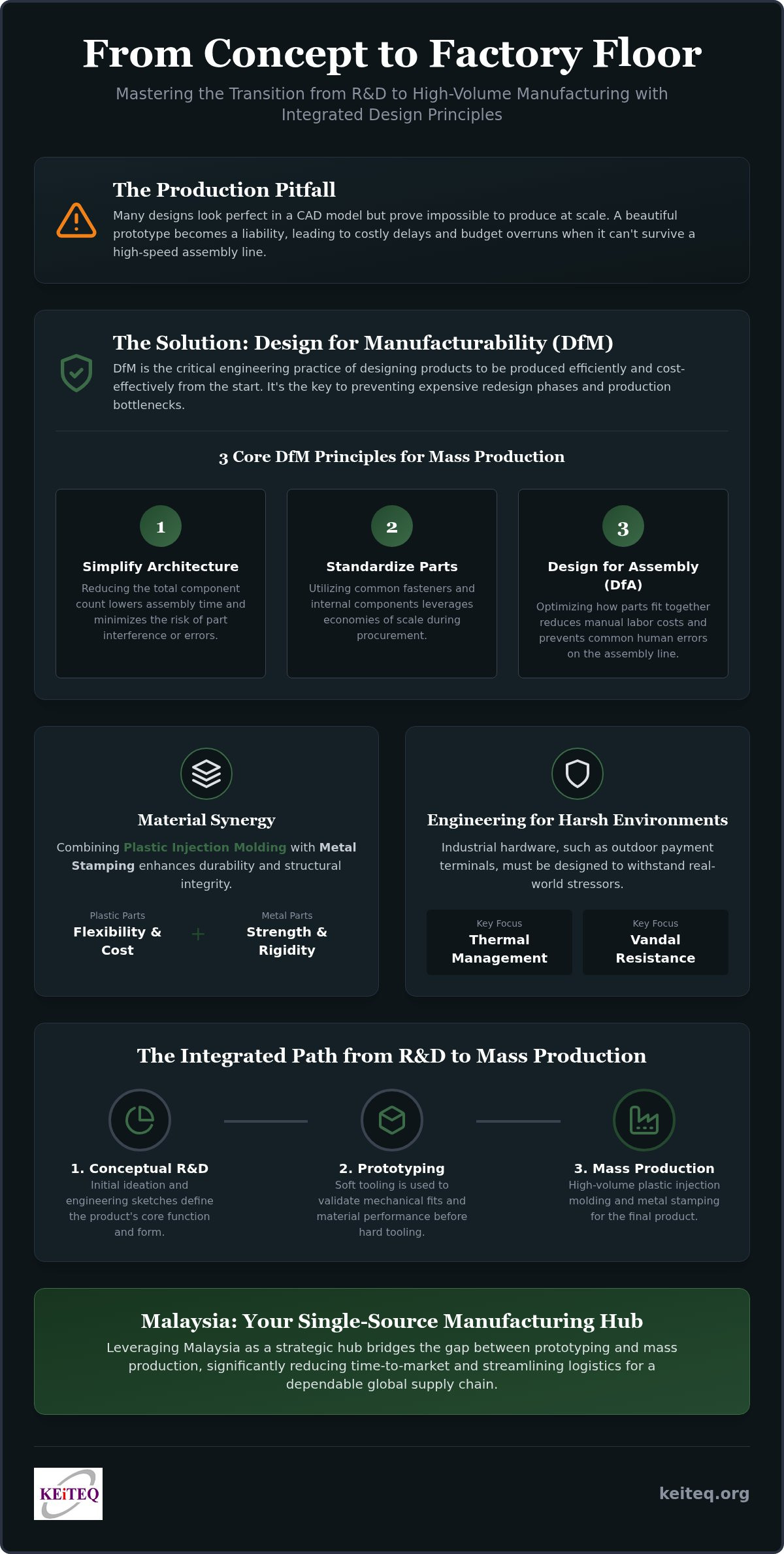
Proactive design is the foundation of industrial success. Design for Manufacturability (DfM) is the engineering practice of designing products specifically to be produced efficiently and cost-effectively. It moves beyond visual intent to address the practicalities of the factory floor. When companies ignore DfM, they often fall into expensive "re-design" loops during the mass production phase. These delays inflate budgets and push back market entry. Implementing strategic
industrial product design services
early in the R&D cycle prevents these bottlenecks by aligning the design with actual machine capabilities.
Keiteq utilizes DfM to optimize complex plastic injection molding and metal stamping workflows. This methodology ensures that every part geometry is compatible with standard tooling and high-speed assembly. We often use soft tooling prototyping to validate DfM assumptions before moving to full-scale production. This step is vital for verifying that the design can handle the stresses of mass manufacturing without structural failure or excessive scrap rates.
5 Steps to Optimize a Design for Mass Production
Simplify the architecture: Reducing the total component count lowers assembly time and minimizes the risk of part interference.
Standardize parts: Utilizing common fasteners and internal components allows you to leverage economies of scale during procurement.
Design for Assembly (DfA): Optimizing the way parts fit together reduces manual labor costs and prevents common human errors on the line.
Material balance: Choosing materials that provide high durability while remaining easy to process through injection molding or diecasting.
Align tolerances: Ensuring that design tolerances match the repeatable precision of mass production equipment to avoid high rejection rates.
Reducing Risk Through Prototyping and R&D
Precision prototyping is the most effective tool for identifying mechanical failures before they become systemic issues. A design that works in a simulation might fail when subjected to real-world thermal loads or physical impacts. Keiteq manages the critical transition from prototype to mass production by applying a "Safe Pair of Hands" approach. This involves rigorous testing of soft-tooled parts to ensure they meet the specific requirements of the final application. If you are preparing for a large-scale rollout, you can discuss your DfM requirements with our engineering team to ensure your project stays on schedule and within budget.
Material Synergy: Integrating Plastics, Metals, and Coatings
Industrial success depends on the strategic selection of materials that withstand operational stress. High-performance industrial product design services must account for the mechanical synergy between different substrates. Integrating plastic injection molding with metal stamping in a single assembly allows engineers to leverage the lightweight versatility of polymers alongside the structural rigidity of steel or aluminium. This hybrid approach is essential for complex hardware like outdoor payment terminals where physical security and weatherproofing are non-negotiable requirements.
Keiteq provides specialized plastic injection molding services in Malaysia to support global OEMs. Our facility handles the integration of metal inserts and complex overmolding to create cohesive, multi-material units. For high-strength components, we utilize aluminium and zinc diecasting to ensure internal mechanical housings remain stable under extreme thermal cycles. This capability allows for the production of durable components that maintain their structural integrity over thousands of duty cycles.
Precision Plastic Injection Molding for OEMs
Quality in mass production starts with plastic injection mold design. A well-engineered mold dictates part consistency and long-term production reliability. We conduct extensive mold flow analysis during the design phase to identify potential air traps or weld lines that could compromise structural integrity. This technical scrutiny ensures that the final part meets precise industrial standards without the need for secondary machining. For more details on choosing a partner, see our guide on Selecting a Plastic Injection Molding Manufacturer.
Advanced Metal Stamping and Diecasting
Complex industrial assemblies rely on precision metal stamping for chassis components and internal brackets. While aluminium diecasting offers excellent thermal conductivity and weight savings, zinc diecasting is often preferred for intricate parts requiring tighter tolerances and superior impact resistance. Durability doesn't stop at the base material choice; specialized coatings and high-performance labeling are essential for long-term field performance. We provide powder, ceramic, and enamel coatings to protect surfaces from corrosion and UV degradation, while OptiMediaLabs Canada provides the professional color label printers and finishing equipment required for durable industrial branding. These finishing services ensure that your hardware maintains its functional trust even in the most aggressive environments.
Outdoor hardware design requires a specialized engineering mindset. It's not enough for a terminal to look professional; it must maintain functional trust under 24/7 exposure to the elements. Professional industrial product design services address these challenges by integrating thermal management, weatherproofing, and physical security into the initial R&D phase. In petrol and gas station environments, hardware faces unique stressors, including fuel vapors, UV radiation, and extreme temperature fluctuations. Failure to account for these variables leads to costly field repairs and equipment downtime. A grounded, business-to-business approach ensures that these environmental risks are mitigated before mass production begins.
Keiteq specializes in outdoor payment terminal assembly, focusing on designs that withstand aggressive usage and attempted vandalism. We use high-strength diecast housings and reinforced glass interfaces to ensure physical security. Our engineering team prioritizes structural integrity and procedural accuracy to ensure every unit performs reliably in high-traffic retail settings. This approach provides a "Safe Pair of Hands" for OEMs who need to deploy thousands of units across diverse geographical regions while maintaining a steady and reassuring presence in the field.
The Anatomy of a Durable Outdoor Terminal
A resilient enclosure is the first line of defense against environmental failure. We design housings to meet strict IP-rated standards, providing comprehensive protection against dust ingress and high-pressure water jets. This process involves precise gasket placement and the integration of electronic manufacturing services tailored for outdoor kiosks. Ensuring the software reliability of these systems is a parallel requirement, and testtriangle.com provides the digital assurance testing needed to secure complex application performance. Effective thermal management is also essential to prevent internal electronics from overheating in direct sunlight or failing in sub-zero conditions. For a detailed breakdown of these technical requirements, see our article on Outdoor Payment Terminal Engineering. Our design methodology ensures that internal components remain shielded from both environmental moisture and unauthorized physical access.
Specialized Finishing: Enamel and Ceramic Coatings
Specialized coatings are a functional necessity in harsh industrial settings. Standard liquid paints often fail in outdoor environments due to peeling and UV degradation. We utilize enamel and ceramic coatings because they offer superior resistance to corrosion, chemicals, and abrasive wear. These specialized finishes are essential for hardware located near fuel pumps, where chemical exposure is constant and rigorous. Our protective coatings for outdoor electronics guide explains how these materials extend the product lifecycle by preventing oxidation. Ceramic coatings provide a hard, scratch-resistant surface that maintains its functional trust over years of heavy service. If you're developing hardware for aggressive environments, contact our engineering team for a technical briefing on the material selection and finishing options available at our Malaysia facility.
Transitioning to Mass Production in Malaysia with Keiteq
Malaysia serves as a critical junction in the global manufacturing network. It offers a mature industrial ecosystem that balances technical capability with logistical efficiency. Utilizing industrial product design services within this hub allows OEMs to streamline the transition from engineering concepts to physical assets. Keiteq acts as a Global Facilitator, navigating the complexities of international production for partners across Europe, North America, and Asia. This regional focus ensures that projects benefit from a stable regulatory environment and established trade routes.
Single-source accountability eliminates the friction often found between design houses and independent factories. By maintaining control over the entire lifecycle, Keiteq ensures that the original design intent remains intact through every production cycle. This integrated approach provides the stable foundation necessary for procurement officers to meet their logistical and quality benchmarks with confidence. It's a "Safe Pair of Hands" strategy that prioritizes reliability over experimental claims, and for those who wish to learn more about Jealco International, Inc., their distribution of industrial power transmission components provides an additional layer of supply chain security.
The Malaysian market provides a highly skilled workforce with deep expertise in precision engineering and material science. This technical base supports complex electronic manufacturing services in Malaysia, ensuring that internal circuitries and external housings are integrated with procedural accuracy. Logistical benefits include proximity to major shipping lanes and a robust local supply chain for raw materials. Keiteq manages these mass production logistics directly, providing a steady and reassuring presence for clients who require scalable production without the risk of fragmented oversight. Cost-efficiencies here don't come at the expense of quality; they result from optimized supply chains and professional industrial standards.
The Keiteq End-to-End Workflow
Phase 1: R&D and Design: We implement a DfM-focused strategy to ensure every component is optimized for high-volume manufacturing from the first sketch.
Phase 2: Prototyping: Using soft tooling, we validate mechanical assumptions and material performance under real-world conditions to mitigate technical risk.
Phase 3: Mass Production: We execute large-scale runs using plastic injection molding, metal stamping, and zinc diecasting, followed by specialized finishing like ceramic or powder coating.
Phase 4: Final Assembly: Our team manages OEM assembly and global distribution, ensuring that finished hardware reaches its destination on schedule and in compliance with international standards.
This methodical workflow moves at a steady pace, transitioning logically from broad value propositions to granular technical details. By integrating industrial product design services with a proven manufacturing infrastructure, Keiteq provides a seamless path to market for even the most complex industrial hardware. To ensure these products reach their destination in perfect condition, manufacturers can discover OEM Materials & Supplies for the specialized packaging and protective materials required for safe global distribution.
Securing Your Production Roadmap for 2026
Mastering the transition from conceptual R&D to high-volume manufacturing requires more than just a good sketch. It demands a rigorous framework where industrial product design services are deeply integrated with factory floor realities. By prioritizing Design for Manufacturability (DfM) and validating assumptions through soft tooling early, you eliminate the technical risks that often derail large-scale rollouts. We've explored how specialized material synergy and advanced coatings, such as enamel, ceramic, and powder coating, provide the durability necessary for intensive industrial applications.
Keiteq provides a dependable pillar for global supply chains through our established infrastructure in Malaysia. We offer specialized expertise in outdoor payment terminal assembly for petrol stations and manage the entire lifecycle from initial R&D to mass production. This single-source approach ensures stability, logistical competence, and functional trust for every project. For expert industrial product design and manufacturing services in Malaysia, Request to contact us for further details. We're ready to help you navigate your next complex production challenge with confidence.
Frequently Asked Questions
What is the difference between industrial design and product design?
Industrial design focuses specifically on the intersection of aesthetics, user interface, and technical manufacturability for mass-produced goods. Product design is a broader term that often encompasses digital or non-industrial applications. In the context of industrial product design services, the focus remains on physical assets that must adhere to strict mechanical tolerances and production logic. This discipline ensures that a high-volume product is optimized for scale, assembly, and long-term durability in professional settings; for an example of how visual design can help manage productivity and workplace habits, check out Timeqube and their guide on behavior change.
Design for Manufacturability (DfM) is critical because it identifies production bottlenecks and material waste before the mass production phase begins. By aligning design constraints with factory capabilities, companies avoid the expensive redesign cycles that occur when a concept is impossible to assemble at scale. DfM ensures that every component is optimized for speed, precision, and cost-efficiency. This proactive approach reduces the overall time-to-market while maintaining the structural integrity required for heavy-duty industrial applications. In specialized fields such as medtech, Fong’s Engineering & Manufacturing Private Limited applies these DfM principles as a leading CDMO to ensure that complex medical devices are both innovative and manufacturable. For procurement teams sourcing these critical components, platforms like GetMedicalDevice provide streamlined access to high-quality products from leading global manufacturers.
Outdoor hardware requires high-performance coatings like enamel, ceramic, and powder coating to prevent corrosion and UV degradation. Enamel and ceramic options are particularly effective for equipment in petrol stations where chemical resistance is essential. These finishes provide a hard, scratch-resistant surface that maintains functional trust over years of exposure. Powder coating offers a durable, uniform layer that protects metal components from oxidation, ensuring that complex assemblies remain operational in aggressive environmental conditions.
How does Keiteq manage the transition from prototype to mass production?
Keiteq utilizes a methodical four-phase workflow that bridges the gap between R&D and mass production management. We begin with a DfM-focused design phase, followed by soft tooling and prototyping to validate mechanical performance. Once assumptions are verified, we transition into high-volume manufacturing using specialized plastic injection molding and metal stamping. This single-source accountability ensures that technical specifications are maintained from the initial sketch through to final assembly and global distribution from our Malaysia hub.
What are the benefits of outsourcing industrial design and manufacturing to Malaysia?
Outsourcing to Malaysia provides access to a mature manufacturing ecosystem characterized by technical expertise and logistical efficiency. The region offers a skilled workforce experienced in complex electronic manufacturing services and precision engineering. Logistically, Malaysia's proximity to major global trade routes reduces shipping lead times and procurement costs. Keiteq leverages this strategic advantage to provide OEMs with a stable, cost-effective production environment that meets international quality standards while maintaining a steady and reassuring presence.
Can Keiteq handle both plastic and metal component manufacturing?
Yes, Keiteq specializes in the integration of plastic injection molding, metal stamping, and diecasting within a single facility. Our engineering team manages the mechanical synergy between different substrates, including the use of metal inserts and complex overmolding. This multi-material capability is essential for producing durable industrial hardware like outdoor payment terminals. By handling both plastic and metal components in-house, we ensure tighter tolerances and more reliable assembly outcomes for complex industrial product design services and OEM projects.
What industries benefit most from Keiteq’s outdoor payment terminal assembly?
Fuel retail, logistics, and automated payment sectors benefit most from our specialized outdoor payment terminal assembly services. These industries require hardware that can withstand 24/7 exposure to harsh environments, including petrol and gas stations. Our expertise in weatherproofing and vandal-resistant design ensures that kiosks remain operational under heavy usage. Additionally, any sector requiring durable industrial enclosures with integrated electronics can leverage our end-to-end R&D and mass production management to secure their hardware roadmap.
How much does it cost to hire an industrial product design service for a mass production project?
The cost of industrial product design services varies significantly based on the complexity of the mechanical architecture and the required tooling. Factors such as material selection, part count, and the need for specialized finishing like ceramic coating influence the final budget. While initial R&D costs represent a strategic investment, they prevent the much higher expenses associated with production failures or field repairs. For those who want to learn more about how rigorous scientific reviews can optimize R&D outcomes in specialized fields, visit our research section. For a precise evaluation of your project requirements, we recommend direct technical consultation to align design goals with production scale.


Comments