
Industrial Surface Finishing: A Comprehensive Guide to Coating and Treatment
- 2 days ago
- 12 min read
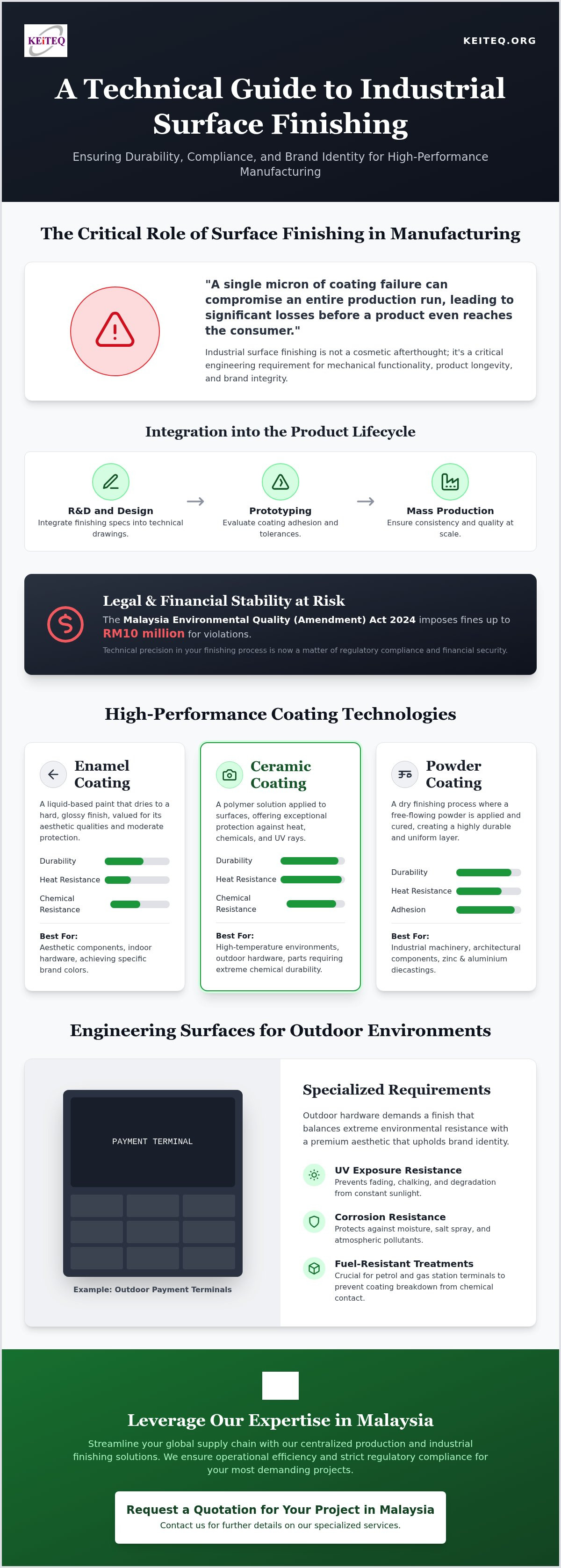
A single micron of coating failure can compromise an entire production run, leading to significant losses before a product even reaches the consumer. Most manufacturing leaders understand that industrial surface finishing is not a cosmetic afterthought; it's a critical engineering requirement for mechanical functionality. You've likely faced the frustration of premature corrosion in outdoor environments or inconsistent coating quality across mass production batches. With the Malaysia Environmental Quality (Amendment) Act 2024 now imposing fines up to RM10 million for environmental violations, the technical precision of your finishing process is now a matter of legal and financial stability.
This guide provides the technical framework you need to master the strategic selection of coatings, ensuring your products achieve both aesthetic excellence and strict regulatory compliance. We'll examine the specific requirements for enamel, ceramic, and powder coating while addressing the latest 2026 VOC and PFAS regulations. By following this methodical approach, you can extend product life and maintain brand identity through absolute consistency. From substrate preparation to final inspection, we'll outline the steps necessary to turn surface treatment into a competitive advantage for your global supply chain.
Table of Contents
Defining Industrial Surface Finishing in the Product Lifecycle
High-Performance Coating Technologies: Enamel, Ceramic, and Powder
Engineering Surfaces for Outdoor Environments and Payment Terminals
Selection Criteria for Industrial Surface Finishing Services
Industrial Finishing and Manufacturing Solutions in Malaysia
Defining Industrial Surface Finishing in the Product Lifecycle
Surface finishing encompasses a broad range of mechanical and chemical treatments designed to alter the physical properties of a component. In a professional manufacturing environment, industrial surface finishing acts as the final barrier between a product and its operational environment. It's a strategic layer that determines a part's resistance to corrosion, its surface hardness, and even its electrical characteristics. Without a methodical approach to finishing, even the most precisely machined metal stamping or plastic molding remains vulnerable to environmental degradation and mechanical wear.
Reliable production management requires finishing to be integrated into the product lifecycle from the very beginning. It's not an aesthetic veneer applied at the end of the line. Instead, it's a functional specification that dictates how a product will perform over its entire service life. By establishing these requirements early, manufacturers ensure that every batch meets the necessary industrial standards for durability and safety. This integrated approach is especially critical when managing high-volume mass production, where consistency across thousands of units is the primary metric of success.
The Intersection of R&D and Surface Treatment
Effective surface treatment starts during the prototyping and soft tooling phase. Engineers must evaluate how specific design choices, such as draft angles or corner radii, will affect coating adhesion and thickness. If a finish isn't considered during R&D, you risk coating failure due to poor substrate preparation or improper tolerance management. Integrating finishing specifications directly into technical drawings allows for a seamless transition to mass production. This foresight prevents the costly delays associated with re-tooling or batch rejections when the chosen coating doesn't bond correctly to the substrate.
Functional vs. Aesthetic Requirements
Modern industrial components must often satisfy two masters: technical performance and brand identity. For consumer-facing hardware like outdoor payment terminals, the finish must withstand extreme UV exposure and chemical contact while maintaining a premium look. Achieving this balance requires precise control over surface roughness (RA). A surface that's too smooth might lead to poor powder coating adhesion; one that's too rough might compromise the aesthetic finish or trap contaminants.
Functional requirements like wear protection and corrosion resistance are non-negotiable in harsh environments. However, the visual consistency of a product line is equally important for brand recognition. A "safe pair of hands" in manufacturing understands how to deliver industrial-grade protection without sacrificing the sleek, professional appearance that procurement officers expect. This integrated approach ensures that the final product is both a durable tool and a refined representation of the brand.
High-Performance Coating Technologies: Enamel, Ceramic, and Powder
Selecting the correct industrial surface finishing method requires a precise understanding of the substrate and its final operating environment. While some competitors focus exclusively on traditional plating, modern high-performance hardware demands more specialized solutions. The choice between enamel, ceramic, and powder coating often dictates the long-term reliability of the component. For instance, aluminium diecasting typically pairs well with powder or ceramic for weight-sensitive applications. In contrast, zinc diecasting provides a robust base for heavy-duty industrial finishes that require higher structural mass. Each technology offers distinct advantages in durability, heat resistance, and total cost of ownership.
Consistency is the primary challenge in mass production management. A finish that looks perfect on a prototype must perform identically across a run of ten thousand units. Inconsistent application leads to localized failures, which can compromise the entire assembly's durability and lead to costly batch rejections. Professional finishing facilities prioritize process control to ensure that every part meets the specified industrial standards, regardless of production volume.
Powder Coating Services for Industrial Durability
Powder coating utilizes an electrostatic application process where dry powder is sprayed onto a grounded metal part. The component then undergoes heat curing, causing the powder to flow and form a hard, continuous skin. This method offers exceptional impact resistance, making it ideal for metal stamping components and large-scale industrial assemblies. Because it doesn't require a liquid solvent, it's an environmentally friendly option that helps manufacturers comply with the stricter 2026 VOC limits. It's a stable, cost-effective choice for mass production where consistency is paramount.
Ceramic and Enamel Coatings for Extreme Conditions
Ceramic coating is engineered for environments requiring superior heat resistance and chemical stability. It maintains its integrity at temperatures that would cause standard organic finishes to degrade. Enamel coating provides a glass-like finish that offers the ultimate protection against harsh weather and corrosive agents. This makes it the preferred solution for outdoor payment terminal enclosures, particularly those located at petrol or gas stations where fuel exposure is constant. The inorganic nature of enamel ensures it won't fade or peel under intense UV radiation.
Achieving uniform quality across complex geometries requires deep technical expertise. If you're currently evaluating the best treatment for your next hardware project, you can contact our technical team to discuss specific substrate compatibility and performance requirements. By aligning the coating technology with the mechanical design, you ensure a safe pair of hands for your global supply chain needs. Our facilities in Malaysia are equipped to handle these advanced processes with the precision required for high-stakes industrial applications.
Engineering Surfaces for Outdoor Environments and Payment Terminals
Outdoor hardware operates in a hostile environment defined by intense UV radiation, fluctuating humidity, and aggressive chemical contact. In the fuel retail sector, industrial surface finishing must also provide absolute resistance to petrol, diesel, and common cleaning solvents. Standard coatings often fail because they don't account for the microscopic porosity that allows chemicals to reach the underlying substrate. A successful design requires a synergistic approach where metal component manufacturing and protective coatings work in tandem to create a hermetic barrier. This is especially true for enclosures housing sensitive electronics, where a single breach can lead to catastrophic system failure.
The integration of advanced coatings with metal diecasting or stamping processes ensures that the physical protection is as robust as the material itself. It's not enough to simply apply a layer of paint; the finish must be chemically bonded to a properly prepared surface. This level of technical precision is what separates a reliable industrial enclosure from a consumer-grade product that will degrade within months of field deployment.
Corrosion Protection for Fuel Retail Hardware
Field reliability is established through rigorous salt spray testing and environmental simulation during the R&D phase. Engineers must verify that the chosen finish can withstand thousands of hours of exposure without blistering or delamination. For high-stakes hardware like an Outdoor Payment Terminal Assembly, multi-layer coating strategies are essential. This typically involves a specialized primer followed by a high-durability topcoat to ensure extended field life in coastal or tropical regions. These layers provide redundant levels of electrochemical protection, ensuring the enclosure remains intact even if the outer surface is physically scratched or abraded during use.
Maintaining Precision Tolerances in Mass Production
Coating thickness directly influences the final assembly of payment terminal enclosures. If an enamel or powder layer is too thick, it can interfere with the fit of gaskets, screens, or keypad components. Managing these tolerances requires precise calibration of application equipment and constant monitoring throughout the production run. In high-precision scenarios, we utilize secondary machining, such as grinding and polishing after the coating is cured, to achieve an exact fit for critical interfaces. Quality control protocols for mass production include ultrasonic thickness gauging and adhesion testing to ensure every unit meets the specified tolerances. This methodical approach ensures that the protective layer enhances the product without compromising its mechanical integrity.
Selection Criteria for Industrial Surface Finishing Services
Selecting a partner for industrial surface finishing requires more than a review of their equipment list. It demands a rigorous evaluation of their ability to integrate finishing with the preceding manufacturing stages. A safe pair of hands in this sector manages four primary criteria: substrate compatibility, environmental resilience, scalability, and compliance. Scalability for mass production management ensures that the quality achieved in the prototype stage is replicated across thousands of units without deviation. If a provider treats finishing as an isolated service, they risk creating a technical bottleneck in your global supply chain.
Material compatibility is the first technical hurdle. The chemical bond between a coating and a substrate varies significantly between zinc diecasting and plastic injection molding. A provider must demonstrate expertise in surface preparation, including mechanical methods like shot blasting or chemical treatments like pickling. These processes remove contaminants and create the necessary surface profile for long-term adhesion. Without this foundational step, even the most advanced coatings will eventually delaminate or fail prematurely in the field.
Evaluating Coating Compatibility with Substrates
The success of any finish depends on the microscopic interaction at the surface interface. For metal stamping, we prioritize shot blasting and chemical cleaning to ensure a pristine surface. When dealing with Plastic Injection Molding Services, the focus shifts to ensuring the polymer's surface energy is high enough for the coating to bond. Adhesion testing, such as cross-hatch or pull-off tests, must be performed on every new material combination. This prevents the delamination issues that often plague mass production runs when substrate variations occur.
Quality Control and Compliance Standards
Reliable finishing requires standardized testing protocols to verify that every batch meets the required industrial standards. This includes ultrasonic thickness gauging to ensure the coating falls within the specified microns, and Rockwell or Vickers hardness testing to confirm wear resistance. In the 2026 regulatory environment, documentation is no longer optional. Global supply chains require full transparency regarding VOC emissions and substance compliance, especially under the EU REACH and U.S. EPA guidelines. In Malaysia, the Environmental Quality (Amendment) Act 2024 has increased the stakes for compliance, with fines reaching RM10 million for violations.
When auditing a potential partner, look for integrated management systems that track a part from the initial casting to the final cured finish. This level of traceability ensures that quality control is a continuous process rather than a final gate. If you require a partner that understands the complexities of high-precision industrial assemblies, you should contact us for a technical consultation. Our facilities provide the necessary documentation and testing to ensure your products are ready for global distribution.
Industrial Finishing and Manufacturing Solutions in Malaysia
Malaysia has consolidated its position as a primary hub for high-precision manufacturing within the Southeast Asian region. The Malaysia metal finishing chemicals market, valued at USD 6.48 billion in 2025, reflects the massive scale of local production requirements. For global OEMs, the region offers a unique concentration of technical expertise and logistical infrastructure. Integrating industrial surface finishing within this ecosystem allows for a seamless transition from raw substrate to finished product. This regional focus eliminates the risks associated with fragmented supply chains where parts are shipped between multiple countries for different processing stages.
The strategic advantage of operating in Malaysia is further bolstered by a robust regulatory framework that aligns with global standards. With mandatory sustainability reporting aligned with IFRS S1 and S2 standards becoming effective in January 2026, Malaysian manufacturers are now more transparent and compliant than ever. This evolution ensures that your supply chain meets international ESG requirements while maintaining the high-volume output necessary for global distribution. Strategic investments continue to flow into the sector, with Johor alone recording RM91.1 billion in approved industrial investments in the third quarter of 2025. This capital influx supports the advanced facilities required for complex hardware projects, positioning Malaysia as a stable and competent partner for international procurement.
Regional Expertise in Plastic and Metal Components
The local manufacturing landscape is characterized by a high degree of specialization in both polymer and metallic processing. Facilities providing Plastic Injection Molding in Malaysia are increasingly integrated with advanced finishing lines to meet the demands of the consumer electronics and automotive sectors. This synergy is vital for Electronic Manufacturing Services, where the enclosure's finish must provide both electromagnetic shielding and aesthetic consistency. By leveraging local supply chains, manufacturers achieve faster turnaround times and reduced freight costs, ensuring a more resilient production cycle.
Streamlining the Supply Chain with Integrated Services
Consolidating manufacturing processes under a single roof significantly reduces lead times and technical friction. When diecasting, stamping, and coating are managed by one entity, the handover between stages is governed by a unified quality control system. This provides single-point accountability from Prototype to Mass Production. Such an integrated approach is essential for supporting global petrol and gas station infrastructure, where components must meet stringent durability standards before being deployed worldwide. Keiteq delivers these turnkey hardware solutions from our centralized Malaysia operations, ensuring that every enclosure is engineered for extreme environmental resilience.
For professional services within this specific market, we invite you to reach out to our regional office. Please submit a Request for Quotation or a Request to contact us for further details regarding our integrated manufacturing and industrial surface finishing capabilities in Malaysia.
Optimizing Production Through Strategic Surface Treatment
Success in complex hardware manufacturing depends on the seamless integration of engineering and protection. Choosing the right industrial surface finishing ensures that your components withstand extreme UV exposure, chemical contact, and mechanical wear. By prioritizing substrate compatibility and regulatory compliance during the design phase, you secure a reliable path to market. Our facilities in Malaysia provide a safe pair of hands for your global supply chain, offering specialized expertise in enamel and ceramic coating for high-stakes environments.
We're specialized in Outdoor Payment Terminal Assembly and provide end-to-end mass production management to ensure consistency across every unit. Whether you're navigating new VOC regulations or scaling a project for the fuel retail sector, our integrated approach eliminates technical friction. For expert industrial finishing and manufacturing solutions in Malaysia, Request to contact us for further details or submit a Request for Quotation today. We look forward to helping you achieve excellence in your next production run.
Frequently Asked Questions
What is the difference between industrial surface treatment and finishing?
Surface treatment refers to the preparatory mechanical or chemical processes that alter a substrate's surface energy or profile. This includes shot blasting, pickling, or degreasing to remove contaminants. In contrast, industrial surface finishing is the application of the final protective layer, such as powder or enamel coating. While treatment ensures adhesion, finishing provides the ultimate resistance to environmental degradation and mechanical wear.
How do I choose between powder coating and enamel coating for outdoor use?
Enamel coating is the superior choice for extreme environments where chemical contact and UV radiation are constant, such as petrol station enclosures. It provides a glass-like barrier that doesn't fade or peel under intense stress. Powder coating offers excellent impact resistance and cost-efficiency for general outdoor hardware. Your selection should depend on the expected service life and the specific chemical exposure risks of the installation site.
Can plastic injection molded parts receive industrial surface finishing?
Plastic components can be finished to improve UV resistance or aesthetic consistency across an assembly. This process requires specialized low-temperature curing cycles and specific primers to ensure adhesion without warping the substrate. It's a common requirement for consumer-facing outdoor hardware where the internal structure is plastic but the exterior must match metal components. Proper substrate preparation is vital to prevent delamination over time.
What are the typical lead times for high-volume industrial coating services?
Lead times for mass production typically range from two to four weeks depending on batch size and coating complexity. This timeline assumes that the R&D and prototyping phases are already complete. Strategic manufacturing hubs in Malaysia often provide faster turnarounds by integrating diecasting and finishing in a single location. This proximity reduces logistical delays and ensures that quality control remains consistent throughout the production run.
How does surface finishing affect the dimensional tolerances of a part?
Surface finishing adds a measurable layer of thickness, typically ranging from 20 to 100 microns depending on the technology used. These dimensions must be integrated into the initial technical drawings to prevent assembly interference. If tolerances are critical, secondary machining or grinding after the coating process may be necessary. Neglecting these calculations during the R&D phase often leads to fitment issues during the final assembly of electronic enclosures.
Why is surface preparation critical before applying industrial coatings?
Preparation is the primary factor determining the longevity of a finish. Contaminants like oils, oxidation, or dust prevent the coating from forming a chemical or mechanical bond with the substrate. Processes like shot blasting or chemical pickling create a specific surface profile that maximizes adhesion. Without rigorous preparation, the finish will likely suffer from localized blistering or total delamination when exposed to environmental stress.
What industrial standards govern surface finishing for outdoor electronics?
Outdoor hardware must comply with rigorous testing standards like ISO 9227 for salt spray resistance and ASTM D3359 for adhesion quality. These benchmarks ensure the enclosure can protect sensitive electronics in high-humidity or coastal environments. Compliance with the 2026 U.S. EPA and EU REACH regulations is also mandatory for global distribution. These standards provide a technical framework for verifying that the finish meets the promised durability requirements.
Does industrial finishing improve the electrical conductivity of metal parts?
Most common industrial finishes, including powder and enamel coatings, act as electrical insulators rather than conductors. If your application requires electrical grounding or EMI shielding, you must specify conductive coatings or leave contact points masked during the finishing process. Alternatively, specialized metallic plating or conductive paints can be applied. It's essential to define these electrical requirements during the design phase to ensure the finish doesn't compromise system functionality.


Comments