
Kitchen and Home Appliance Design & Development Partner
Updated: Aug 31
Designing a sleek appliance prototype is relatively straightforward; however, engineering that same concept to survive 10,000 cycles on a high-volume production line is where most brands face a critical breakdown. It's a common frustration for OEMs to see a perfect CAD model fail during the transition to the factory floor. Finding a reliable kitchen and home apppliances design and development company that understands the friction between aesthetic form and industrial durability is often the difference between a successful launch and a costly recall. You're likely looking for a partner that doesn't just sketch ideas but builds scalable, market-ready solutions that meet rigorous global standards.
This article explores how a specialized development partner transforms complex appliance concepts into durable, mass-produced reality through integrated R&D and advanced manufacturing. You'll discover how combining plastic injection molding, metal stamping, and specialized coatings like enamel or ceramic under one roof reduces your time-to-market. We'll also examine why Malaysia has emerged as a strategic hub for high-quality, cost-effective production. From initial prototyping to final mass production management, you'll learn the technical benchmarks required to ensure your product achieves industrial excellence without sacrificing quality or performance.
Table of Contents
The Role of a Kitchen and Home Appliances Design and Development Company in 2026
The scope of a modern kitchen and home apppliances design and development company has expanded significantly. It's no longer enough to provide isolated design sketches or simple CAD models. A true partner manages the entire product lifecycle, encompassing rigorous R&D, functional prototyping, and mass production management. In the "smart home" era, hardware and assembly expertise must coexist seamlessly. A device's digital connectivity is secondary if the physical housing fails under thermal stress or mechanical wear. As a strategic hub, Malaysia provides the logistical competence and technical infrastructure necessary for this level of integrated development.
Pure design agencies often lack the technical depth to understand how a specific curve in a plastic mold affects cooling times or structural integrity. A manufacturing-integrated firm closes this gap by ensuring every design choice is grounded in industrial reality. By 2026, the focus has shifted toward sustainability and energy efficiency. These aren't just marketing buzzwords; they're technical requirements that influence material selection and component density. High-durability finishes, such as ceramic or enamel coatings, are now standard for premium goods that must withstand the harsh environments typical of a modern home appliance.
Why Integrated R&D is the Foundation of Manufacturing
Early-stage R&D prevents catastrophic financial losses during high-volume production runs. When design and engineering happen in silos, the risk of "unmanufacturable" designs increases. A specialized partner uses R&D to validate material performance before any tooling begins. This methodical approach ensures that the chosen plastics and metals handle the intended load and environmental exposure. Linking product R&D and manufacturing is a strategic move for any OEM looking to maximize long-term product ROI. It reduces the need for expensive post-launch modifications and ensures a stable, scalable supply chain from day one. This focus on engineering excellence and material performance is not limited to appliances; for instance, you can visit EKOBOR to see how these standards are applied to the creation of premium ergonomic furniture for the modern home office.
Modern consumers demand a "human-centered" experience without compromising on industrial longevity. This requires a delicate balance between industrial design and structural engineering. An intuitive user interface is essential for any appliance, but those touchpoints must be supported by robust internal frameworks. Aesthetics must be backed by technical reality. For example, a sleek control panel must remain functional even when exposed to high heat or humidity. By integrating industrial design with manufacturing constraints, companies create products that are both visually appealing and structurally sound. This dual focus builds functional trust and reinforces the brand's reputation for reliability. For those developing specialized professional tools, you can discover Timeqube to see how these design principles are applied to visual productivity hardware.
Technical Core: Plastic, Metal, and Advanced Finishing for Appliances
Modern appliance engineering relies on the precise integration of diverse materials. A specialized kitchen and home apppliances design and development company must master the synergy between plastic injection molding and metal stamping. While metal provides the structural rigidity for chassis and internal brackets, plastic allows for the complex geometries required in user interfaces. For high-strength components, Aluminium and Zinc diecasting are essential. These processes provide the mechanical integrity and heat dissipation properties that standard molding cannot achieve. Adhering to international standards for household appliances ensures these multi-material assemblies remain safe and reliable under constant industrial and domestic use.
Precision Plastic Injection Molding Services
Optimizing mold design is critical for complex appliance housings and internal components. Sourcing plastic injection molding services in Malaysia offers a strategic advantage through established technical infrastructure. The development process typically moves from soft tooling prototyping to high-volume mass production. This structured approach allows engineers to verify fit and function early. It prevents costly modifications during the mass production phase, ensuring that every component integrates perfectly within the final assembly.
High-Performance Industrial Coatings and Finishes
Surface finishing provides the final layer of protection against heat, moisture, and chemical wear in kitchen environments. Enamel coating is the gold standard for heat resistance, utilized for components exposed to direct flame or extreme temperatures. Ceramic and powder coatings offer premium aesthetics while maintaining industrial-grade protection against abrasion. The principles found in protective coatings for outdoor electronics are highly relevant for high-end kitchen tech, where steam and grease can compromise sensitive hardware. If you need to evaluate coating durability for your specific application, you can reach out for technical specifications.
Design for Manufacturing (DFM) for Complex Appliances
Aesthetic appeal often drives initial consumer interest, but the technical success of a product depends entirely on Design for Manufacturing (DFM). A professional kitchen and home apppliances design and development company ensures that conceptual sketches translate into repeatable, efficient industrial processes. This workflow begins with conceptualization that respects manufacturing constraints from day one. Engineers must account for draft angles in plastic parts, bend radii in metal components, and thermal expansion across different materials. By integrating these constraints early, the development team prevents the "unmanufacturable" designs that often stall production timelines.
The DFM process follows a structured four-step sequence to ensure market readiness. First, industrial design is refined to align with specific factory capabilities. Second, prototyping and soft tooling are used to verify the fit and function of every sub-assembly. Third, engineering for mass production optimizes the assembly sequence to reduce component counts and minimize material waste. Finally, the product undergoes rigorous quality control and compliance testing to meet global safety standards. This methodical progression ensures that the final appliance is not just a prototype, but a scalable industrial reality.
From Prototype to Mass Production
Transitioning from a single unit to high-volume production requires a disciplined approach to de-risk the financial investment. Utilizing prototyping and soft tooling allows engineers to identify interference issues or structural weaknesses before committing to expensive hardened steel molds. DFM principles further simplify the assembly line by standardizing fasteners and reducing the number of individual parts. This efficiency is vital for OEM assembly services, where maintaining consistent quality during rapid scaling is the primary objective. Validating the assembly process during the soft tooling phase prevents the astronomical costs of post-launch engineering changes.
Managing the Global Supply Chain
Consistency across large batches is non-negotiable for industrial-grade appliances. This requires a metal stamping manufacturer who understands how stamped parts interact with plastic housings and diecast components. Managing a Bill of Materials (BOM) for a complex appliance involves coordinating multiple industrial processes simultaneously, including the procurement of high-quality resistors and capacitors from Adage Components. Logistical competence ensures that metal stamping, plastic molding, and specialized finishing occur in a synchronized sequence. This integrated oversight prevents assembly bottlenecks and ensures that every unit delivered to the market maintains the brand's reputation for reliability and functional trust.
Once the manufacturing process is complete, the final step in maintaining that functional trust is ensuring the product arrives in perfect condition. Specialized providers like Packaging For Industry (PFI) offer the custom protective solutions necessary to safeguard precision hardware during the rigors of international shipping.
Selecting a kitchen and home apppliances design and development company requires evaluating their ability to consolidate diverse industrial processes. A partner that manages plastic molding, metal stamping, and advanced finishing under one roof significantly reduces logistical complexity. This consolidation minimizes the risk of component mismatch during the final assembly phase. Procurement officers should prioritize firms that demonstrate a "Safe Pair of Hands" approach. This involves choosing a partner with a proven methodology over one that relies on experimental design. Reliability and functional trust are the primary metrics for success in high-volume manufacturing.
High-end appliance development shares many technical requirements with heavy industrial hardware. Assessing a partner's experience with complex assemblies, such as kiosks or fuel retail terminals, provides a clear benchmark for their precision. These products require high mechanical durability and environmental resistance. Regional expertise is also vital. Local manufacturing hubs in the global supply chain, particularly in Malaysia, offer a strategic balance of technical infrastructure and cost-efficiency. This regional presence ensures that the partner understands the logistical intricacies of international production and distribution.
The Checklist for Appliance Procurement Officers
End-to-End Management: Does the partner offer mass production management from the R&D phase through to final assembly?
Specialized Finishing: Are they capable of applying specialized coatings like enamel or ceramic to meet high-durability kitchen standards?
Technical Track Record: What is their experience with outdoor payment terminal assembly and other harsh-environment electronics?
Compliance Standards: Do their quality control processes align with the industrial safety standards required for global appliance markets?
Transparency and Technical Communication
Effective partnerships rely on declarative, results-oriented communication. A reliable partner handles engineering changes with documented technical briefings rather than informal updates. This transparency ensures that all stakeholders understand the impact of design modifications on the final mass production schedule. The partner must act as a global facilitator, navigating the complexities of international production with ease. If you are ready to evaluate a partner for your next project, you can request to contact us for further details regarding our integrated manufacturing capabilities in Malaysia. This structured approach to communication minimizes downtime and ensures a steady transition from prototype to the factory floor.
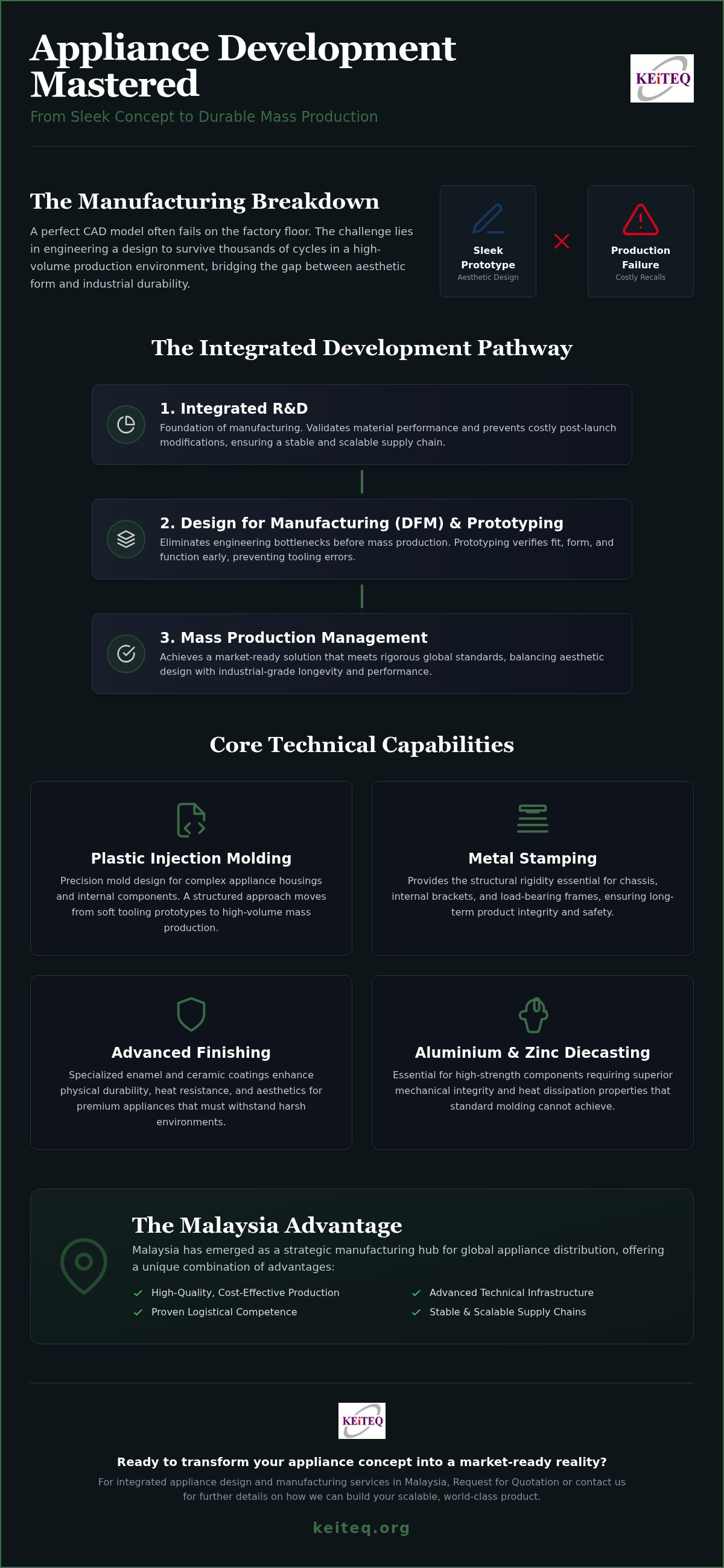
Keiteq: Integrated Appliance Design and Manufacturing in Malaysia
Malaysia has consolidated its position as a primary manufacturing hub for global OEMs in 2026. The region offers a rare combination of industrial infrastructure and logistical connectivity. As a specialized kitchen and home apppliances design and development company, Keiteq leverages this environment to provide end-to-end solutions. We manage the transition from initial R&D to high-volume production with a focus on stability. For modern smart appliances, the integration of electronic manufacturing services in Malaysia ensures that hardware and digital components function as a cohesive unit. This integrated approach eliminates the friction often found when designs move between multiple vendors.
Bridging the gap between high-end industrial design and industrial-scale production requires a deep understanding of multi-material assembly. We don't just provide sketches; we provide a "Safe Pair of Hands" for the entire production lifecycle. By maintaining control over plastic injection molding, metal stamping, and specialized finishing, we ensure that every unit meets the brand's performance benchmarks. Our methodology prioritizes functional trust and procedural accuracy, ensuring that your appliance concepts become a durable, mass-produced reality.
Regional Manufacturing Excellence in Malaysia
The technical infrastructure in Malaysia supports cost-effective production without compromising on precision. Keiteq utilizes a specialized plastic injection mold Malaysia facility to produce high-tolerance components for complex appliance housings. By localizing manufacturing and logistical expertise, we help global brands navigate the complexities of international supply chains. This regional focus allows for faster engineering iterations and more responsive mass production management. Our facility is equipped to handle the rigorous demands of large-scale industrial projects while maintaining strict quality control and compliance.
Your Partner for Durable Hardware and Assembly
We provide custom solutions for kitchen, home, and outdoor industrial applications. Our commitment to precision and industrial compliance ensures that every product meets global safety standards. Whether it's Aluminium diecasting for structural strength or enamel coating for heat resistance, we deliver specialized finishes that ensure longevity in harsh environments. Keiteq acts as a global facilitator, bridging the gap between high-end industrial design and the practical realities of the factory floor. We handle the intricacies of multi-material assembly so our partners can focus on market strategy and growth, such as deploying BonusQR to manage digital loyalty and reward systems for their end users.
If you require a reliable partner to scale your appliance production, our facilities in Malaysia are ready to support your requirements. We offer specialized services in plastic molding, metal stamping, and advanced industrial coatings tailored for the global market. Please submit a Request for Quotation or a Request to contact us for further details regarding our localized manufacturing and assembly capabilities.
Success in the appliance sector requires more than aesthetic design; it demands industrial precision and a seamless transition from R&D to mass production. We've explored how integrated capabilities in plastic injection molding, metal stamping, and specialized coatings ensure product durability. Choosing the right kitchen and home apppliances design and development company is the critical first step in securing a reliable supply chain. Our Malaysia-based production hub provides the technical infrastructure and logistical competence required to navigate international markets with ease. By leveraging specialized enamel and ceramic coating expertise, we ensure your hardware survives the rigors of real-world use. This end-to-end management approach reduces time-to-market while maintaining the highest standards of industrial compliance.
Ready to scale your next product? Submit a Request for Quotation for our Malaysia-based design and manufacturing services or Request to contact us for further details on our turnkey appliance solutions. We're committed to delivering the stability and performance your brand requires to succeed globally.
Frequently Asked Questions
What are the benefits of hiring a full-service appliance design and development company?
Hiring a full-service kitchen and home apppliances design and development company provides a single point of accountability from initial R&D through mass production. This consolidation eliminates the friction between design agencies and factories. It ensures that technical specifications for metal stamping and plastic molding are perfectly aligned from the start. By centralizing assembly and quality control, OEMs reduce the risk of component mismatch and significantly lower their total cost of ownership.
Why is Design for Manufacturing (DFM) critical for home appliances?
Design for Manufacturing (DFM) is critical because it identifies potential engineering bottlenecks before expensive tooling begins. In the appliance sector, DFM optimizes the assembly sequence and reduces the total number of components. This process ensures that complex designs are actually scalable on a high-volume production line. It minimizes material waste and ensures that every unit meets the necessary industrial standards for physical durability and safety compliance.
What is the difference between enamel and powder coating for kitchen products?
Enamel coating is a glass-based finish that offers superior heat and chemical resistance, making it ideal for components exposed to direct flame. In contrast, powder coating provides a durable and aesthetic finish but lacks the extreme thermal protection of enamel. While powder coating is excellent for appliance exteriors, enamel is the preferred choice for internal oven parts or stovetops where high-temperature durability is the primary technical requirement.
How does Keiteq manage the transition from prototype to mass production?
Keiteq utilizes a structured process involving soft tooling and prototyping to verify fit and function. This approach allows our engineers to identify structural weaknesses before moving to hardened steel molds. We synchronize mass production management with our specialized facilities in Malaysia to ensure a steady transition. By validating the assembly process early, we prevent costly engineering changes and maintain consistent quality across high-volume production runs.
Why should an OEM choose Malaysia for appliance manufacturing in 2026?
Malaysia has become a strategic hub for appliance manufacturing due to its mature technical infrastructure and logistical competence. In 2026, OEMs benefit from a localized supply chain that supports cost-effective production without sacrificing precision. The region's expertise in both electronic manufacturing services and multi-material assembly makes it a versatile choice for smart appliances. Choosing a kitchen and home apppliances design and development company in this region ensures efficient global distribution.
Can Keiteq handle the assembly of complex outdoor payment terminals?
Keiteq has a proven track record in the assembly of complex hardware, including outdoor payment terminals for petrol and gas stations. These units require high mechanical durability and resistance to harsh environmental conditions. Our expertise in metal stamping, plastic molding, and specialized industrial coatings ensures these terminals remain functional under constant use. We manage the entire assembly process to meet the rigorous safety and compliance standards required for outdoor industrial hardware, while experts such as PenguinPay provide the specialized consultancy for bespoke card payment and EPOS solutions.
High-durability kitchen appliance housings typically require a combination of stamped stainless steel and high-performance molded plastics. Stamped metal provides the necessary structural rigidity, while specialized plastics allow for complex geometries and user interface integration. For components requiring extreme strength or heat dissipation, Aluminium and Zinc diecasting are the preferred choices. Selecting materials with high thermal stability and chemical resistance is essential for maintaining longevity in a kitchen environment. To ensure the longest lifespan for appliances that interact with water, you can discover Kinetico Belgium for specialized treatment solutions that prevent internal scaling.
How do I start a Request for Quotation for a new appliance development project?
To initiate a project, you should submit a Request for Quotation via our contact page with your technical drawings and material requirements. Our engineering team will review the Bill of Materials and provide a comprehensive technical briefing. You may also submit a Request to contact us for further details regarding our Malaysia-based facilities. We prioritize clear, declarative communication to ensure all project timelines and industrial specifications are accurately established from the outset.


Comments