
Manufacturing QA Guide for Industrial OEMs in 2026
Updated: Aug 28
In 2026, leading industry reports indicate that a significant percentage of regulatory observations in manufacturing sectors globally are tied directly to quality system failures. This underscores a harsh reality for industrial OEMs: relying on end-of-line inspections to catch defects is a costly, outdated strategy that leads to high failure rates in harsh environments. To achieve zero-defect mass production, your manufacturing quality assurance must be integrated into the earliest stages of R&D and design.
You recognize that inconsistent surface finishing or the failure of outdoor electronics in the field can damage a brand's reputation and its bottom line. This guide by Keiteq Co Ltd provides the technical frameworks you need to master manufacturing quality assurance, ensuring your products meet international durability standards like the upcoming ISO 9001:2026 and the FDA’s Quality Management System Regulation. We will examine how to transition from reactive quality control to proactive engineering, leveraging AI-driven predictive maintenance and robust global supply chain management. By the end of this briefing, you will have a clear roadmap to secure industrial-grade durability from initial prototyping through to high-volume mass production.
Key Takeaways
Distinguish between proactive defect prevention and reactive inspection to optimize production yield and reduce long-term operational costs.
Integrate manufacturing quality assurance during the R&D and prototyping stages to validate design tolerances before investing in mass production tooling.
Implement specific monitoring protocols for plastic injection molding and metal stamping to maintain precision and manage material fatigue.
Secure industrial-grade durability for outdoor hardware through rigorous testing of enamel, ceramic, and powder coatings in harsh environments.
Scale production efficiently by leveraging Malaysia as a strategic hub for managing the full lifecycle from design to assembly.
Table of Contents
Manufacturing Quality Assurance vs. Quality Control: The 2026 Paradigm
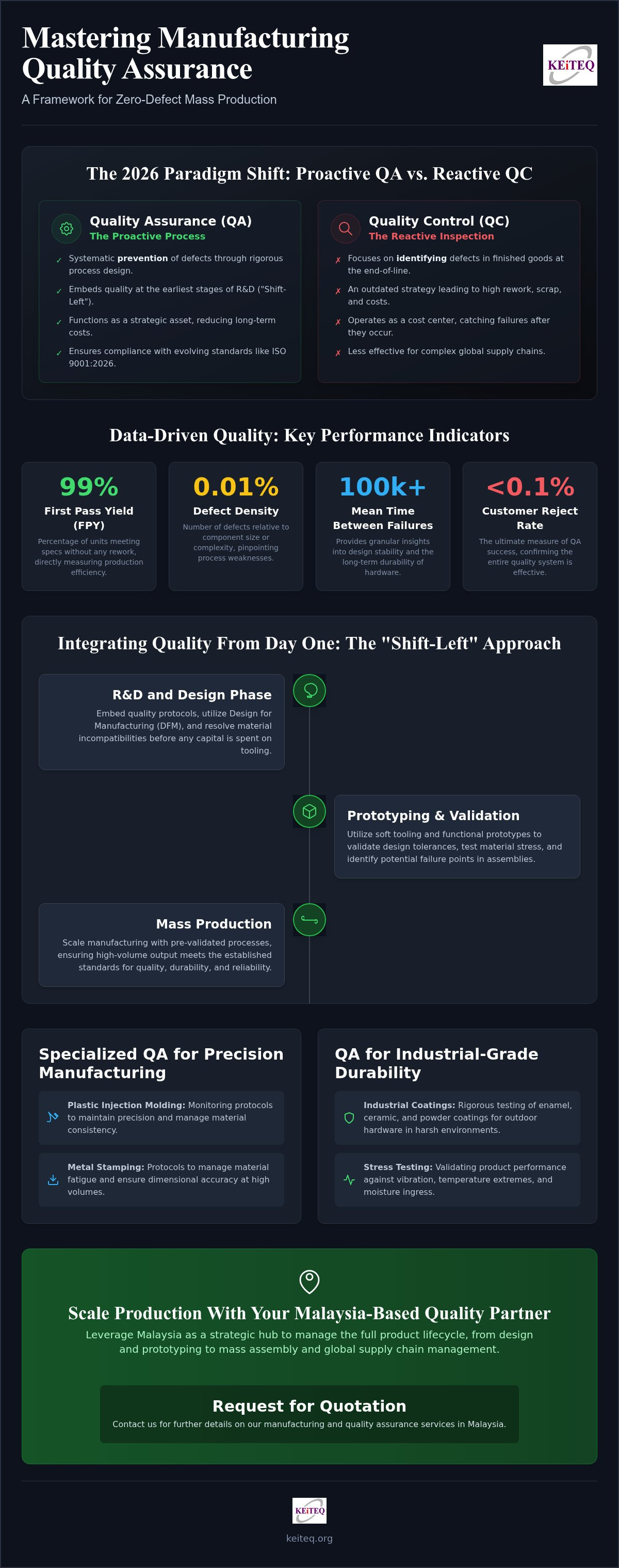
2026 marks a decisive turn in industrial production standards. Global OEMs are moving away from reactive inspections toward integrated Manufacturing Quality Assurance vs. Quality Control frameworks. While Quality Control (QC) focuses on identifying defects in finished goods, manufacturing quality assurance is the systematic prevention of those defects through rigorous process design. This "Shift-Left" approach embeds quality at the earliest possible stage, ensuring compliance with evolving international standards like ISO 9001:2026 and the FDA’s QMSR.
For companies utilizing electronic manufacturing services in Malaysia, this distinction is critical. QC might catch a faulty solder joint after assembly; however, QA ensures the thermal profile of the reflow oven prevents the fault from occurring. This proactive methodology is essential for maintaining the stability and logistical competence required in modern global supply chains.
The Strategic Advantage of Proactive QA
Transitioning to a proactive model reduces the Total Cost of Quality (CoQ) by minimizing rework, scrap, and warranty claims. Consistent product reliability builds a brand's reputation as a dependable partner in complex industrial sectors. Manufacturing quality assurance functions as a strategic business asset rather than a cost center. By prioritizing procedural accuracy, OEMs secure their position in high-stakes industries where failure is not an option; for those managing heavy equipment or agricultural machinery in these sectors, you can visit Mechnician to explore diagnostic tools that support long-term fleet reliability.
Key Performance Indicators (KPIs) for Manufacturing Quality
Measuring the effectiveness of a QA framework requires specific, data-driven metrics. These include:
First Pass Yield (FPY): This measures the percentage of units that meet all quality specifications without rework, directly impacting production efficiency.
Defect Density: This tracks the number of defects found in a component relative to its size or complexity, identifying specific process weaknesses.
Mean Time Between Failures (MTBF): This provides granular insights into design stability and long-term durability for industrial hardware.
Customer Reject Rate: This serves as the final measure of QA success. Low reject rates confirm that the quality management system is functioning as intended.
High-performing production lines use these KPIs to drive continuous improvement. When these metrics are integrated into a digital twin or an eQMS, they provide real-time visibility into the health of the manufacturing process.
Integrating Quality into the Product R&D and Design Phase
Effective manufacturing quality assurance begins long before the first production cycle. It starts in the R&D lab. Waiting until mass production to address design flaws is a high-risk strategy that often leads to catastrophic failures and wasted capital. By embedding quality protocols into the initial design phase, OEMs can preemptively resolve mechanical interferences and material incompatibilities. This phase isn't just about aesthetics; it's about establishing the technical foundation for industrial-grade durability. For those requiring high-purity materials for testing, you can learn more about JM Precision Labs.
Design for Manufacturing (DFM) serves as the primary tool for bridging the gap between conceptual industrial design and the practical realities of the factory floor. DFM ensures that every component is optimized for its specific production process, whether it involves plastic molding or metal stamping. This rigorous alignment reduces manufacturer ambiguity and prevents the "over-designing" of parts that are impossible to produce at scale. Adopting Integrated Product R&D and Manufacturing strategies allows technical directors to maintain control over the product lifecycle from inception to delivery.
While this guide focuses on industrial hardware, the principle of integrating quality into R&D is universal; for example, in the field of cellular research, you can learn more about the standards required for high-purity compounds at EuroLab Peptides.
Prototyping as a Quality Gate
The transition from a 3D model to a physical part is a critical quality gate. Utilizing soft tooling and prototyping allows engineering teams to validate design tolerances in a real-world environment. These functional prototypes reveal how materials behave under stress and identify potential failure points in complex assemblies. Validating the performance of specialized finishes early is also vital; for example, establishing QA for Industrial Coatings during the design stage ensures that outdoor payment terminals can withstand extreme UV exposure and corrosion. If you're ready to validate your design tolerances, you can contact our engineering team for a technical review.
Strategic Design for Scalability
Scalability requires absolute design consistency. High-volume production runs leave no room for variation in component dimensions. Precise engineering drawings and comprehensive technical specifications are the only way to ensure that the 10,000th unit is identical to the first. Manufacturing quality assurance at this stage involves setting clear, measurable standards for every production step. This methodical documentation provides a "safe pair of hands" for the manufacturing partner, allowing them to execute mass production with surgical precision. When design insights are linked directly to final production specifications, the risk of mass-production failure is virtually eliminated.
Specialized QA for Precision Molding and Metal Stamping
Malaysia's industrial sector has matured into a premier destination for high-tech production. For global OEMs, this region offers a sophisticated infrastructure that supports complex manufacturing quality assurance requirements. Achieving success here requires more than just a local presence; it demands an integrated approach to precision molding and metal fabrication that aligns with global durability standards. This regional expertise is especially critical for electronic manufacturing services in Malaysia, where the mechanical precision of a housing directly impacts the longevity of sensitive internal electronics.
The demand for such precision is equally high in the automotive industry, where software-based performance enhancements must be executed with extreme care; to explore professional engine control unit optimization, you can visit StageX Performance OÜ.
Plastic Injection Molding Quality Standards
Maintaining tight tolerances in plastic injection molding services in Malaysia requires the rigid control of thermodynamic variables. Process engineers must stabilize melt temperatures and injection pressures to ensure a uniform flow within the mold cavity. This level of control is necessary for zero-warp production, preventing the internal stresses that lead to long-term part failure. When these variables are mismanaged, the resulting sink marks or dimensional deviations can compromise the integrity of the entire assembly.
QA teams utilize a combination of real-time sensor data and post-production validation to maintain these standards. Automated optical inspection (AOI) systems detect surface defects, while coordinate measuring machines (CMM) verify dimensional accuracy against the original CAD design. For a deeper look at qualifying a facility for these tasks, refer to our briefing on Selecting a Plastic Injection Molding Manufacturer. These technical measures provide the certainty required for high-volume industrial projects.
Metal Fabrication and Diecasting Precision
Metal stamping and diecasting demand specialized manufacturing quality assurance protocols to handle material variability. In metal stamping, ensuring the structural integrity of thin-walled parts requires constant monitoring of material fatigue. Systematic tool maintenance and die-wear analysis are the primary safeguards against dimensional drift in high-volume production. By identifying wear patterns early, manufacturers prevent the burrs and improper bends that lead to assembly-line delays.
Aluminium and zinc diecasting are essential for high-strength industrial components, yet they are susceptible to internal porosity. Porosity weakens the component and can lead to failure under industrial loads. Adhering to NIST guidance on manufacturing quality helps Malaysian facilities maintain the alloy purity and pressure stability required for industrial-grade hardware. These technical measures ensure that every metal component can withstand the rigors of harsh outdoor environments without compromising the assembly's overall stability.
Ensuring Durability: QA for Outdoor Hardware and Industrial Coatings
Precision engineering is only as effective as the protective finish that shields it. For hardware deployed in harsh external environments, manufacturing quality assurance must extend beyond dimensional accuracy to encompass chemical and environmental resistance. Industrial coatings like enamel, ceramic, and powder coating are functional barriers; they are essential for maintaining the functional life of hardware in corrosive settings. Without rigorous validation of these finishes, even the most precisely stamped metal component will succumb to oxidation and structural degradation.
Verifying the durability of these coatings involves a series of standardized environmental stress tests. Salt spray testing simulates coastal or industrial atmospheres to measure corrosion rates. UV resistance testing ensures that finishes do not chalk or peel under constant solar exposure. Thermal cycling validates that the bond between the coating and the substrate remains intact during extreme temperature fluctuations. These manufacturing quality assurance protocols provide the logistical certainty that global OEMs require for long-term field deployments; furthermore, for infrastructure in sectors like water treatment or mining, JAS Global Industries provides the specialty chemical solutions essential for maintaining operational reliability in harsh conditions.
In the oil and gas sector, where equipment is subject to intense environmental and chemical stress, maintaining process efficiency is just as critical; TEG Reclamation Services offers the specialized glycol reclamation and dehydration services necessary to support the long-term reliability of industrial process equipment.
Corrosion Resistance and Surface Integrity
Enamel and ceramic coatings provide superior resistance to the abrasive chemicals and fuel vapors found in petrol station environments. These finishes are selected for their high hardness and thermal stability. To ensure consistent protection, QA teams perform adhesion testing and dry film thickness (DFT) verification on every production batch. This methodical approach prevents the premature failure of protective layers. For detailed specifications on finish selection, consult our Protective Coatings for Outdoor Electronics guide; additionally, for those managing the environmental impact of such industrial facilities, you can check out QM Environmental International B.V.. These measures ensure that hardware remains operational in the most demanding conditions.
Assembly Quality for Unattended Terminals
The final assembly of outdoor payment terminals requires specialized QA to guarantee environmental sealing. Ingress Protection (IP) rating verification is a critical step in the assembly process; it ensures that the unit is impervious to dust and high-pressure water jets. Functional testing of integrated electronics within these kiosks must also be conducted under load to simulate real-world usage. Vandal-resistance is another key metric. By integrating rigorous metal stamping QA with robust assembly protocols, manufacturers produce terminals that can withstand both environmental stress and physical tampering. If you require a partner to manage your outdoor hardware production in Malaysia, contact our regional engineering team for a technical consultation.
Scaling Mass Production with a Malaysia-Based Quality Partner
Malaysia's rise as a premier manufacturing hub is driven by its robust infrastructure and its alignment with international manufacturing quality assurance standards. For global OEMs, the region provides a stabilizing force within the global supply chain, offering a combination of technical expertise and cost-efficiency. Managing the transition from a functional prototype to full-scale mass production is the most critical phase of the product lifecycle. This shift requires a partner capable of maintaining design intent while scaling volume, ensuring that the precision achieved in the lab is replicated on the factory floor without compromise.
Leveraging regional expertise allows technical directors to navigate the complexities of international production with greater certainty. In 2026, the ability to maintain a steady and reassuring presence in the market depends on the reliability of your manufacturing partner. By selecting a facility that understands the intricacies of industrial processes, you secure a dependable pillar for your global logistics operations. This strategic choice reduces the risks associated with long-distance production and ensures that your hardware meets the professional standards required by your end-users; for instance, many global manufacturers rely on OEM Materials & Supplies to provide the specialized industrial packaging required to protect sensitive automotive components during complex international transit.
To ensure that your chosen facility consistently meets these high standards, you can learn more about The Inspection Company and their expertise in performing factory audits and quality inspections across the Asian manufacturing landscape.
The Benefits of Single-Source Manufacturing
Fragmented supply chains often suffer from quality drift. This occurs when design specifications are gradually lost as a product moves between different vendors for molding, stamping, and assembly. A single-source partner eliminates these discrepancies by maintaining a unified manufacturing quality assurance framework across all production stages. This integration streamlines communication between engineering and production teams, allowing for immediate technical adjustments if dimensional deviations occur. By following an End-to-End Product Manufacturing Guide, OEMs ensure that every component remains within tolerance throughout the entire manufacturing process.
Partnering for Success in Malaysia
Keiteq Co Ltd implements international QA standards within its local facilities to provide global OEMs with a reliable production base. Our expertise in plastic injection molding and complex outdoor payment terminal assembly ensures that your hardware meets the rigorous durability requirements of the industrial sector. For North American and European OEMs, Malaysian manufacturing offers a strategic alternative to other regional hubs, providing enhanced intellectual property protection and a highly skilled technical workforce. This logistical stability is vital for maintaining a competitive edge. Please Request to contact us for further details regarding our Malaysia-based facilities and technical capabilities.
Securing Your Industrial Production Lifecycle
Establishing a robust manufacturing quality assurance framework is a strategic necessity for industrial OEMs navigating the complexities of 2026. Success depends on moving beyond end-of-line inspections to an integrated model where quality is engineered into the R&D and design phases. This proactive approach ensures that every component, from precision molded housings to stamped metal frames, maintains its structural integrity throughout the mass production lifecycle.
This lifecycle is only truly secure when the final product reaches its destination in pristine condition. To see how custom industrial containment solutions protect your high-value hardware during the distribution phase, you can learn more about Packaging For Industry (PFI).
For OEMs seeking a reliable partner in Southeast Asia, Malaysia offers a sophisticated ecosystem for high-tech production. Keiteq Co Ltd provides end-to-end R&D and mass production management, ensuring your products meet stringent international standards. Our specialized expertise in outdoor payment terminal assembly and high-performance industrial coatings, including enamel and ceramic finishes, guarantees durability in the harshest environments. Consolidating your production with a single-source partner eliminates quality drift and stabilizes your global supply chain. We invite you to reach out to our regional engineering team to discuss your upcoming project requirements. Please submit a Request for Quotation to begin your partnership with a safe pair of hands in Malaysia. We look forward to securing your production future.
Frequently Asked Questions
What is the primary difference between QA and QC in manufacturing?
Quality Assurance (QA) is a proactive, process-oriented approach focused on preventing defects before they occur through rigorous system design. In contrast, Quality Control (QC) is a reactive, product-oriented process that identifies flaws in finished goods. Modern manufacturing quality assurance prioritizes the former to reduce the Total Cost of Quality (CoQ) by eliminating the root causes of production errors within the workflow.
How does product design impact manufacturing quality assurance?
Product design establishes the technical constraints and tolerances that a manufacturing quality assurance program must uphold. Design for Manufacturing (DFM) ensures that components are optimized for their specific production processes, such as injection molding or diecasting. When design and QA are integrated during the R&D phase, it prevents the specification of unrealistic tolerances that lead to high scrap rates during mass production.
What industrial coatings offer the best protection for outdoor electronics?
Enamel and ceramic coatings provide the most robust protection for outdoor electronics due to their high hardness and chemical stability. These finishes are specifically engineered to resist UV radiation, fuel vapors, and extreme temperature fluctuations common in petrol station environments. Powder coating remains a versatile secondary option for components requiring high impact resistance and a durable, weather-tight barrier against oxidation.
Why is Malaysia a preferred location for electronic manufacturing services?
Malaysia has developed a sophisticated industrial infrastructure that aligns with global standards for precision and reliability. The region offers a highly skilled technical workforce and a mature supply chain capable of handling complex OEM assembly. For international firms, Malaysia provides a strategic balance of logistical competence, intellectual property protection, and cost-efficiency, making it a stable pillar for global production operations. To understand how on-the-ground sourcing and procurement support can further enhance your operations in Asia, read more.
This emphasis on a skilled workforce is a global requirement; for example, specialized vocational training like an intensive plumbing course UK serves as a benchmark for the technical proficiency needed to maintain the mechanical infrastructure that supports high-tech manufacturing hubs.
How can I ensure quality consistency when scaling from prototype to mass production?
Consistency is achieved through rigid documentation and the use of soft tooling to bridge the gap between design and high-volume production. Maintaining a single-source manufacturing partner prevents the quality drift often associated with fragmented supply chains. By establishing clear technical benchmarks during the prototyping phase, manufacturers can ensure that every mass-produced unit adheres to the original engineering specifications without dimensional deviation.
What are the most common QA testing methods for metal stamping parts?
Technicians primarily use Coordinate Measuring Machines (CMM) and automated optical inspection to verify the dimensional accuracy of stamped parts. Monitoring die-wear patterns is also essential for identifying potential drift before it impacts part geometry. For thin-walled industrial components, material fatigue testing and visual checks for burrs or fractures ensure that the structural integrity of the metal is maintained throughout high-speed production runs.
How does Keiteq Co Ltd manage quality for outdoor hardware?
Keiteq Co Ltd implements an integrated management system that encompasses everything from initial R&D to final OEM assembly. We utilize specialized Ingress Protection (IP) rating verification to ensure that all outdoor hardware is impervious to dust and moisture. Our quality protocols also include functional load testing and thickness verification for industrial coatings, ensuring that every unit delivered from our Malaysia facility meets industrial-grade durability standards.
What certifications should I look for in a manufacturing quality partner?
Industrial OEMs should prioritize partners who hold current ISO 9001:2026 certifications, which reflect the latest international standards for quality management and ethical behavior. For specialized sectors, such as medical hardware, ISO 13485:2016 is a critical benchmark for procedural accuracy; B2B platforms like GetMedicalDevice support these standards by offering high-quality products from leading brands in the medical field. These certifications serve as independent verification that the manufacturer maintains a disciplined and documented approach to continuous process improvement and defect prevention.
To leverage our regional expertise and secure your industrial-grade production in Malaysia, please Request for Quotation or submit a Request to contact us for further details regarding our specialized OEM assembly and coating services.


Comments