
Manufacturing Sourcing Platforms vs. Direct to Factory: A Strategic Guide for OEMs
- 2 days ago
- 12 min read
The global procurement software market is projected to reach $17.5 billion by 2033, yet digital scale hasn't solved the fundamental issue of production reliability. Choosing between manufacturing sourcing platforms vs direct to factory models is now a critical decision for OEMs aiming to stabilize their industrial production in 2026. While marketplaces provide transactional speed for standard components, they often fail when complex assemblies require deep technical integration.
You've likely encountered the friction of communication barriers or the risk of intellectual property theft on open platforms. It's a valid concern for any manufacturer prioritizing long-term stability over short-term savings. This guide analyzes the strategic trade-offs you must consider to optimize your supply chain. We, at Keiteq Co Ltd, will explore how direct partnerships in Malaysia enable integrated R&D and consistent quality control. You'll gain a methodical framework to reduce time-to-market while eliminating the hidden costs associated with anonymous middleman platforms. This briefing ensures your production remains disciplined, compliant, and ready for the logistical realities of the next decade.
Key Takeaways
Understand the fundamental differences between manufacturing sourcing platforms vs direct to factory models to identify which aligns with your production scale and risk tolerance.
Identify the hidden risks of anonymous marketplaces, specifically focusing on how rotating suppliers can lead to quality fragmentation and critical communication gaps.
Discover how direct factory partnerships shorten feedback loops through integrated R&D, ensuring technical tolerances remain consistent from prototype to final assembly.
Apply a strategic framework to determine when your product's complexity or order volume necessitates a shift from digital platforms to a dedicated manufacturing partner.
Leverage Malaysia’s industrial ecosystem and specialized assembly expertise to secure a reliable, single-source supply chain for complex hardware projects.
Table of Contents
Defining the Landscape: Manufacturing Sourcing Platforms vs. Direct-to-Factory
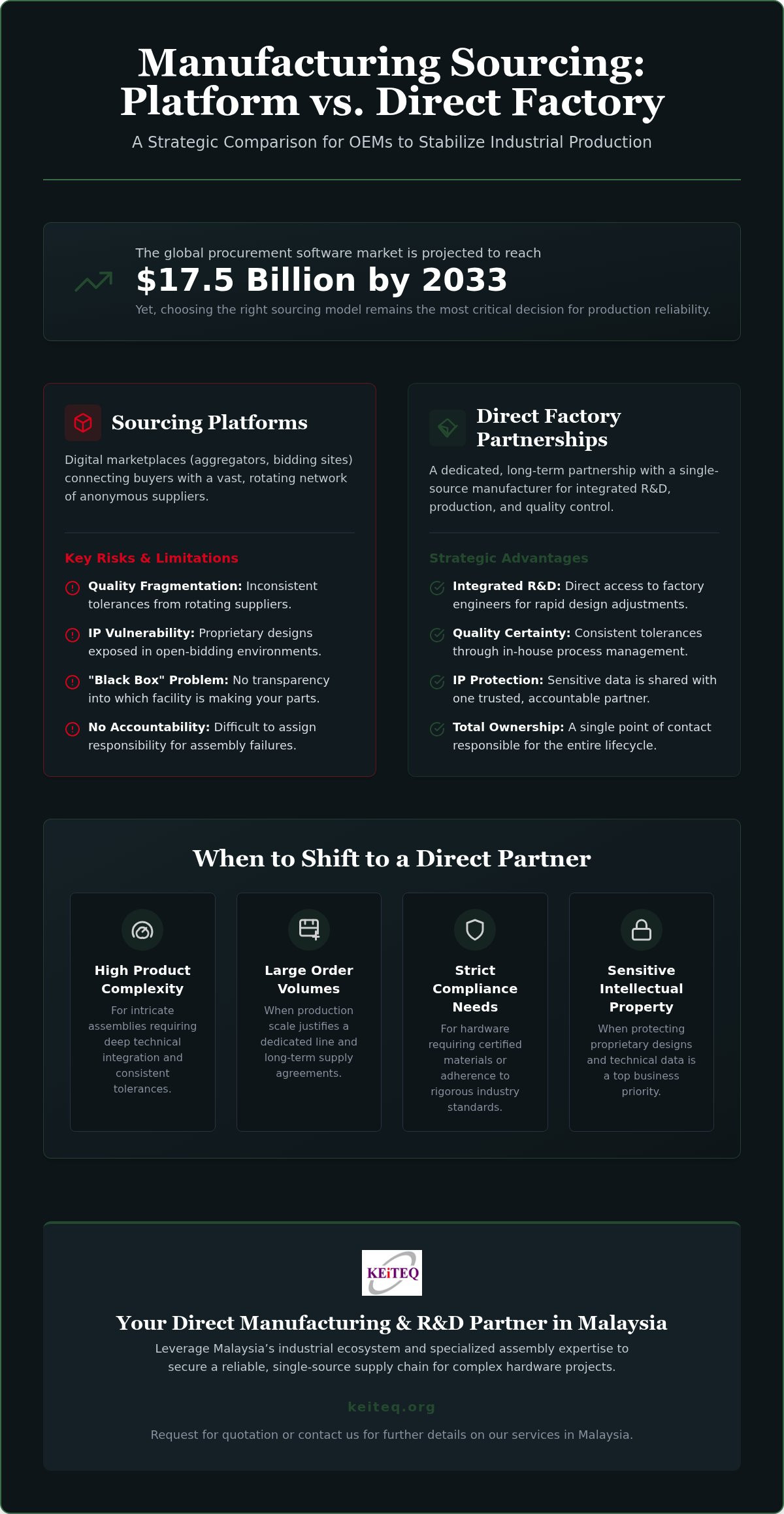
The choice between manufacturing sourcing platforms vs direct to factory models dictates the long-term viability of an industrial supply chain. Sourcing platforms act as digital marketplaces, leveraging algorithms to connect buyers with a vast network of disparate suppliers. In contrast, the direct-to-factory model establishes a dedicated partnership with a single-source manufacturer. As we move through 2026, Original Equipment Manufacturers (OEMs) are increasingly moving away from transactional sourcing for complex hardware. This shift is driven by a need for greater accountability. When a critical assembly fails, platform users often struggle to identify the responsible party within a rotating network. A direct partner assumes total ownership of the output, providing a clear line of responsibility from the initial procurement processes to final delivery.
The Rise of Digital Manufacturing Marketplaces
Digital platforms generally fall into two categories: aggregators and bidding marketplaces. Aggregators standardize pricing and manage the interface, while bidding sites allow factories to compete on cost. These models are ideal for rapid prototyping or low-volume CNC machining where speed outweighs structural integration. However, platforms often suffer from the "Black Box" problem. The OEM rarely knows which specific facility is producing their parts on any given day. This lack of transparency creates significant risks for hardware requiring strict material compliance or proprietary technical standards. While platforms provide capacity, they rarely provide the technical depth required for high-stakes industrial production.
Direct Factory Partnerships: More Than Just Production
Direct factory relationships offer a holistic alternative by integrating R&D, design, and mass production under one roof. This model is particularly effective for complex projects such as outdoor payment terminal assembly. A direct partner acts as a "Global Facilitator," navigating international industrial standards and ensuring technical consistency across the entire production lifecycle. By establishing a direct link to the factory floor, OEMs eliminate the friction caused by middleman interfaces.
Integrated Engineering: Direct access to factory engineers allows for immediate design adjustments and technical troubleshooting.
Supply Chain Resilience: Long-term agreements protect against the volatility and price surges common in open marketplaces.
Quality Certainty: Specialized services like plastic injection mold fabrication are managed in-house, ensuring tolerances are met without third-party interference.
By consolidating these capabilities, manufacturers provide a reliable foundation that transactional platforms cannot replicate. This methodical approach ensures that every component, from metal stamping to final coating, meets the rigorous demands of the global market.
The Hidden Risks of Sourcing Platforms for Complex Hardware
The strategic comparison of manufacturing sourcing platforms vs direct to factory models must account for the high cost of quality fragmentation. Digital marketplaces frequently rotate production among various suppliers to optimize their own internal margins. This rotation leads to inconsistent tolerances and finish variations that compromise complex assemblies. Managing a fragmented network also introduces hidden logistics costs. Coordinating multiple shipments from disparate locations increases administrative overhead and complicates the quality assurance process. These hidden fees often exceed the initial cost savings promised by the platform interface.
Intellectual Property (IP) vulnerabilities represent another significant concern for OEMs. Open-bidding environments expose proprietary designs to a wide range of unvetted entities during the quoting stage. Without a single point of accountability, tracking the distribution of sensitive technical data becomes nearly impossible. Adopting a strategic approach to sourcing is essential for protecting these assets. When designs are treated as transactional data, the risk of unauthorized replication increases. A direct partnership provides a "Safe Pair of Hands" for sensitive engineering data.
Technical Dilution and the Loss of DFM Expertise
Automated quoting engines prioritize speed over precision. They often miss critical Design for Manufacturing (DFM) flaws that a senior factory engineer would identify immediately. For example, an outdoor payment terminal requires specialized assembly knowledge regarding environmental sealing and structural durability. Platforms lack this specialized tribal knowledge. Without direct engineering feedback, OEMs risk producing units that fail in field conditions. If you're encountering these technical hurdles, you can consult with our engineering team for a more integrated solution.
Supply Chain Fragility in Marketplaces
Platform-based supply chains are inherently fragile. If a primary supplier goes offline or fails a quality audit, the platform may shift production to a new factory. This shift requires expensive re-tooling and the re-validation of industrial processes. Anonymous networks also hide "ghost" factories where work is sub-contracted to unverified facilities. This lack of visibility is a major barrier for companies requiring strict adherence to mass production management protocols. A direct partnership eliminates these layers of anonymity. It's a system that ensures every part is manufactured in a controlled, audited environment with full traceability and compliance with ISO or ASTM standards.
Similar rigorous standards are required in the healthcare sector, where specialized B2B platforms like GetMedicalDevice provide access to high-quality products from leading brands, ensuring that every item meets the necessary safety and performance certifications.
Working with an expert partner like Buying Office Asia can help OEMs overcome these visibility challenges by providing professional on-the-ground sourcing and procurement management across the region.
This commitment to traceability and precision is mirrored in other high-stakes fields like biotechnology, where researchers can learn more about the cellular studies that rely on high-grade materials and verified standards.
Strategic Advantages of Direct Factory Partnerships
Direct partnerships provide a strategic depth that transactional marketplaces simply cannot match. When evaluating manufacturing sourcing platforms vs direct to factory models, the primary differentiator is the integration of R&D with production. This unified approach provides single-source accountability. It ensures that complex assemblies involving molding, stamping, and finishing are managed as a single project rather than a series of disconnected tasks. By establishing a direct relationship, OEMs gain access to customized quality control protocols tailored to their specific industrial applications. This level of oversight guarantees that every component meets rigorous internal standards before it leaves the factory floor.
Bridging the Gap from Prototype to Mass Production
In a direct factory environment, the transition from design to delivery is seamless. Utilizing soft tooling prototyping allows engineers to validate designs using production-equivalent materials before committing to expensive hard tooling. This methodical approach reduces error rates significantly. The same team handles the initial design and the eventual mass production management. This consistency preserves technical knowledge and prevents the dilution of engineering intent. It's particularly vital when developing specialized finishing for harsh environments. Advanced enamel, ceramic, or powder coating treatments require precise application. A direct partner oversees these processes on-site, ensuring procedural accuracy that anonymous platform suppliers often overlook.
Customized OEM Assembly and Finishing
Operational efficiency increases when you co-locate plastic injection molding services with metal stamping and final assembly. This integration is essential for specialized equipment like gas station kiosks or outdoor payment terminals. These units must withstand extreme weather and heavy usage. Direct partners implement customized quality control protocols that address these environmental challenges. They don't rely on generic platform standards. Instead, they provide rigorous surface treatments and structural testing under strict factory supervision.
Long-term cost optimization is another pillar of the direct model. Platforms often charge a commission on every order, which can range from 2% to 8% depending on volume. Direct partnerships eliminate these middleman fees. They allow for volume discounts and tooling amortization over the entire product lifecycle. This creates a sustainable financial structure that platforms can't replicate. It transforms manufacturing from a variable expense into a strategic asset, providing the stability required for global supply chain operations.
Navigating the Decision: When to Shift to a Direct Partner
Determining the optimal moment to transition between manufacturing sourcing platforms vs direct to factory models requires a rigorous assessment of technical risk. Speed is the primary advantage of digital marketplaces. However, this speed becomes a liability when hardware projects exceed a certain threshold of complexity. If your assembly contains more than 10 unique components, the coordination required to maintain tolerances across a fragmented platform network often leads to failure. Direct partnerships offer the structural discipline needed for multi-part integration. This is particularly true for products destined for outdoor environments where "good enough" components will fail under environmental stress.
The volume trigger is the second critical metric. Sourcing platforms often charge commissions between 5% and 8% for order volumes up to $50,000. As production scales toward mass-market levels, these fees represent a significant drain on margins. Transitioning to a direct factory partner allows for tooling amortization and volume-based price stability. Geopolitics also play a decisive role. While a 10% tariff currently applies to most Malaysian goods imported to the U.S. as of July 2026, the region remains a strategic "China-Plus-One" alternative. Malaysia’s established industrial infrastructure provides a level of reliability and logistical competence that offsets the variable costs of platform-based sourcing.
A Framework for Hardware Procurement Teams
Procurement teams must move beyond unit price to calculate the Total Cost of Ownership (TCO). This calculation includes the cost of quality audits, shipping coordination, and the technical debt incurred by using unvetted suppliers. High-growth OEMs require more than just parts; they need integrated support. Utilizing electronic manufacturing services in Malaysia allows companies to consolidate their supply chain under a single point of accountability. This consolidation reduces the administrative burden and ensures that engineering feedback is applied consistently across the entire bill of materials. To begin this transition, you can contact our team for a detailed TCO analysis of your current production model.
Scaling for the Future: 2026 and Beyond
Supply chain visibility is the most valuable currency in 2026. Direct partners provide real-time insights into material sourcing and production schedules that platforms cannot replicate. This transparency is essential for meeting modern sustainability and ethical sourcing standards. Transitioning your Intellectual Property from an open marketplace to a dedicated partner also secures your designs against unauthorized replication. By centralizing production, you create a controlled environment where IP protection is a procedural standard rather than an afterthought. This methodical approach ensures your brand remains resilient against global disruptions and regulatory shifts.
Keiteq: Your Direct Manufacturing and R&D Partner in Malaysia
Keiteq Co Ltd serves as a steady anchor in a volatile global supply chain. When weighing manufacturing sourcing platforms vs direct to factory models, Keiteq Co Ltd provides the integrated R&D and logistical competence required for high-stakes industrial projects. We manage the entire lifecycle, from initial design and metal stamping to full-scale mass production management. Our approach prioritizes functional trust over transactional speed. This methodology ensures that every technical specification is met with procedural accuracy. We provide a "Safe Pair of Hands" for complex hardware, ensuring your production remains disciplined and compliant with international standards.
Why Malaysia is the Strategic Choice for 2026 Manufacturing
Malaysia's industrial infrastructure is a cornerstone of regional stability. In 2026, the nation remains a premier hub due to its skilled engineering workforce and advanced logistics networks. Keiteq Co Ltd is a primary partner for plastic injection mold manufacturing in Malaysia, offering global OEMs a reliable alternative to China-centric sourcing. Our operations provide the precision required for complex assemblies that anonymous platform networks often fail to deliver. Even with the +3.80 sen/kWh electricity rate adjustment implemented in August 2026, Malaysia’s industrial ecosystem remains globally competitive. We leverage these regional advantages to provide stability and scale for our international partners.
Request for Quotation: Start Your Production Journey
Our specialized outdoor payment terminal assembly for fuel retail demonstrates our deep technical expertise. These units must survive extreme weather and heavy usage. They require advanced finishing services like enamel and ceramic coating. Keiteq Co Ltd integrates these capabilities with plastic injection molding and aluminium diecasting under one roof. This consolidation eliminates the risk of quality fragmentation common in platform-based models. We manage the transition from prototyping and soft tooling to mass production with methodical precision. This integrated approach ensures your hardware is built for durability in harsh environments. We invite procurement directors and technical leads to discuss their Malaysia-based production needs to secure a resilient supply chain.
Please submit a Request for Quotation or a Request to contact us for further details to explore our comprehensive manufacturing services in Malaysia.
Optimizing Your Global Supply Chain Strategy
The decision between manufacturing sourcing platforms vs direct to factory models defines the operational stability of your hardware project. Digital marketplaces offer rapid entry for simple components; however, they cannot provide the single-source accountability required for complex industrial assemblies. Transitioning to a direct partner ensures that technical tribal knowledge remains within your supply chain. This prevents the quality fragmentation that often plagues anonymous networks. By integrating R&D with mass production management, OEMs reduce time-to-market while securing their intellectual property in a controlled environment.
Keiteq provides this steady partnership through our Malaysia-based operations. Our expertise includes specialized assembly for outdoor payment terminals and advanced finishing services like enamel and ceramic coating. We manage every phase from prototype to final mass production to ensure your product survives demanding field conditions. Our facility provides the technical depth and logistical reliability necessary to navigate the industrial landscape of 2026. Please submit a Request for Quotation or a Request to contact us for further details on our Malaysia-based manufacturing services to begin optimizing your production today.
Frequently Asked Questions
What is the main difference between a manufacturing platform and a direct factory?
The primary difference in the manufacturing sourcing platforms vs direct to factory comparison lies in accountability and transparency. Platforms act as digital intermediaries connecting buyers to rotating supplier networks; a direct factory provides a single-source partnership with full visibility into the production floor. This direct model eliminates the "Black Box" issue where OEMs are unaware of which specific facility produces their hardware. Direct partnerships foster long-term stability through integrated engineering and dedicated mass production management.
When should I stop using sourcing platforms and find a direct factory partner?
OEMs should transition when product complexity exceeds ten unique components or when order volumes reach mass-market levels. As production scales, the 5-8% commission typical of sourcing platforms becomes a significant financial liability. If your hardware requires strict industrial standards or specialized assembly, the lack of technical feedback from automated platforms poses a high risk. Moving to a direct factory partner secures your supply chain through customized quality protocols and volume-based price stability.
Are manufacturing sourcing platforms safe for my intellectual property?
Sourcing platforms often expose proprietary designs to unvetted entities during the open-bidding phase, increasing the risk of unauthorized replication. Direct factory partnerships mitigate this risk by centralizing technical data within a single, audited environment. This model ensures that intellectual property is treated as a core asset rather than transactional data. By establishing a direct operational relationship, you create a controlled ecosystem where IP protection is a procedural standard across the entire production lifecycle.
How do I manage quality control when working directly with a factory in Malaysia?
Managing quality in Malaysia involves implementing customized protocols that address specific environmental and structural requirements. Direct factory partners provide real-time oversight and full traceability, which is impossible in anonymous platform networks. This methodical approach ensures compliance with ISO and ASTM standards through rigorous on-site inspections. By working directly with a Malaysian facility, you gain a "Safe Pair of Hands" that assumes total accountability for tolerances, material compliance, and final assembly performance.
Can a direct factory help with product R&D and design for manufacturing?
Yes, a direct factory partner integrates R&D and Design for Manufacturing (DFM) to shorten the feedback loop between prototype and mass production. Unlike automated platforms, factory engineers provide granular feedback on design flaws before they become expensive production errors. This integration ensures that technical intent is preserved from initial prototyping to the final assembly line. It allows for immediate adjustments in metal stamping or plastic molding, optimizing the product for durability and cost-efficiency.
What are the benefits of sourcing plastic and metal components from the same factory?
Co-locating plastic injection molding and metal stamping within one factory significantly reduces assembly lead times and logistical overhead. This approach ensures consistent tolerances between different material types, which is critical for complex hardware integrations. It eliminates the need to coordinate shipments from multiple disparate suppliers, reducing the risk of quality fragmentation. Single-source production provides a holistic view of the assembly process, allowing for more precise troubleshooting and faster time-to-market.
Why is Malaysia becoming a preferred hub for outdoor payment terminal assembly?
Malaysia is a preferred hub due to its advanced industrial infrastructure and specialized expertise in outdoor payment terminal assembly for fuel retail. The region offers a skilled engineering workforce capable of managing complex hardware that must withstand extreme environmental stress. Malaysia provides a strategic "China-Plus-One" advantage, offering regional stability and established logistics networks. These factors ensure that OEMs receive reliable production and advanced finishing services, such as enamel and ceramic coating, for harsh environments.
Is it more expensive to work directly with a factory than through a platform?
Direct factory partnerships offer long-term cost optimization through tooling amortization and volume-based discounts that platforms cannot match. While platforms may seem cheaper for low-volume prototyping, they often become more expensive due to hidden middleman fees and logistical inefficiencies. Eliminating the platform's commission allows for more competitive unit pricing at scale. The reduction in technical errors and quality rejections provided by a direct partner lowers the total cost of ownership over the product's lifecycle.


Comments