
Petrol Station Hardware: Engineering & OEM Guide 2026
Can your current hardware withstand another year of 24/7 exposure while maintaining strict compliance with the latest PCI DSS 4.0 security mandates? For many fuel retailers, the answer is a costly "no" as high failure rates in harsh outdoor environments continue to erode profit margins. Specialized petrol station hardware manufacturing is no longer just about building a box. It's about engineering a resilient ecosystem that survives extreme heat, moisture, and constant physical use. You've likely felt the frustration of managing separate vendors for plastic and metal parts, only to find the final assembly lacks the precision required for modern payment terminals.
We understand that reliability is the only metric that truly matters on the forecourt. This guide explores how precision R&D, advanced metal stamping, and specialized assembly techniques deliver the high-performance hardware required for 2026 and beyond. You'll learn how a single-source partner reduces lead times and ensures every component meets international durability standards. We'll also highlight how our integrated manufacturing services in Malaysia provide the technical support needed to transition from prototyping to mass production without the typical logistical bottlenecks.
Table of Contents
The Critical Role of Precision Engineering in Petrol Station Hardware
Core Manufacturing Processes: Metal Stamping, Diecasting, and Plastic Molding
Engineering Outdoor Payment Terminals for Durability and Security
Selecting an OEM Partner: From R&D to Mass Production Management
Keiteq: Turnkey Petrol Station Hardware Manufacturing in Malaysia
The Critical Role of Precision Engineering in Petrol Station Hardware
Petrol station hardware manufacturing encompasses the specialized design and production of fuel dispensers, payment kiosks, and protective enclosures. These components serve as the primary interface between the retail brand and the consumer; however, their function extends far beyond aesthetics. Precision engineering is mandatory because these systems operate in environments where failure isn't just a maintenance issue, it's a safety and revenue risk. High-performance hardware must withstand 24/7 operational cycles while remaining impervious to volatile chemicals and extreme weather fluctuations.
Modern fuel dispenser design must account for constant exposure to volatile organic compounds (VOCs) and abrasive cleaning agents. Without high-tolerance manufacturing, seals fail and structural integrity degrades. The industry's current pivot toward "Smart Stations" adds another layer of complexity. Manufacturers must now integrate sensitive IoT sensors and advanced payment systems into rugged shells that weren't originally designed for high-density electronics. This creates a unique manufacturing challenge: delivering a sleek, modern user experience while maintaining the industrial-grade durability expected of petrol station hardware manufacturing.
Challenges of Outdoor Industrial Environments
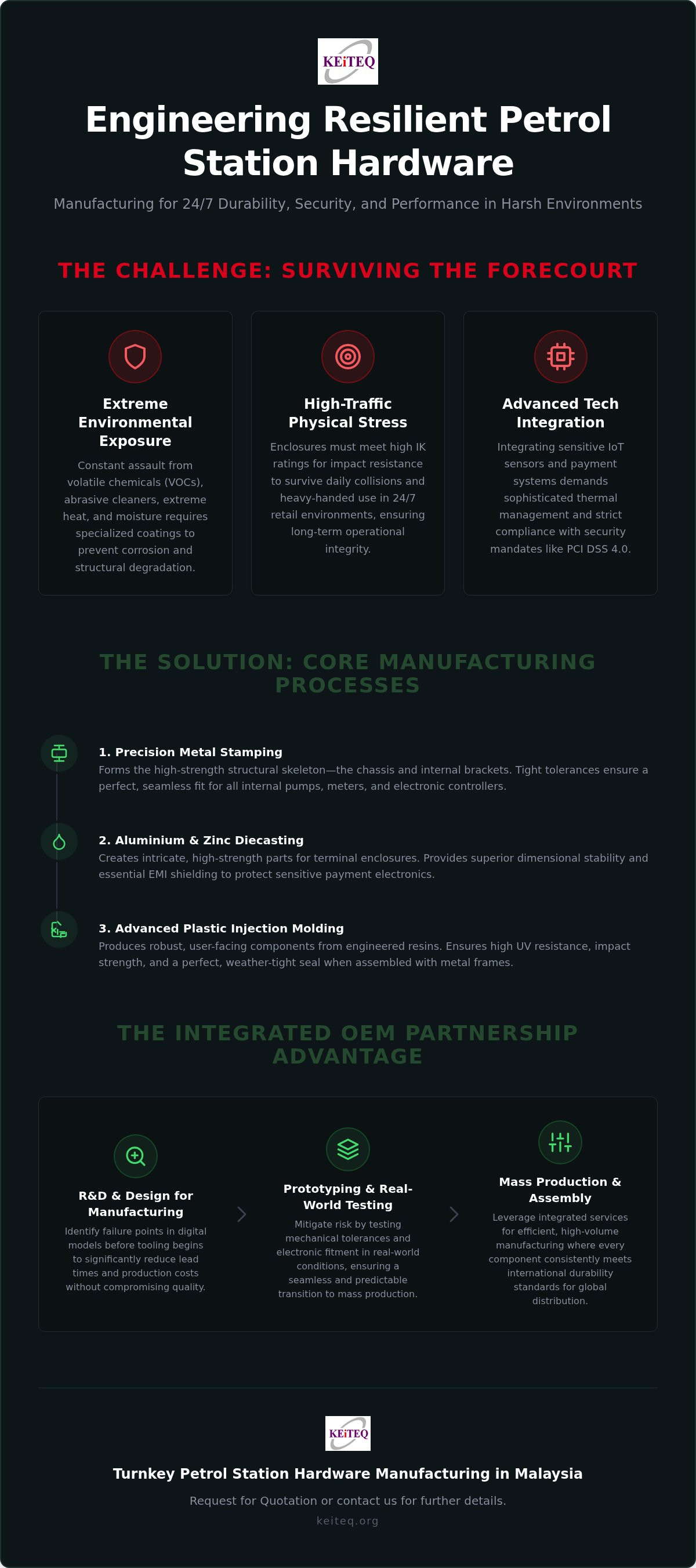
Hardware situated on a fuel forecourt faces a relentless assault from the elements. Corrosion resistance is a non-negotiable requirement; surfaces must be treated with specialized coatings to prevent oxidation in fuel-heavy atmospheres. Beyond chemical exposure, impact resistance is critical. Enclosures must meet high IK ratings to survive the physical stress of high-traffic retail environments where accidental collisions or heavy-handed use are daily occurrences. Thermal management presents the final hurdle. As payment terminals become more powerful, dissipating heat within a sealed, sun-exposed enclosure requires sophisticated internal airflow engineering and heat-sink integration to prevent system throttling or hardware failure.
The Integrated R&D Approach
Longevity starts long before the first part is cast. A robust R&D phase is the foundation of any successful hardware project. By utilizing strategic product design services, OEMs can identify potential failure points in the digital model before expensive tooling begins. This integrated approach ensures that every bracket, mold, and circuit housing is optimized for the specific stresses of the petrol station environment. Prototyping serves as a vital risk-mitigation tool during this process. It allows engineers to test mechanical tolerances and electronic fitment in real-world conditions, ensuring that the transition to mass production is seamless, predictable, and cost-effective.
Core Manufacturing Processes: Metal Stamping, Diecasting, and Plastic Molding
Petrol station hardware manufacturing requires a disciplined integration of diverse material sciences to produce components that are both structurally sound and functionally precise. The foundation of a fuel dispenser lies in its chassis and internal brackets, which are typically produced through precision metal stamping. These parts must maintain tight tolerances to ensure the seamless fitment of internal pumps, meters, and electronic controllers. While stamping provides the structural skeleton, aluminium and zinc diecasting are utilized for intricate, high-strength terminal components. These die-cast parts offer superior dimensional stability and electromagnetic interference (EMI) shielding, which is vital for housing sensitive payment electronics.
The user-facing interface relies heavily on advanced plastic injection molding. These components aren't standard consumer plastics; they're engineered resins designed for UV resistance and high impact strength. Ergonomic housings for card readers and touchscreens must provide a tactile, professional feel while remaining impervious to the degrading effects of constant sunlight and fuel vapors. The synergy between these metal and plastic components is what defines a high-quality assembly. A well-engineered unit ensures that plastic interfaces snap perfectly into metal frames, creating a weather-tight seal that protects the internal systems from the elements.
Advanced Industrial Finishing and Coatings
Selecting the correct finish is as important as the base material itself. While powder coating is a standard for many industrial applications, ceramic coating offers superior hardness and thermal resistance for dispensers located in high-heat regions. In environments with heavy chemical exposure, enamel coating remains the gold standard due to its non-porous surface and resistance to acidic cleaners. For a deeper technical analysis of these options, refer to our guide on protective coatings for outdoor electronics. These layers ensure that hardware remains compliant with the Payment Card Industry Data Security Standards by preventing physical tampering through corrosion-weakened enclosures.
Scaling with Custom Metal Stamping
Maintaining consistency across high-volume production runs is a primary challenge for OEMs. A specialized metal stamping manufacturer utilizes automated quality control systems to monitor part dimensions in real-time, ensuring that the 10,000th bracket is identical to the first. During early-stage R&D, soft tooling allows for rapid prototyping without the massive capital investment of permanent dies. This iterative process is essential for refining designs before committing to mass production. If you require specific technical guidance on material selection for your next project, you can contact our engineering team for a detailed consultation regarding our facilities in Malaysia.
Engineering Outdoor Payment Terminals for Durability and Security
Petrol station hardware manufacturing must address the heightened security risks associated with unattended payment terminals (UPT). These units are primary targets for both physical tampering and environmental degradation. Engineering a secure terminal requires a holistic approach that combines hardened metal enclosures with sophisticated electronic integration. Critical components such as secure card readers, sunlight-readable touchscreens, and high-speed thermal printers must be housed in a way that prevents unauthorized access while remaining accessible for routine maintenance by authorized technicians. Reliability in this sector is a function of disciplined engineering; a single failure in a payment kiosk can halt operations across multiple fueling points.
Enclosure design is the first line of defense. By utilizing tamper-evident features and high-strength alloys, manufacturers can mitigate the risk of skimming and physical vandalism. This engineering process must also adhere to strict fuel dispenser safety standards to ensure that electronic components don't pose a combustion risk in the presence of fuel vapors. The integration of these electronics into custom-molded housings requires precise tolerances. Even a minor misalignment can compromise the weather seal or lead to premature component failure. Our approach focuses on creating a "Safe Pair of Hands" environment where security and durability are engineered into the product's DNA from the initial R&D phase.
Outdoor Payment Terminal Assembly Requirements
Meeting IP65 or IP66 ratings for water and dust ingress protection is mandatory for any hardware situated on the forecourt. The outdoor payment terminal assembly process involves complex sealing techniques and the use of gaskets that remain resilient under extreme thermal cycling. Manufacturers must implement rigorous testing protocols, including salt spray tests and vibration analysis, to simulate years of service in variable climates. These protocols ensure that the terminal remains operational whether it's facing tropical humidity or sub-zero temperatures, protecting the retailer's investment and the consumer's data.
The Role of Electronic Manufacturing Services (EMS)
The transition to modern fuel kiosks necessitates advanced electronic manufacturing services in Malaysia to manage the complexity of PCBA integration. Modern terminals require the seamless installation of processors capable of handling PCI DSS 4.0 encryption and multi-factor authentication. Integrating these PCBAs into ruggedized industrial enclosures requires specialized assembly lines that prevent electrostatic discharge (ESD) and ensure perfect connectivity. Final assembly and functional testing (FCT) provide the ultimate validation, confirming that the turnkey solution meets all performance specifications before it leaves the factory floor. This integrated approach eliminates the risks associated with managing multiple vendors for mechanical and electronic components.
Selecting an OEM Partner: From R&D to Mass Production Management
Choosing an OEM partner for petrol station hardware manufacturing is a strategic decision that impacts the entire lifecycle of the fueling forecourt. Many procurement teams mistake simple parts distribution for manufacturing, but true industrial value lies in a partner's ability to provide technical R&D and design support. An experienced partner doesn't just execute a drawing. They apply "Design for Manufacturing" (DfM) principles to optimize part geometry, reduce material waste, and eliminate assembly bottlenecks. This proactive engineering phase is critical when integrating new payment terminal designs that must comply with modern security standards like PCI DSS 4.0.
Managing mass production on a global scale requires a partner capable of maintaining strict quality control across thousands of units. While a multi-vendor strategy might seem to offer price flexibility, it often introduces hidden costs through logistical delays and component misalignments. A single-source approach ensures that the metal chassis, plastic interface, and electronic assembly are perfectly synchronized. This holistic management style reduces lead times and provides a clear line of accountability for the final product's performance. It's about moving away from fragmented procurement toward a more stable, integrated supply chain.
Bridging the Gap from Prototype to Production
The transition from a functional prototype to a mass-produced unit is where many hardware projects falter. Utilizing single-source manufacturing benefits the OEM by providing a seamless handoff between R&D and the factory floor. During the early stages, soft tooling and prototyping allow for rapid iteration and physical testing without the high capital cost of permanent dies. Once the design is validated, the manufacturer transitions to high-volume hard tooling, ensuring that every unit meets the exact specifications of the original master. This process is essential for managing supply chain risks in the volatile industrial hardware market.
Quality Standards and Compliance
Industrial hardware must survive decades of use, making compliance with global standards a non-negotiable requirement. ISO certifications provide the procedural framework for consistent production, but fuel station hardware requires additional specialized testing. Enclosures must undergo rigorous environmental testing, including salt spray analysis for coastal installations and UV exposure tests for high-heat regions. Terminal housings must also meet specific impact resistance ratings to ensure security against physical tampering. If you're ready to discuss your production requirements in the Southeast Asian market, you should contact us for a Request for Quotation regarding our integrated facilities in Malaysia.
Keiteq: Turnkey Petrol Station Hardware Manufacturing in Malaysia
Keiteq operates as a dependable pillar in the global supply chain, providing end-to-end industrial solutions from our specialized manufacturing hub in Malaysia. We manage the entire lifecycle of petrol station hardware manufacturing, from initial R&D and design to complex assembly and mass production. Our facility is engineered to handle the rigorous demands of the fuel retail sector, where hardware must perform under constant use and environmental stress. By consolidating R&D, metal stamping, and plastic molding under one roof, we eliminate the logistical fragmentation that often leads to lead-time delays and quality inconsistencies.
Our expertise extends to specialized industrial coatings that are essential for forecourt longevity. We provide in-house enamel, ceramic, and powder coating services, ensuring that every dispenser chassis and terminal enclosure is shielded against chemical corrosion and UV degradation. This integrated approach has been proven through successful large-scale deployments, including our partnership with TNS to supply outdoor payment terminals for major retailers like Petron Malaysia. These projects demonstrate our ability to deliver high-performance hardware that meets both regional requirements and international safety standards.
Plastic Injection Molding Excellence in Malaysia
Precision is the core of our plastic injection molding services in Malaysia. We specialize in custom mold design for complex petrol station interfaces, utilizing engineered resins that offer superior impact resistance and thermal stability. Our engineering team works closely with OEMs to refine part geometries during the R&D phase, ensuring that every plastic component integrates perfectly with metal frames. This capability allows us to scale production rapidly to meet the high-volume needs of global fuel retailers while maintaining the tight tolerances required for secure payment terminal housings.
Comprehensive Assembly and Finishing
We manage the entire outdoor payment terminal assembly lifecycle, ensuring that electronic components are housed in weather-tight, tamper-resistant enclosures. Our assembly lines are optimized for technical precision, incorporating functional testing (FCT) to validate every unit before shipment. By maintaining in-house control over the finishing and assembly stages, we provide a "Safe Pair of Hands" for complex industrial projects. This turnkey model ensures that the final product is ready for immediate deployment in the field, backed by a rigorous quality assurance process that meets the most demanding industrial specifications.
If you are looking for a reliable manufacturing partner to handle your regional or global hardware requirements, we invite you to engage with our technical team. Our Malaysia-based facility is equipped to support your project from the first prototype to full-scale market rollout.
Request for Quotation or Request to contact us for further details regarding our professional manufacturing and assembly services in Malaysia.
Optimizing Your Forecourt Infrastructure for 2026
The evolution of fuel retail requires hardware that is as secure as it is durable. Success in this environment depends on moving beyond simple parts procurement and embracing a fully integrated approach to petrol station hardware manufacturing. By prioritizing precision R&D and specialized assembly, retailers can effectively mitigate the risks of environmental degradation and physical tampering. A single-source partnership ensures that complex components like outdoor payment terminals are engineered to meet the latest security standards while surviving the relentless rigors of the forecourt.
Our facility in Malaysia serves as a global facilitator for high-performance hardware. We provide end-to-end R&D and mass production management, specialized outdoor payment terminal assembly, and advanced industrial coating solutions designed for maximum operational life. This integrated model provides the stability and logistical competence needed for large-scale rollouts. It's about ensuring every component is a reliable pillar in your supply chain, backed by a "Safe Pair of Hands" that understands industrial realities.
For professional petrol station hardware manufacturing and assembly services in Malaysia, Request for Quotation or contact us for further details to see how our engineering expertise can support your next project. We look forward to helping you build a more resilient retail environment.
Frequently Asked Questions
What are the most durable materials for petrol station hardware enclosures?
High-grade stainless steel and aluminium alloys are the primary materials for durable enclosures. These metals provide the structural integrity needed to withstand physical stress and environmental exposure. For plastic components, we utilize UV-stabilized resins that prevent brittleness and discoloration under constant sunlight. This material selection is a core part of petrol station hardware manufacturing, ensuring that all external surfaces maintain their protective properties over long-term operational cycles.
How does Keiteq manage the R&D process for new petrol station equipment?
Our R&D process begins with Design for Manufacturing (DfM) to optimize part geometry and reduce production costs. We transition from digital models to physical prototyping using soft tooling, which allows for rigorous testing before committing to permanent dies. This methodical approach ensures that every new piece of equipment is refined for both performance and manufacturability, reducing the risks associated with large-scale industrial rollouts.
What is the difference between powder coating and enamel for fuel dispensers?
Enamel coating provides superior resistance to harsh chemicals and fuel vapors compared to standard powder coating. While powder coating offers excellent aesthetic versatility and durability, enamel creates a non-porous surface that is nearly impervious to acidic cleaners. We evaluate the specific environmental conditions of the forecourt to recommend the most effective coating solution for long-term corrosion protection and structural maintenance.
Can Keiteq handle both plastic and metal component manufacturing in-house?
We provide comprehensive turnkey services that include both plastic injection molding and precision metal stamping in-house. This integrated capability allows us to manage the synergy between different material types within a single assembly. By handling both processes internally, we eliminate the alignment issues often found with multi-vendor strategies. This is a significant advantage in petrol station hardware manufacturing, ensuring that every bracket and housing fits perfectly.
What certifications are required for outdoor payment terminal hardware?
Outdoor payment terminals must comply with PCI DSS 4.0 for data security and meet specific IP ratings for weatherproofing. Hardware situated on the forecourt typically requires an IP65 or IP66 rating to ensure protection against water and dust ingress. Additionally, IK ratings are utilized to measure impact resistance, ensuring that the terminal enclosure can withstand physical vandalism or accidental damage in high-traffic retail environments.
How does Keiteq ensure the security of unattended payment kiosks?
Security is managed through a combination of hardened physical enclosures and tamper-evident assembly techniques. We engineer payment kiosks with reinforced locking mechanisms and specialized internal brackets that prevent unauthorized access to sensitive electronics. Our assembly process in Malaysia includes rigorous functional testing to ensure that all security sensors and electronic safeguards are fully operational before the hardware is deployed to the field.
What are the lead times for transitioning from prototype to mass production?
Transitioning from prototype to mass production typically depends on the complexity of the design and the specific tooling requirements. By using an integrated manufacturing model, we significantly reduce lead times compared to managing fragmented supply chains. Our use of soft tooling during the R&D phase allows for faster iterations, while our established mass production management systems ensure a seamless handoff to high-volume hard tooling.
Does Keiteq offer specialized manufacturing services in Malaysia for the fuel sector?
We operate a specialized manufacturing hub in Malaysia that provides end-to-end services for the global fuel retail sector. Our facility handles everything from initial product R&D to final outdoor payment terminal assembly. This regional presence allows us to support clients with localized technical expertise while maintaining the scale necessary for international distribution. Our Malaysian operations are focused on delivering high-quality, compliant hardware with reduced logistical overhead.


Comments