
Plastic Injection Molding: 2026 Procurement Guide
- 9 hours ago
- 11 min read
Fragmented supply chains are no longer a viable strategy for hardware OEMs aiming for market leadership in 2026. When you manage separate vendors for plastic and metal components, you often face inconsistent part quality and high logistics costs that stall your growth. Reliable plastic injection molding services must do more than just press parts; they need to function as a technical extension of your engineering team.
We understand that maintaining precision across high-volume runs is a constant pressure for procurement officers. This guide provides the roadmap to mastering complex industrial molding while discovering how integrated manufacturing in Malaysia optimizes your lifecycle from initial R&D to mass production. You'll learn how a single-source partner reduces time-to-market for complex hardware and ensures high-durability components for outdoor use. We will cover the latest regulatory shifts, including the FDA Quality Management System Regulation (QMSR) and Malaysia's 2026 voluntary Extended Producer Responsibility (EPR) framework, to ensure your procurement strategy remains compliant and efficient.
Table of Contents
The Strategic Importance of Precision Plastic Injection Molding Services
Industrial plastic injection molding is the definitive backbone for durable OEM hardware, providing the structural housing and internal components required for long-term reliability. Unlike basic casting, the plastic injection molding process allows for the creation of complex, high-strength parts that meet the rigorous demands of industrial environments. Precision molding is especially critical for tight-tolerance outdoor enclosures, where even a micron-level deviation can compromise the ingress protection (IP) rating against moisture and dust. By utilizing advanced engineering resins, manufacturers reduce total part weight without sacrificing structural integrity, which is a vital requirement for portable or pole-mounted hardware.
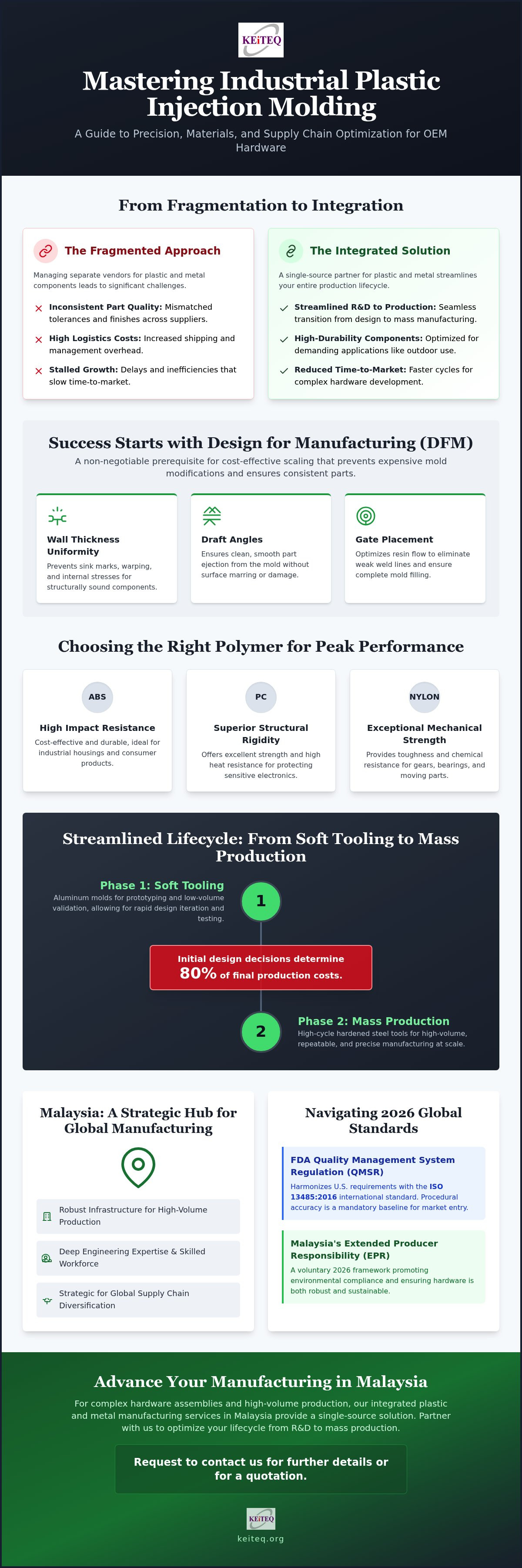
Success in mass production starts with Design for Manufacturing (DFM). This process is a non-negotiable prerequisite for cost-effective scaling. DFM reviews identify potential tooling issues before the first steel is cut, focusing on:
Wall Thickness Uniformity: Preventing sink marks and internal stresses.
Draft Angles: Ensuring clean part ejection without surface marring.
Gate Placement: Optimizing resin flow to eliminate weak weld lines.
Addressing these technical constraints early prevents expensive mold modifications and ensures that your plastic injection molding services deliver consistent parts at scale. When sourcing plastic injection molding services, technical directors must prioritize partners who provide this level of upfront engineering analysis to avoid downstream failures.
Meeting Global OEM Standards in 2026
The landscape of quality standards has evolved significantly. As of February 2, 2026, the FDA Quality Management System Regulation (QMSR) has harmonized U.S. requirements with the international standard ISO 13485:2016. For OEMs, this means procedural accuracy isn't optional; it's a baseline for market entry. Modern production facilities must maintain high-volume consistency while integrating sustainable, high-performance thermoplastics. These materials must balance durability with the emerging requirements of Malaysia's 2026 voluntary Extended Producer Responsibility (EPR) framework, ensuring that hardware remains both robust and compliant with global environmental mandates.
The Role of R&D in Early-Stage Molding
Initial design decisions often determine 80% of final production costs. A design that looks perfect on a screen might be impossible to eject from a mold or prone to warping during cooling. Partnering with a specialist in integrated product R&D and manufacturing bridges the gap between conceptual industrial design and physical tooling. This collaborative approach ensures that part geometry is optimized for the specific flow characteristics of the chosen polymer. By aligning design intent with manufacturing reality, you eliminate the technical friction that typically delays time-to-market for complex hardware assemblies.
Technical Parameters: Material Selection and Mold Engineering
Selecting the correct polymer is a foundational engineering decision that dictates the performance limits of the final component. Industrial-grade plastic injection molding services rely on several primary categories of polymers to meet specific mechanical requirements:
ABS: Provides high impact resistance and cost-effective processing for industrial housings.
Polycarbonate (PC): Offers superior structural rigidity and high heat resistance for sensitive internal electronics.
Nylon (PA): Delivers exceptional mechanical strength and chemical resistance for moving parts or gear assemblies.
Each material presents unique technical parameters of injection molding, such as varying shrink rates and melt temperatures, which must be accounted for during the tool design phase. Mold engineering requires a strategic choice between high-cycle hardened steel tools and aluminum soft tooling. While aluminum molds are suitable for soft tooling prototyping and low-volume validation, mass production demands P20 or H13 hardened steel to maintain tolerances over hundreds of thousands of cycles. Precision is governed by ISO 20457:2018, which sets the standard for tolerances in molded plastic parts. Standard tolerances typically hover around ±0.1 mm, but achieving ±0.05 mm requires meticulous control over gate placement and cooling rates. Improper gate location leads to weld lines that weaken the part, while uneven cooling causes internal stresses that result in warping or sink marks.
For complex hardware, integrating threaded inserts or utilizing overmolding techniques eliminates the need for secondary assembly. Overmolding allows for the bonding of a soft-touch elastomer over a rigid plastic substrate, enhancing ergonomics and sealing capabilities. This level of technical depth ensures that plastic injection molding services produce components ready for immediate integration into high-level assemblies.
Engineering for Harsh Outdoor Environments
Components destined for fuel retail or utility sectors require specialized material formulations. We utilize UV-stabilized resins, such as PC/ASA blends, to prevent brittleness and color fading in outdoor payment terminals. Chemical resistance is equally vital; components must withstand exposure to petrol, diesel, and industrial cleaning agents without degrading. Thermal stability refers to a polymer's ability to maintain its mechanical properties and dimensional accuracy across extreme temperature fluctuations without significant degradation.
Advanced Mold Design and Tooling Strategy
Hardened production molds are engineered to facilitate specific post-processing requirements. If a part requires powder coating or specialized ceramic enameling, the mold surface must be textured to improve adhesion. Wall thickness optimization is a critical focus; we maintain uniform walls to prevent heat traps that cause surface defects. If you are currently evaluating production feasibility, you can contact our engineering team for a technical review of your part geometry.
Regional Advantage: Why Malaysia is the Global Hub for Molding
Malaysia's dominance in the 2026 plastics market is a direct result of its unique dual-hub status. The country provides both the raw petrochemical feedstock and the specialized downstream expertise required for high-precision plastic injection molding services. For procurement directors based in the US seeking to diversify their supply chains, this region offers a stable and technically mature alternative. The Malaysian plastics market reached an estimated USD 4.19 billion in 2026, supported by a Compound Annual Growth Rate (CAGR) of 3.86%. This growth is concentrated in the electronics and electrical sectors, ensuring that the local infrastructure is specifically tuned for high-specification industrial hardware.
While regional regulations apply, premier facilities in the region align their operational protocols with international safety benchmarks. This includes strict adherence to OSHA safety standards for injection molding, ensuring that factory floor practices meet the rigorous audit requirements of global OEMs. This alignment guarantees that production remains disciplined and predictable, providing a "Safe Pair of Hands" for US-based companies managing production from across the globe. By leveraging these established standards, Keiteq Co Ltd ensures that every project maintains the procedural accuracy required for international compliance.
Logistics and Supply Chain Stability
Sourcing plastic injection molding services in Malaysia provides immediate access to a world-class export infrastructure. Major ports like Port Klang and Tanjung Pelepas facilitate rapid shipping to US markets, while the country's National Semiconductor Strategy continues to attract investment in high-precision molding. The presence of established electronic manufacturing services in Malaysia allows for the seamless integration of molded parts into complex hardware assemblies. This proximity to adjacent technical services reduces the transit risks and lead times typically associated with fragmented production strategies.
Keiteq Co Ltd: Strategic Operations in Malaysia
Keiteq Co Ltd leverages its robust operational presence in Malaysia, offering global OEMs a seasoned partner for industrial-scale projects. As a leading plastic injection mold Malaysia specialist, Keiteq Co Ltd strategically operates within the primary manufacturing clusters of Selangor, Johor, and Penang, positioning us to efficiently serve international demand. We understand the intricacies of international production and navigate them with ease. Our expertise in managing high-cycle production runs ensures that your components are manufactured to the highest professional standards. Keiteq Co Ltd functions as a reliable pillar within your global supply chain, providing the stability and logistical competence required for success in 2026.
Lifecycle Management: From Soft Tooling to Mass Production
Managing the transition from a conceptual design to a high-volume product requires a disciplined, multi-stage approach. Fragmented plastic injection molding services often fail because they treat prototyping and mass production as isolated events. A successful lifecycle begins with a rigorous Design for Manufacturing (DFM) review. This initial R&D phase validates part geometry against the physical realities of resin flow and mold ejection. Once the geometry is verified, the process moves through five critical stages:
Step 1: Initial DFM review to eliminate technical friction in part design.
Step 2:Soft tooling prototyping to facilitate functional testing and market validation.
Step 3: Finalization of mold design for high-volume durability using hardened steel.
Step 4: Pilot production runs to calibrate machines and ensure batch consistency.
Step 5: Full-scale mass production management with continuous quality oversight.
This methodical progression ensures that technical errors are caught early, preventing costly modifications to production-grade tools. By integrating these stages under a single manufacturing partner, you maintain the technical continuity required for complex hardware builds.
The Value of Soft Tooling in R&D
Soft tooling serves as a strategic hedge against financial risk during the product development phase. It allows engineers to test material performance and structural integrity in real-world conditions without the lead times of permanent steel molds. Using aluminum or soft steel inserts provides a cost-effective way to produce hundreds of functional parts for field testing. Soft tooling acts as the critical bridge to successful mass production by allowing for geometry validation before capital-intensive steel molds are commissioned.
Mass Production Management and Quality Control
Transitioning to mass production requires a shift toward statistical process control (SPC). In high-volume runs, maintaining batch-to-batch consistency in color and mechanical properties is paramount. This level of precision is only possible through rigorous machine calibration and real-time monitoring of injection pressures and cooling cycles. Success depends on selecting a plastic injection molding manufacturer that offers end-to-end oversight. This ensures that every component leaving the factory floor meets the exact specifications established during the R&D phase. If you're ready to move from design to delivery, contact our technical team for a production feasibility assessment in Malaysia.
The Integrated Edge: Plastic-Metal Synergy and Finishing
Industrial enclosures for heavy-duty applications require a level of structural reinforcement that polymers alone cannot always provide. This necessitates a strategic synergy between high-precision metal stamping and plastic injection molding services. While previous stages of the lifecycle focus on part geometry and resin flow, the final assembly depends on the seamless integration of these disparate materials. Stamped metal frames provide the load-bearing skeleton for outdoor units, while molded plastic components offer the intricate internal details and electrical insulation. Positioning Keiteq Co Ltd as the single-source provider for these hybrid components eliminates the technical friction and logistical overhead associated with managing multiple specialized vendors.
Specialized Coatings for Industrial Longevity
Surface finishing serves as the definitive barrier against environmental degradation in high-traffic or industrial zones. Beyond the initial molding process, components often require advanced coatings to survive decades of exposure. Ceramic and enamel coatings provide exceptional resistance to both extreme heat and abrasive wear, ensuring that functional surfaces do not degrade under stress. Powder coating adds a durable, aesthetic finish to metal-plastic assemblies, protecting the substrate from oxidation and UV damage. For technical directors seeking deeper insights into these protective layers, our industrial reference guide for protective coatings details the specific performance metrics of each application.
Turnkey Assembly for Outdoor Hardware
The final stage of production involves the complex integration of molded parts, stamped metals, and sensitive electronics into a single, functional unit. Keiteq Co Ltd specializes in the turnkey assembly of outdoor payment terminals, particularly for the petrol and gas station sectors. These assemblies must meet rigorous IP ratings and tamper-resistance standards to operate in unattended environments. By managing the full assembly process in Malaysia, Keiteq Co Ltd provides a "Safe Pair of Hands" that ensures every interface between metal and plastic is verified for tolerance and fit. This holistic oversight reduces the risk of assembly-level failures and ensures that the final hardware is ready for immediate global deployment.
Optimizing Your 2026 Manufacturing Strategy
Industrial success in the coming year depends on consolidating fragmented supply chains into a single, technically proficient hub. Mastering the transition from soft tooling to mass production ensures that your hardware meets the rigorous precision standards required for global market entry. By prioritizing a partner with integrated plastic and metal capabilities, you eliminate the logistical friction that typically compromises part quality and increases time-to-market.
Our specialized expertise in outdoor payment terminal assembly and advanced industrial finishing, including ceramic and enamel coatings, provides the durability necessary for harsh environments. Malaysia continues to be the premier region for these operations, offering a mature ecosystem of engineering talent and robust export infrastructure. Utilizing professional plastic injection molding services within this regional hub allows you to maintain high-volume consistency while navigating evolving regulatory requirements like the FDA QMSR and local sustainability frameworks.
For professional manufacturing solutions in Malaysia, Request for Quotation or Request to contact us for further details. We are ready to facilitate your next large-scale production project with precision and stability.
Frequently Asked Questions
What are the primary benefits of using plastic injection molding services in Malaysia?
Malaysia serves as a strategic manufacturing hub due to its advanced petrochemical infrastructure and skilled engineering workforce. Keiteq Co Ltd leverages this regional ecosystem to provide plastic injection molding services that offer a balance of technical precision and logistical efficiency. By sourcing from this established corridor, US-based OEMs benefit from a mature supply chain that is specifically optimized for high-specification electronics and industrial hardware.
How do I choose between soft tooling and hardened steel molds for my project?
The choice depends on your production volume and the current stage of the product lifecycle. Soft tooling is the preferred option for functional prototyping and market validation runs where geometry may still evolve. Keiteq Co Ltd recommends transitioning to hardened steel molds only when you're ready for high-volume mass production, as these tools are engineered to maintain tight tolerances over hundreds of thousands of cycles.
Can Keiteq Co Ltd handle both plastic molding and metal stamping for a single assembly?
Yes, Keiteq Co Ltd provides integrated manufacturing by combining plastic molding and metal stamping under a single roof. This synergy is essential for complex industrial enclosures where metal provides structural rigidity and plastic offers intricate detailing. By managing both processes, Keiteq Co Ltd ensures technical continuity and eliminates the assembly discrepancies that typically arise when using multiple vendors.
What materials are best for outdoor payment terminal enclosures?
UV-stabilized polymers, such as PC/ASA blends, are the industry standard for outdoor environments. These materials prevent the brittleness and color degradation caused by prolonged sun exposure. Keiteq Co Ltd selects specific resins based on their chemical resistance and thermal stability, ensuring that enclosures used in petrol or gas stations can withstand both environmental stress and physical wear.
How long does it typically take to transition from prototype to mass production?
The transition from a validated prototype to full-scale production usually spans several weeks, depending on the complexity of the mold design. This timeline includes a comprehensive DFM review, tool fabrication, and pilot production runs to calibrate machinery. Keiteq Co Ltd manages this entire progression to ensure that the transition is seamless and that the final parts match the established engineering benchmarks.
Does Keiteq Co Ltd offer specialized finishing like ceramic or enamel coating?
Keiteq Co Ltd provides advanced industrial finishes, including ceramic and enamel coatings, for components requiring extreme durability. Ceramic coatings are utilized for their superior heat and abrasion resistance, while enamel provides a chemically inert barrier for hardware in volatile environments. These finishes are part of our turnkey assembly service, ensuring that every hybrid component is fully protected before deployment.
Is DFM (Design for Manufacturing) included in your injection molding services?
DFM is a non-negotiable phase of the plastic injection molding services provided by Keiteq Co Ltd. Our engineering team conducts an upfront analysis of your part geometry to identify potential issues like sink marks, warping, or improper gate placement. This proactive review ensures that the final mold is optimized for cost-effective scaling and high-volume consistency.
What quality certifications does Keiteq Co Ltd maintain for industrial manufacturing?
Keiteq Co Ltd maintains ISO 9001 and ISO 13485:2016 certifications to ensure our production meets global quality standards. We also align our procedural accuracy with the 2026 FDA Quality Management System Regulation (QMSR) for medical and industrial-grade components. These certifications guarantee that our manufacturing processes are disciplined, documented, and capable of meeting the most rigorous audit requirements.


Comments