
Precision Insert Molding Services in Johor: Quality OEM
Updated: Aug 16
A single component failure in a high-stakes industrial environment often stems from a weak mechanical joint rather than the material itself. You've likely seen how multi-part assemblies struggle under environmental stress, leading to costly downtime and compromised performance. Choosing specialized insert molding services Johor allows you to bypass these vulnerabilities by integrating metal and plastic into a single, cohesive unit. This shift doesn't just enhance durability; it also addresses the high assembly costs and logistical headaches associated with fragmented production lines.
You're about to learn how to leverage precision engineering to achieve superior industrial durability for your most demanding applications. This article breaks down the strategic benefits of integrated production, from reduced part counts to enhanced structural integrity. We'll preview how Keiteq’s turnkey manufacturing model in Malaysia simplifies your supply chain by combining R&D, plastic injection, and advanced finishing under one roof. By the end, you'll understand why a consolidated approach in Johor is the most reliable path for global OEMs managing complex hardware requirements.
Table of Contents
Understanding Insert Molding Services in Johor’s Manufacturing Landscape
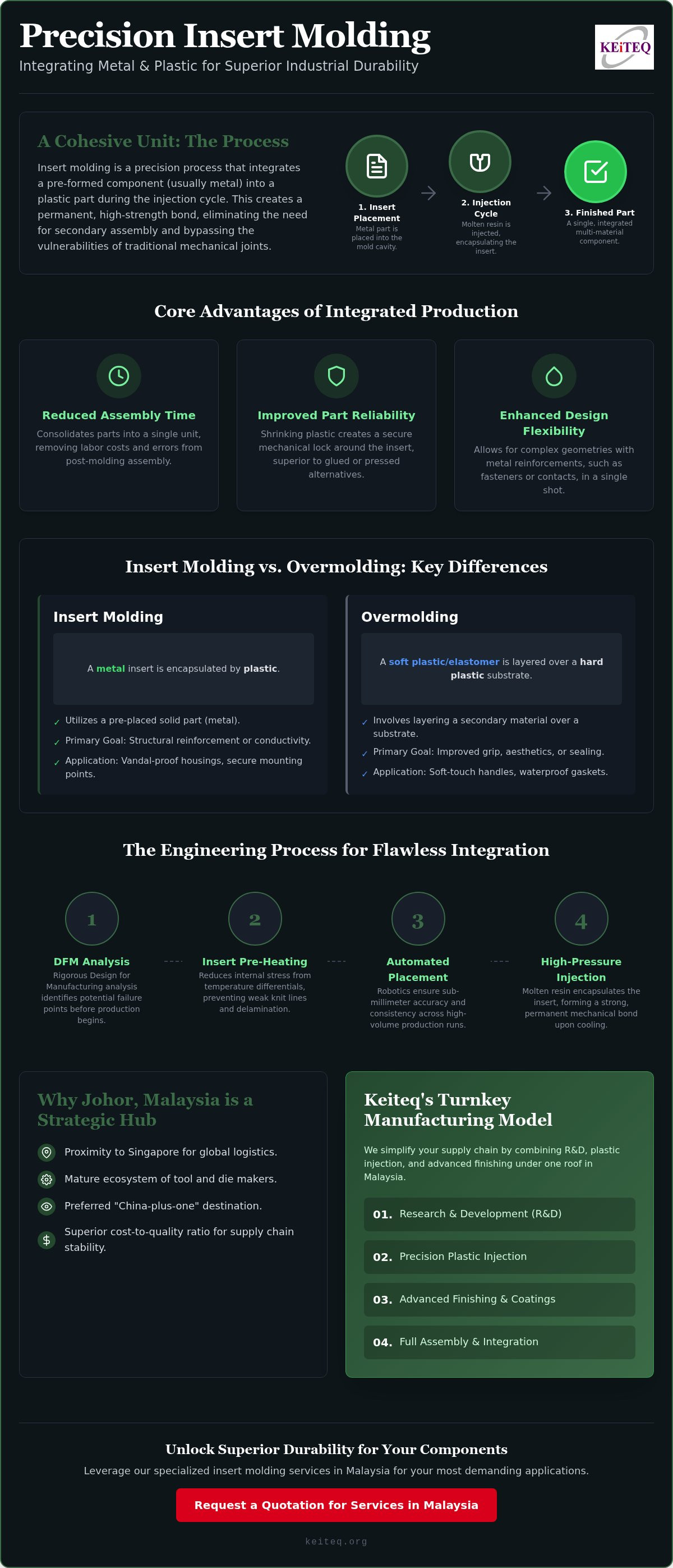
Insert molding is a precision engineering process that integrates a pre-formed component, usually metal, into a plastic part during the injection cycle. The operator or a robot places the insert into the mold cavity before molten resin is injected to encapsulate it. This technique creates a permanent, high-strength bond that eliminates the need for secondary assembly steps. For global manufacturers, insert molding services Johor offer a sophisticated solution to create durable, multi-material components that withstand rigorous industrial use.
The primary advantages of this method center on structural performance and cost efficiency. By integrating fasteners, pins, or electrical contacts directly into the housing, engineers achieve several critical outcomes:
Reduced Assembly Time: Consolidating parts into a single unit removes the labor costs and errors associated with post-molding fasteners.
Improved Part Reliability: The plastic shrinks around the insert as it cools, creating a mechanical lock that is far more secure than glued or pressed alternatives.
Enhanced Design Flexibility: Complex geometries that require metal reinforcements can be produced in a single shot.
Industry projections for 2026 indicate a sharp shift toward high-complexity, multi-material components. This evolution is driven by the rise of SmartTech and Mobility sectors, where lightweight yet robust enclosures are mandatory for EV infrastructure and IoT devices. Johor's manufacturing base is already adapting to these requirements by integrating advanced sensors and conductive elements into standard molded parts.
The Strategic Advantage of Johor for Global OEMs
Johor's position as a manufacturing powerhouse isn't accidental. Its proximity to Singapore provides seamless access to international logistics corridors and global financial services. Within the region, a mature ecosystem of tool and die makers supports rapid prototyping and high-precision mold fabrication. This established infrastructure allows Malaysia to serve as a preferred "China-plus-one" destination. It offers a superior cost-to-quality ratio that appeals to procurement officers looking for supply chain stability without sacrificing technical excellence. By utilizing insert molding services Johor, companies can maintain high production standards while diversifying their geographic risk.
Insert Molding vs. Overmolding: Key Differences
While both processes involve multiple materials, their applications differ significantly. Insert molding utilizes a pre-placed solid part, typically metal, to provide structural reinforcement or electrical conductivity. In contrast, overmolding involves layering a secondary plastic or elastomer over a primary plastic substrate to improve grip or aesthetics. Industrial applications requiring metal-grade strength, such as outdoor payment terminal housings, rely on insert molding for secure mounting points. This ensures the unit remains vandal-proof and weather-sealed in harsh environments where plastic-only threads would fail under stress.
The Engineering Process Behind Precision Plastic Insert Molding
Precision is the primary metric for success in multi-material integration. The engineering phase begins with a rigorous Design for Manufacturing (DFM) analysis. This process identifies potential failure points, such as uneven cooling or air traps, before a single mold is cut. For those utilizing insert molding services Johor, this technical scrutiny ensures that the bond between the metal substrate and the thermoplastic remains intact under industrial load. Without proper DFM, parts are prone to delamination or structural weakness that only appears after the product enters the field.
Thermal management during the molding cycle is equally vital. Pre-heating the metal inserts before they enter the mold cavity reduces the internal stress caused by radical temperature differentials. When molten plastic hits a cold metal insert, it can freeze prematurely, leading to weak knit lines. Modern Johor production facilities solve this by using automated pick-and-place robotics. These systems maintain precise cycle times and position inserts with sub-millimeter accuracy, ensuring consistency across high-volume runs. High-pressure injection requires the mold to secure the insert firmly; any displacement during the shot results in a scrapped part.
Critical Design Considerations for Metal Inserts
Mechanical interlocking is achieved through specific metal geometries. Knurling, grooves, and undercuts allow the plastic to flow into recesses, creating a permanent physical bond. Engineers must also account for the thermal expansion coefficient. Metal and plastic expand at different rates. If these aren't matched or compensated for in the design, the part may crack during thermal cycling. Proper wall thickness around the insert is also necessary to prevent sink marks or stress fractures. If you're unsure about your current part geometry, you can consult with our engineering team for a technical review.
Material Selection: Thermoplastics and Engineering Resins
The choice of resin dictates the component's lifespan in harsh environments. High-performance materials like PBT, PPS, and glass-filled Nylon are preferred for their dimensional stability and chemical resistance. In the tropical climate of Malaysia, high humidity can affect certain polymers. Glass-filled resins are particularly effective here because they resist moisture-induced warping and maintain stiffness. You can explore more about material properties through Keiteq’s plastic injection molding services in Malaysia to find the optimal resin for your specific industrial application. Selecting the right material ensures the insert molding services Johor providers deliver parts that survive both the factory floor and the elements.
Optimising Durability: Beyond Standard Insert Molding with Specialised Coatings
Standard manufacturing often overlooks the vulnerability of exposed metal surfaces once the molding process is complete. While insert molding services Johor providers excel at creating high-strength bonds, the longevity of the final product depends on "Total Component Protection." This approach ensures that the metal substrate isn't just anchored within the plastic but is also shielded from environmental degradation where it remains exposed. By applying specialized finishes, manufacturers can extend the service life of industrial hardware by several years, even in corrosive atmospheres.
Keiteq differentiates itself by managing the entire component lifecycle, from initial molding to high-performance finishing, under a single management umbrella. This integration eliminates the logistical risks associated with transporting semi-finished parts between molders and coaters. It also ensures that the coating process doesn't compromise the integrity of the plastic-to-metal bond. Unlike traditional wet paint, which often peels or chips under mechanical stress, industrial-grade coatings provide a level of wear resistance essential for heavy-use environments.
Enamel and Ceramic Coating for Harsh Environments
Ceramic coatings offer exceptional heat and chemical resistance, making them ideal for components exposed to industrial solvents or extreme temperatures. However, for outdoor petrol station hardware, enamel remains the gold standard. It provides a glass-like finish that is virtually impervious to UV radiation and moisture. This level of protection is critical for maintaining the structural integrity of payment terminal housings over decades of use. Technical specifications for these applications are detailed in our Industrial Surface Finishing Guide.
Powder Coating for Industrial Aesthetics and Protection
Powder coating serves as a robust alternative for parts requiring high impact resistance and color consistency. This VOC-free process is environmentally responsible and produces a thicker, more durable layer than liquid spray. For outdoor payment terminal enclosures, powder coating provides the necessary defense against physical vandalism and scratches. It also ensures that global brand colors remain consistent across different production batches. By utilizing integrated insert molding services Johor, procurement teams can secure a finished product that meets both aesthetic and functional durability standards without managing multiple vendors.
Industrial Applications and Material Selection for Johor’s Climate
Johor’s tropical environment presents unique engineering hurdles that standard manufacturing often ignores. High UV exposure, consistent humidity levels often exceeding 80%, and corrosive salt spray from the nearby coast can degrade both polymers and metal inserts. When utilizing insert molding services Johor, engineers must select materials that maintain dimensional stability under these extreme conditions. Galvanic corrosion occurs when two dissimilar metals come into electrical contact in the presence of an electrolyte like humid air, leading to rapid deterioration of the joint. Preventing this requires the careful selection of plated inserts or the use of non-conductive resins to break the electrical path between components.
Addressing these environmental challenges also involves considering the lifecycle of the materials used; for example, Healix specializes in recycling plastic fiber waste from maritime and agricultural sources into circular plastics, offering a sustainable alternative for industrial components.
The regional EV supply chain is another growing sector for these specialized services. Insert-molded connectors and busbars are essential for high-voltage battery systems where safety and conductivity are paramount. These components must withstand thermal cycling without the plastic housing cracking or pulling away from the metal core. By sourcing insert molding services Johor, OEMs benefit from a local supply chain that understands these specific performance requirements for the Southeast Asian market. This regional expertise ensures that components don't just meet global standards but are also optimized for local environmental stresses.
Petrol and Gas Station Hardware Solutions
Fuel retail environments demand hardware that's both explosion-proof and completely weather-sealed. Insert molding simplifies the complex integration of metal keypads and screen bezels into ruggedized plastic housings. This process creates a seamless barrier against fuel vapors and driving rain, which is far more effective than using gaskets or secondary adhesives. For more details on these specialized builds, read our guide on Outdoor Payment Terminal Assembly. These enclosures must survive 24/7 exposure while maintaining the integrity of sensitive internal electronics.
SmartTech and Communication Device Enclosures
Miniaturization in Johor-based electronics manufacturing has increased the demand for EMI/RFI shielding within compact housings. Insert-molded metal foils or mesh can provide this protection without adding significant bulk to the device. This approach is common in Electronic Manufacturing Services in Malaysia, where high-density communication devices require robust structural support and interference management. Integrating these shields directly into the molded part reduces the total part count and simplifies final assembly. If you need a partner to handle these complex material integrations, contact Keiteq for an engineering consultation.
Turnkey Insert Molding and Assembly Solutions in Malaysia
Supply chain efficiency isn't just about speed; it's about the consolidation of accountability. Keiteq acts as a strategic partner by offering a consolidated manufacturing route that spans from initial concept to final assembly. Managing multiple vendors for molding, stamping, and finishing often leads to fragmented communication and quality drift. By centralizing these operations, we provide a "Safe Pair of Hands" for complex industrial hardware. Utilizing insert molding services Johor within this integrated model ensures that engineering intent is preserved throughout every production stage, reducing the total part count and simplifying your logistics.
The journey from concept to reality begins with soft tooling prototyping to validate design assumptions before committing to high-volume steel molds. This phased approach allows for rapid iterations and functional testing of the metal-to-plastic bond strength. Once validated, the project moves into mass production management, where our Johor facility utilizes automated systems to maintain rigorous cycle times and procedural accuracy. This transition minimizes the risks of design-to-production errors that typically plague multi-partner supply chains. We don't just mold parts; we manage the entire lifecycle to ensure stability for your global production needs.
From Product R&D to Mass Production
Bridging the gap between a design file and the factory floor requires a deep understanding of material behavior and tooling constraints. Our team coordinates closely with clients to refine geometries for optimal flow and cooling. This collaborative process is part of our Product R&D and Manufacturing Pillar, which serves as a strategic guide for OEMs seeking regional stability. Johor’s established logistics corridors further enhance this efficiency, allowing for reliable distribution across the Asia-Pacific region and beyond. Our Johor operations are built on a foundation of stability and logistical competence, ensuring your deadlines are met with precision.
Quality Assurance and Global Compliance
Reliability is verified through rigorous testing protocols that measure dimensional accuracy and the structural integrity of the insert bond. International procurement officers require certainty that parts will perform in the field without delamination or failure. Our adherence to ISO compliance standards provides this necessary assurance, ensuring that every batch meets the strict requirements of sectors like fuel retail and EV infrastructure. We maintain a disciplined approach to quality control, documenting every step from raw material intake to final OEM assembly. This focus on procedural accuracy is what defines our presence in the Malaysian manufacturing sector.
If you're looking to streamline your production with a reliable Malaysian partner, we're ready to assist. Please submit a Request for Quotation or a Request to contact us for further details regarding our specialized insert molding services Johor. We're committed to delivering high-durability solutions that meet your specific industrial standards within the Malaysia market.
Strengthening Your Global Supply Chain with Integrated Expertise
Success in high-stakes manufacturing depends on more than just molding; it requires a deep understanding of material synergy and environmental resilience. By utilizing insert molding services Johor, your organization gains access to a specialized ecosystem that prioritizes structural integrity and long-term performance. We've explored how the integration of metal and plastic, supported by advanced enamel and ceramic coatings, creates components capable of surviving the most demanding outdoor environments. This level of "Total Component Protection" is vital for hardware that must remain functional under constant industrial load.
Keiteq remains a dependable pillar in the regional supply chain, offering a seamless transition from initial product R&D to mass production management. Our expertise in durable hardware for outdoor payment terminals ensures that your designs are executed with procedural accuracy and global compliance. This end-to-end oversight eliminates the logistical risks of fragmented production and provides the stability your business requires for long-term growth. We're ready to secure your production cycle with proven methodology and technical excellence.
For high-precision manufacturing solutions in Malaysia, please Request for Quotation or a Request to contact us for further details. We're committed to providing the technical expertise and regional support necessary to bring your most complex industrial projects to life.
Frequently Asked Questions
What are the typical lead times for insert molding services in Johor?
Typical lead times for insert molding services Johor vary based on tool complexity and production volume. Prototyping often takes 2 to 4 weeks using soft tooling methods, allowing for rapid functional testing. Mass production molds usually require 8 to 12 weeks for fabrication, validation, and pilot runs. These rigorous timelines ensure every component meets industrial tolerances. It's a necessary window to guarantee quality.
Which thermoplastics are best suited for the humid climate in Malaysia?
Resins like PBT, PPS, and glass-filled Nylon are best for Malaysia's high humidity and tropical temperatures. These high-performance materials offer superior dimensional stability and resist moisture absorption far better than standard ABS or Polycarbonate. Selecting the right resin prevents warping and ensures the mechanical lock remains secure. It's the only way to guarantee a long lifespan in harsh, humid outdoor environments.
Can Keiteq handle the assembly of full outdoor payment terminals after molding?
Keiteq provides comprehensive assembly for outdoor payment terminals and other complex hardware following the molding process. Our Johor facility manages the integration of electronics, keypads, and screen bezels into the final ruggedized housings. This turnkey approach simplifies your supply chain. It's about keeping R&D, design, molding, and final OEM assembly under a single management umbrella to ensure total accountability for the finished product.
How does insert molding reduce the total cost of ownership for industrial parts?
Utilizing insert molding services Johor reduces the total cost of ownership by consolidating multiple components into a single unit. This integration eliminates expensive secondary assembly labor and reduces the risk of mechanical fastener failure in the field. Simplified logistics and improved part reliability lead to lower maintenance costs. It's a strategic move that provides a better long-term ROI for global procurement teams.
What types of metal inserts are commonly used in industrial molding?
Common industrial inserts include brass threaded nuts, stainless steel pins, and copper electrical contacts for conductivity. We also utilize aluminum components for weight-sensitive applications or zinc diecast parts for higher structural requirements. Each insert type is chosen based on its mechanical strength, thermal expansion properties, and resistance to corrosion. It's essential to match these properties to ensure a permanent, high-strength bond during production.
Is specialized coating like enamel applied before or after the molding process?
Specialized finishes like enamel or powder coating are typically applied after the molding process is complete to ensure full coverage. This ensures that the entire exposed metal surface is protected from environmental stressors like UV radiation and salt spray. Applying the coating post-molding also prevents the high heat of the injection cycle from damaging the finish. It's the standard procedure for maintaining component longevity.
Does Keiteq provide DFM support for complex multi-material designs?
We provide extensive Design for Manufacturing (DFM) support for all complex multi-material projects to prevent part failure. Our engineers analyze your designs to optimize gate placement, wall thickness, and insert positioning for maximum strength. This technical review identifies potential failure points early in the design cycle. It's a critical step that ensures a more robust bond and higher production yields during mass manufacturing.
How do you ensure the bond between the metal insert and the plastic resin is airtight?
Achieving an airtight bond requires precise mechanical interlocking through knurling, grooves, or undercuts on the metal insert surface. As the plastic resin cools, it shrinks around these specific features to create a permanent, hermetic seal. We verify this integrity through rigorous pressure testing and dimensional inspection. It's how we ensure the component meets the strict weather-sealing standards required for outdoor industrial applications.


Comments