
Product Design Firms for Complex Hardware: 2026 Guide
A visually stunning prototype is a liability if it cannot survive the transition to the factory floor. You've likely experienced the frustration of designs that look perfect on a screen but lead to mechanical failures or massive cost overruns during mass production. It's a common challenge for technical directors who need functional reliability rather than just creative flair. Most hardware projects fail not because of poor aesthetics, but because of a disconnect between the studio and the assembly line.
This 2026 guide shows you how to evaluate product design firms based on their mastery of manufacturability, industrial reliability, and end-to-end R&D integration. You'll discover how to identify partners that prioritize structural integrity and material science from the initial sketch. We'll examine the technical criteria necessary to reduce time-to-market and ensure your hardware meets rigorous industrial standards. This briefing covers the essential synergy between industrial finishing, precision engineering, and scalable production management. By the end, you'll understand why a design partner must be deeply integrated into the practical realities of the factory floor to guarantee a successful product rollout.
Table of Contents
Evaluating Product Design Firms: Beyond Aesthetics to Manufacturability
In the current industrial landscape, the criteria for selecting product design firms have evolved beyond surface-level aesthetics. A visually striking prototype that fails during high-volume assembly is a liability for any hardware project. Modern hardware complexity requires a partner that views design as the first step of a rigorous manufacturing process. This shift from pure Industrial design to integrated Product R&D ensures that every curve, fastener, and material choice serves a functional purpose within a globalized supply chain.
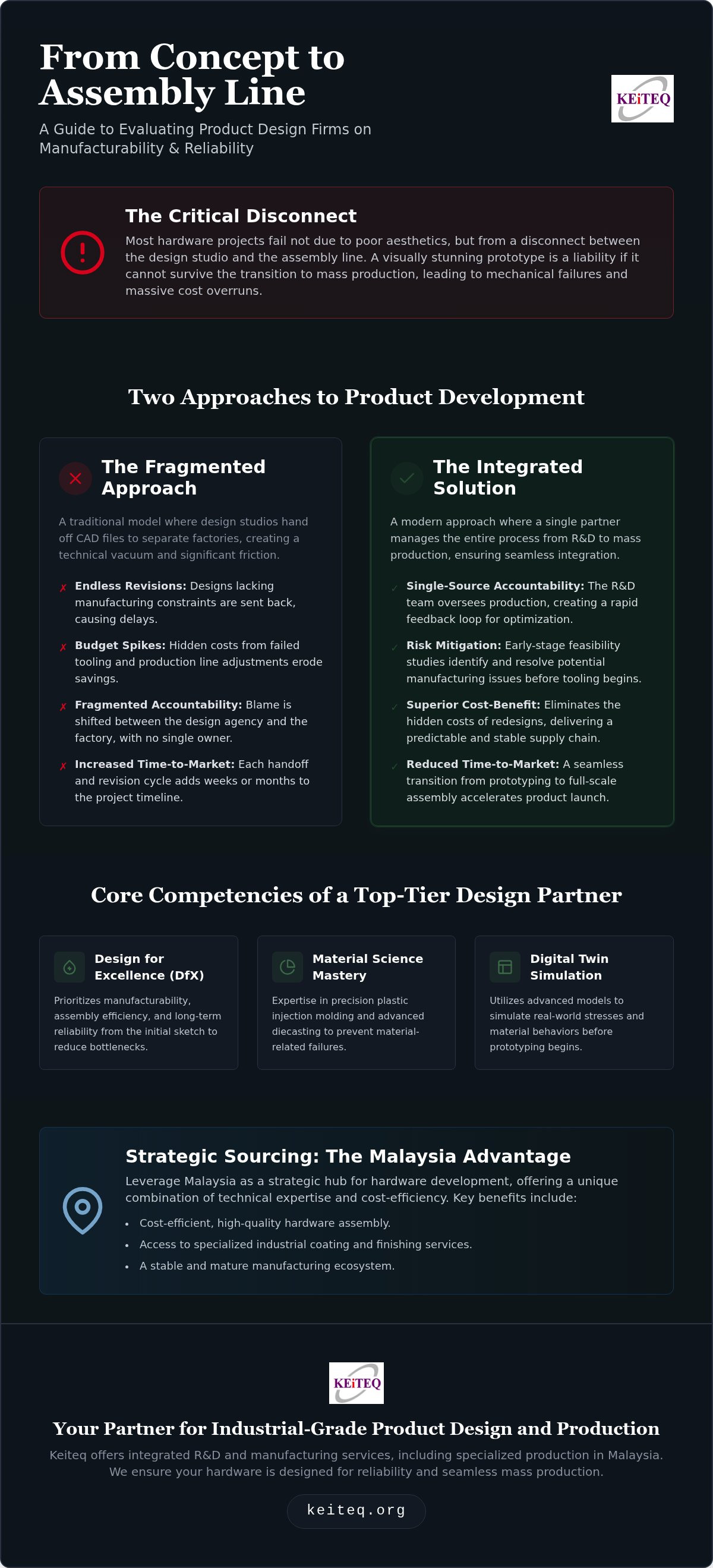
Top-tier firms now operate under the Design for Excellence (DfX) framework. This methodology prioritizes manufacturability, assembly efficiency, and long-term reliability from the earliest sketches. While creative consultancies often focus on emotional resonance and user experience, manufacturing-led firms prioritize mechanical tolerance and industrial durability. It's the difference between a product that looks good in a pitch and one that maintains structural integrity after thousands of cycles in the field.
The Evolution of Industrial Design Services
The industry has moved past 2D conceptualization toward production-ready digital twins. These advanced models allow engineers to simulate real-world stresses and material behaviors before physical prototyping begins. Technical foresight in material selection is critical; choosing the wrong polymer or alloy early can lead to catastrophic failures during mass production. Professional product design firms use these simulations to reduce late-stage engineering changes, which often account for the majority of budget overruns in complex hardware development.
Key Performance Indicators (KPIs) for Design Partners
When auditing a design partner, technical directors must look at specific metrics that impact the bottom line. Time-to-market is the most obvious indicator, but it must be balanced with prototyping accuracy. A firm that can move seamlessly from a digital concept to soft tooling demonstrates a deep understanding of the transition between design and the factory floor. This level of technical precision is a hallmark of Integrated Product R&D and Manufacturing, where design decisions are validated by production realities. Evaluation should also include the firm's ability to manage complex assemblies, such as outdoor payment terminals, where environmental sealing and tamper resistance are non-negotiable requirements. Precision in these areas ensures a predictable scaling process and reduces the risk of expensive recalls or field failures.
The Design-to-Production Gap: Why Integrated Firms Outperform Agencies
The traditional hand-off between a design studio and a factory often creates a technical vacuum known as the "Over-the-Wall" syndrome. In this fragmented model, designers deliver CAD files that lack deep consideration for the specific constraints of the assembly line. When these designs reach the factory gate, they're often sent back for extensive revisions, causing delays and budget spikes. Choosing product design firms that operate with integrated manufacturing capabilities eliminates this friction. Single-source accountability ensures that the team responsible for initial R&D also oversees the mass production management, creating a feedback loop that prioritizes stability.
An integrated approach offers a superior cost-benefit ratio compared to siloed processes. While a creative agency might charge less for the initial design phase, the hidden costs of redesigns, failed toolings, and production delays quickly erode those savings. By centralizing the transition from prototyping to full-scale assembly, technical directors maintain tighter control over quality and logistics. To discuss how integrated R&D can stabilize your supply chain, you can reach out to our technical team for a consultation.
Mitigating Production Risks in Hardware Development
Reliable hardware development depends on identifying un-manufacturable features before a single dollar is spent on tooling. Integrated firms conduct early-stage feasibility studies for both plastic molding and metal stamping components. This methodical approach includes several critical checkpoints:
Evaluating wall thickness and draft angles for plastic injection molding.
Assessing material deformation and stress points in metal stamping.
Validating assembly sequences to reduce labor hours on the factory floor.
Confirming the compatibility of industrial coatings with selected substrates.
These steps ensure that the final design isn't just a concept, but a blueprint for a scalable, high-yield product.
Case Study: The Complexity of Outdoor Hardware
Designing for harsh environments, such as outdoor payment terminals at petrol and gas stations, requires a level of engineering depth that creative agencies rarely possess. These units must integrate sensitive electronics within durable, weather-resistant mechanical enclosures. Success in this category depends on specialized assembly techniques and the application of industrial coatings like enamel or powder coating. A design partner must understand how these finishes interact with the substrate to prevent corrosion and ensure long-term industrial reliability in unattended settings. This specialized knowledge is what separates a veteran manufacturing partner from a generalist design studio.
Core Competencies of Top-Tier Product Design Agencies
Leading product design firms distinguish themselves through a deep mastery of material science and mechanical engineering. While generalist agencies often prioritize visual identity, industrial-grade partners focus on how a component performs under stress. This requires specialized expertise in aluminium and zinc diecasting for structural parts, alongside precision engineering for plastic injection molding. A firm's ability to navigate these technical disciplines determines the final product's durability and cost-efficiency.
High-strength hardware demands a sophisticated approach to metal stamping and diecasting. These processes aren't just about shaping metal; they're about managing thermal properties and structural integrity. A design that ignores the cooling rates of molten zinc or the spring-back effect in metal stamping will inevitably fail during mass production. Professional firms mitigate these risks by integrating engineering constraints into the initial CAD models. This ensures that every part is optimized for the specific manufacturing process it will undergo.
Material Selection and Tooling Strategy
The choice between aluminium and zinc diecasting often dictates the enclosure's weight and precision. Aluminium is the preferred choice for large, lightweight housings that require excellent heat dissipation. Zinc, however, allows for thinner walls and more complex geometries due to its lower melting point and higher fluidity. Top-tier product design firms use soft tooling prototyping to test these materials in real-world conditions. This step validates the mold design and ensures that the final hard tooling will produce high-yield, consistent parts over hundreds of thousands of cycles. It's a disciplined approach that prevents expensive tooling modifications later in the project lifecycle.
Surface Finishing as a Design Requirement
Surface finishing should never be treated as a cosmetic afterthought. In harsh environments, a coating is a functional barrier against corrosion and mechanical wear. Integrated firms design with specific finishes in mind, whether it's enamel, ceramic, or powder coating. This foresight ensures that the substrate is prepared correctly for maximum adhesion and coverage. In-house coating capabilities allow for tighter quality control and a more cohesive assembly process. When finishing is integrated into the design phase, the product achieves a level of industrial reliability that external paint shops cannot match. For a deeper technical analysis of these processes, refer to our Protective Coatings for Outdoor Electronics industrial reference guide.
Strategic Sourcing: The Malaysia Advantage for Product Design and Manufacturing
Selecting the optimal location for hardware development is as critical as the engineering itself. Malaysia has emerged as a primary destination for technical directors seeking product design firms that offer a balance of cost-efficiency and high-end technical precision. The country's established role in the global semiconductor supply chain provides a mature infrastructure for electronic manufacturing services in Malaysia. This ecosystem allows for rapid scaling from initial R&D to full-scale hardware deployment, supported by a workforce deeply familiar with international quality standards. The regional focus on industrial stability and intellectual property protection makes it a secure environment for developing proprietary hardware.
Unlike high-overhead hubs in the West, Malaysia offers significant logistical advantages without compromising on engineering depth. This strategic positioning ensures that procurement officers can manage complex global supply chains with reduced risk and predictable lead times. The synergy between design and production in this region eliminates the communication gaps that often derail complex hardware projects. If you're looking to optimize your production timeline and stabilize your costs, you can Request for Quotation to see how our regional expertise can support your next project.
Regional Expertise in Plastic and Metal Fabrication
The Malaysian manufacturing sector is built on specialized clusters for plastic and metal fabrication. When evaluating plastic injection mold manufacturers in Malaysia, OEMs benefit from a competitive landscape that prioritizes precision and durability. This regional expertise extends to metal stamping and diecasting, where local facilities handle high-strength parts with tight tolerances. Sourcing these services within a single geographic hub reduces shipping times and simplifies quality control. It facilitates a seamless transition from small-batch prototyping to global distribution, ensuring that the design intent is maintained at every scale. Product design firms operating in this environment have direct access to the factory floor, allowing for real-time adjustments that protect the project's bottom line.
Logistics and Quality Standards in Malaysia
Industrial reliability is anchored in strict adherence to international certifications. Malaysian facilities consistently meet ISO standards, providing the procedural accuracy required for medical, automotive, and industrial hardware. Proximity to major shipping lanes in the ASEAN region further enhances its appeal as a global OEM distribution point. This logistical competence, combined with a "Safe Pair of Hands" approach to production management, positions Malaysia as a dependable pillar for international brands. The region's infrastructure is designed to handle the complexities of global trade, from customs navigation to secure warehousing, ensuring that finished products reach their destination without unnecessary delays.
Keiteq: Your Partner for Industrial-Grade Product Design and Production
Keiteq Co Ltd operates at the intersection of technical R&D and large-scale industrial assembly. Unlike product design firms that focus on consumer aesthetics or digital interfaces, we specialize in the structural and mechanical realities of heavy-duty hardware. Our philosophy centers on the belief that a design is only successful if it can be manufactured with high yields and sustained industrial reliability. This end-to-end approach allows us to manage every variable from initial material selection to the final application of protective coatings. By maintaining strict control over the entire development cycle, Keiteq Co Ltd provides a stable foundation for global OEMs looking to deploy complex hardware in demanding environments.
Specialization in outdoor payment terminals for fuel retail requires a deep understanding of environmental sealing and tamper resistance. We don't just design enclosures; we engineer systems that withstand extreme weather and high-traffic use. Our expertise in metal stamping and diecasting ensures that every structural component meets rigorous durability standards. This technical depth is combined with a methodical transition process that moves projects from soft tooling prototypes to full mass production management without the typical friction found in siloed agencies.
Why Global OEMs Choose Keiteq Co Ltd
The primary advantage of partnering with Keiteq Co Ltd is our integrated finishing capability. We treat enamel, ceramic, and powder coating as critical engineering requirements rather than cosmetic additions. This ensures that our outdoor hardware maintains its integrity over years of service in harsh environments. Our proven track record in payment terminal assembly for petrol and gas stations demonstrates our ability to handle the complex integration of sensitive electronics with rugged mechanical housings. We provide the technical foresight needed to identify production risks early, ensuring a predictable path to market for even the most complex hardware projects.
Next Steps for Your Hardware Project
Managing the lifecycle of an industrial product requires more than just engineering talent; it requires logistical competence and a deep familiarity with the factory floor. Keiteq Co Ltd serves as a steady partner throughout the design, prototyping, and assembly phases. We prioritize functional trust and consistency, acting as a "Safe Pair of Hands" for companies that cannot afford production delays or mechanical failures. Our operations in Malaysia provide a strategic gateway for global distribution, offering the precision and scale necessary for international success.
If you're ready to move your hardware project from concept to a manufacturable reality, we invite you to engage with our technical directors. Contact us today to discuss your specific R&D and production requirements. For professional manufacturing services and assembly in Malaysia, please Request for Quotation or send a Request to contact us for further details.
Securing Your Industrial Production for 2026 and Beyond
Success in complex hardware development requires a disciplined transition from digital concept to physical assembly. The most effective product design firms in 2026 are those that operate with a deep understanding of the factory floor, ensuring every component is optimized for high-yield manufacturing. By prioritizing integrated R&D and specialized industrial finishes, technical directors can eliminate costly production delays and ensure long-term structural integrity in harsh environments. This methodical approach transforms a conceptual prototype into a reliable, scalable asset.
Malaysia offers a unique strategic advantage, combining technical precision with global logistical competence. For expert industrial design and manufacturing solutions in Malaysia, we invite you to take the next step in stabilizing your supply chain. Our team provides specialized expertise in enamel, ceramic, and powder coating, alongside proven outdoor payment terminal assembly and end-to-end mass production management. To explore how we can support your specific requirements, please Request for Quotation or submit a Request to contact us for further details. We look forward to helping you deliver reliable, high-performance hardware to the global market.
Frequently Asked Questions
What is the difference between a product design firm and a manufacturing partner?
A product design firm focuses on R&D and conceptualization, while a manufacturing partner executes the physical production at scale. Integrated firms combine these roles to ensure design intent aligns with factory capabilities from the start. This synergy eliminates the technical vacuum often found during hand-offs. Choosing integrated product design firms reduces the risk of designs being un-manufacturable when they reach the assembly line.
How do product design firms handle the transition to mass production?
Transition management involves moving from digital twins to soft tooling and prototyping for validation. Integrated firms use soft tooling to identify mechanical stress points and material behavior before investing in expensive hard tooling. This methodical approach includes mass production management to oversee quality control and assembly sequences. It ensures that the final design is a validated blueprint for high-yield production rather than just a visual concept.
Why is manufacturability (DfM) critical in the design phase?
Design for Manufacturability (DfM) minimizes production costs and prevents mechanical failures by addressing assembly constraints early. It involves optimizing wall thickness for plastic molding and managing thermal properties in diecasting. Without DfM, projects often face expensive redesigns and tooling modifications during the mass production phase. Prioritizing DfM ensures that the hardware is scalable and maintains industrial reliability throughout its entire product lifecycle.
What are the benefits of sourcing product design services in Malaysia?
Malaysia offers a mature infrastructure for electronic manufacturing services and high-precision fabrication. Sourcing here provides cost-efficiency without compromising the technical precision required for complex hardware. The region's expertise in plastic injection molding and metal stamping allows for seamless scaling from prototyping to global distribution. Strategic proximity to major shipping lanes and strict adherence to ISO quality standards make Malaysia a dependable hub for global OEMs.
How much does it cost to hire a product design agency for complex hardware?
Pricing for industrial product design depends on the project's technical complexity and the scope of R&D required. Factors such as material selection, mechanical tolerance requirements, and the need for specialized industrial coatings influence the final investment. While some industry professionals report that integrated firms offer better long-term value by reducing redesign costs, specific project fees vary based on engineering hours and tooling requirements. Procurement officers should request detailed quotations.
What specialized finishes are necessary for outdoor electronic hardware?
Outdoor hardware requires functional barriers such as enamel, ceramic, or powder coating to prevent corrosion and wear. These finishes are essential for units like payment terminals located at petrol or gas stations where environmental exposure is constant. Enamel coating provides high durability and chemical resistance, while ceramic coatings offer superior protection against mechanical abrasion. Integrated firms design these finishes into the substrate preparation phase to ensure maximum adhesion.
How long does the R&D process typically take for industrial components?
The R&D timeline varies based on the complexity of the assembly and the material science involved. A typical cycle moves from initial conceptualization and digital simulation to soft tooling and functional prototyping. While simpler components might move through these phases in a few months, complex hardware requiring specialized assembly and environmental testing can take longer. A methodical approach ensures that the design is fully validated before mass production begins.
Can a product design firm help with intellectual property protection?
Professional product design firms implement strict protocols to safeguard proprietary designs and technical innovations. This includes secure data management, non-disclosure agreements, and operating within legal frameworks like Malaysia's established IP protection laws. By maintaining single-source accountability from R&D to production, firms reduce the risk of intellectual property leakage during hand-offs. This disciplined approach ensures that your hardware innovations remain secure throughout the entire development lifecycle.


Comments