
Scale Fast: High-Volume Injection Molding Factory Malaysia
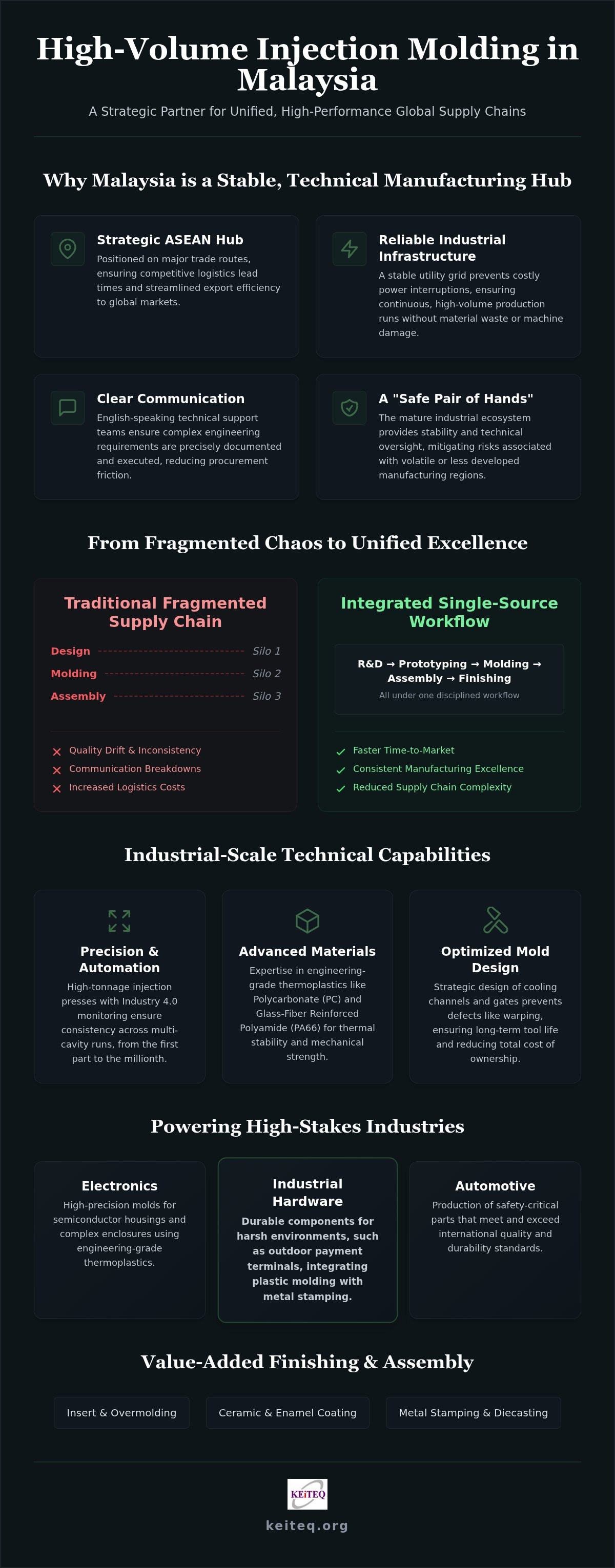
Scaling a hardware product shouldn't mean sacrificing technical oversight for the sake of lower unit costs. You've likely felt the strain of managing fragmented supply chains where design, molding, and assembly happen in silos. It's a complex process that frequently results in quality drift and communication breakdowns. Partnering with a high-volume injection molding factory Malaysia offers a strategic alternative by unifying your production cycle under a single, disciplined workflow.
This article explains how to leverage Malaysia’s advanced infrastructure and integrated R&D to stabilize your global supply chain. We'll examine the benefits of a single-source provider for plastic and metal components, specifically for complex projects like outdoor payment terminal assembly. You'll discover how specialized finishing services, such as ceramic and enamel coating, provide the durability your hardware requires while reducing logistics costs for the ASEAN market. By the end, you'll see why a "safe pair of hands" in the region is the key to faster time-to-market and consistent manufacturing excellence.
Table of Contents
The Landscape of High-Volume Injection Molding in Malaysia
High-volume production in the 2026 industrial context is defined by automated, multi-cavity processes that achieve zero-defect tolerance at scale. It's no longer enough to simply produce parts; factories must integrate real-time quality monitoring and advanced material science. A high‑volume injection molding factory Malaysia provides the technical infrastructure required for these demanding standards. Global OEMs are increasingly moving away from traditional manufacturing hubs due to supply chain volatility. They're seeking the stability and technical maturity that the Malaysian ecosystem offers. This shift is driven by the need for a reliable partner that can manage complex requirements without the risks found in less developed regions.
Malaysia as a Strategic ASEAN Manufacturing Hub
Malaysia's location along the world's busiest trade routes ensures that logistics lead times remain competitive. In 2026, regional trade agreements have further enhanced export efficiency, providing manufacturers with a streamlined path to global markets. The reliability of the Malaysian industrial utility grid is a significant advantage. Unlike emerging manufacturing zones that suffer from frequent power interruptions, Malaysia offers a stable environment for continuous high-volume runs. This stability prevents the material waste and machine damage associated with sudden downtime. Communication is also a primary driver of efficiency. English-speaking technical support teams reduce procurement friction by ensuring that complex engineering requirements are documented and executed with precision. This clarity is essential for maintaining the "safe pair of hands" methodology that global brands expect.
Core Sectors Served by Malaysian Factories
The technical capabilities of Malaysian factories support several high-stakes industries. In the electronics sector, there's a heavy focus on semiconductor housings and complex enclosures. These components require engineering-grade thermoplastics and high-precision molds to ensure proper fit and function. The automotive industry also relies on these facilities for safety-critical parts that must meet international quality standards. For industrial hardware, the demand is for components that can survive harsh environments. A prime example is the production of outdoor payment terminals for gas stations. These projects often require the integration of plastic injection molding with metal stamping and diecasting. By consolidating these services, manufacturers reduce the complexity of their supply chains and ensure that every component is designed for physical durability and procedural accuracy.
Technical Capabilities for Industrial-Scale Molding
High-volume production requires more than just high-tonnage machines; it demands a synergy of precision press technology and robust mold design. A high‑volume injection molding factory Malaysia utilizes advanced injection presses capable of maintaining consistent pressure and temperature across multi-cavity runs. This consistency is vital for minimizing cycle times while ensuring that the millionth part is identical to the first. Modern facilities integrate Industry 4.0 sensors to monitor these variables in real-time, allowing for immediate adjustments that prevent batch-wide defects. High-tonnage machines and automated material handling systems allow for continuous operation, which is critical for meeting the aggressive timelines of global OEMs.
Material selection defines the physical durability of the final product. While standard resins like Polypropylene (PP) are suitable for simple consumer goods, industrial hardware often requires engineering-grade thermoplastics such as Polycarbonate (PC), PBT, or Glass-Fiber Reinforced Polyamide (PA66). These materials offer the thermal stability and mechanical strength needed for demanding environments. Effective mold and die design is the foundation of this process. By optimizing cooling channels and gate placement, engineers ensure long-term tool life and prevent common defects like warping or sink marks. This technical foresight reduces the total cost of ownership by extending the interval between tool maintenance cycles.
Specialized Molding Techniques for Complex Parts
Complex geometries often require specialized processes to achieve functional requirements. Insert molding and overmolding are essential for creating integrated components, such as electronic housings with embedded metal connectors or soft-touch grips. Choosing between vertical and horizontal molding depends on the part's geometry and the level of automation required for insert placement. Gas-assisted injection molding is another strategic choice for structural parts. It reduces weight and improves integrity by creating hollow sections within the part, which also helps eliminate sink marks in thicker wall sections. These techniques allow for the consolidation of multiple parts into a single component, reducing assembly time and potential failure points.
Quality Assurance and Compliance Standards
Maintaining quality at scale requires rigorous compliance and procedural accuracy. ISO certification ensures that the factory follows international standards for management and production. In-process monitoring systems track variables like injection pressure and melt temperature for every cycle. First-article inspection (FAI) protocols are strictly followed before mass production begins to validate tool accuracy against the original CAD specifications. For critical industrial components, traceability systems record every batch of raw material used and the specific production conditions of each run. This level of discipline provides the "safe pair of hands" that technical directors require for global compliance. If your project demands this level of technical rigor, you can contact us for more information about our specific machine capabilities and quality protocols.
Malaysia vs. Global Alternatives: Cost, Quality, and Logistics
Selecting a manufacturing partner requires a shift in focus from simple unit prices to a comprehensive Total Cost of Ownership (TCO) analysis. While some regional competitors might offer lower initial tooling quotes, a high‑volume injection molding factory Malaysia provides long-term financial advantages that often outweigh these upfront differences. In the 2026 industrial landscape, the "China Plus One" strategy has evolved from a trend into a requirement for supply chain resilience. By diversifying production to Malaysia, global OEMs mitigate the risks associated with trade volatility and geopolitical instability. This move provides access to a mature legal framework that prioritizes intellectual property protection and contract enforcement, ensuring your proprietary designs remain secure.
Tooling investment in Malaysia should be evaluated based on lifecycle durability rather than just initial CAPEX. High-quality molds engineered here are designed to withstand millions of cycles with minimal maintenance, preventing the costly downtime often associated with lower-grade tools. This reliability is essential for high-volume runs where even a single day of stopped production can disrupt global distribution schedules. The combination of technical precision and legal security positions Malaysia as a "safe pair of hands" for complex industrial hardware.
Logistics and Supply Chain Resilience
Malaysia's geographic position offers direct shipping advantages to both US and European markets, bypassing the congestion often found in other major manufacturing hubs. Localized production within the ASEAN region also allows companies to reduce their carbon footprint by shortening the distance between raw material sourcing and final assembly. Modern facilities provide integrated inventory management and warehousing solutions, allowing for flexible buffer stock strategies. For manufacturers requiring specialized materials and shipping solutions to secure high-value components during global transit, oemmaterials.com provides essential support. These logistics advantages ensure that your supply chain remains agile and capable of responding to market shifts without excessive freight costs.
Technical misunderstandings frequently lead to production delays and quality drift. Working with English-native engineering teams in Malaysia eliminates the communication barriers that plague many international projects. This clarity is vital when managing the transition from prototyping to full-scale mass production. Real-time project management and transparent reporting standards allow technical directors to maintain oversight without being physically present on the factory floor. This level of collaboration ensures that every technical requirement is understood and executed with procedural accuracy from the start of the project.
Integrating R&D and Specialized Assembly for Turnkey Success
The transition from initial design to full-scale manufacturing is where many hardware projects stall. This "valley of death" often occurs when technical requirements are lost between separate design houses and manufacturing plants. Integrating R&D and design within a high‑volume injection molding factory Malaysia ensures that manufacturing constraints are addressed from the start. You don't want to risk technical drift during the hand-off between vendors. Utilizing soft tooling prototyping allows for market validation with production-grade materials before committing to hard tooling. It's a strategic approach that reduces the risk of expensive design changes during mass production.
Turnkey success depends on the synergy between manufacturing disciplines. Combining plastic molding with metal stamping and diecasting in a single facility simplifies the assembly of complex sub-systems. This integration is vital for outdoor payment terminals and fuel retail hardware where different materials must interface perfectly. Managing these processes under one roof eliminates the need to move parts between multiple vendors. It keeps tolerances tight and logistics simple.
Advanced Finishing for Harsh Environments
Industrial hardware needs protection that goes beyond standard aesthetics. Specialized finishing services like enamel and ceramic coating provide the durability and heat resistance required for components exposed to extreme weather. These coatings are essential for the longevity of outdoor electronics. Precision molding and careful assembly help achieve IP-rated seals, which protect internal circuitry from dust and water. Industrial powder coating services add another layer of corrosion resistance for metal enclosures used in harsh environments.
Case Study: Outdoor Payment Terminal Engineering
Engineering hardware for petrol stations requires managing significant technical complexity. These units integrate rugged metal enclosures with high-precision plastic components for card readers and user interfaces. The design must resist constant UV exposure, moisture, and chemical contact from fuel vapors. Using a single partner for both plastic injection molding and final OEM assembly ensures that every seal and joint meets durability standards. This holistic oversight is what a global facilitator provides to ensure procedural accuracy across the entire build.
To discuss your specific project requirements, contact us for further details regarding our integrated R&D and assembly services in Malaysia.
Partnering with Keiteq Co Ltd for High-Volume Production in Malaysia
Keiteq Co Ltd functions as a Global Facilitator for OEMs, providing the technical precision and operational stability required for industrial scale. Managing high-volume production across borders is a logistical challenge that demands an experienced partner. By utilizing a high‑volume injection molding factory Malaysia, you gain a "safe pair of hands" capable of navigating the intricacies of the factory floor and the requirements of the boardroom alike. Our single-source approach consolidates plastic molding, metal stamping, and specialized assembly into a unified workflow. This integration reduces administrative overhead and prevents the quality drift that often occurs when parts move between multiple vendors. We ensure that every component meets the rigorous standards of your global supply chain through disciplined mass production management.
Strategic Product Development and Design
Operational efficiency begins long before the first injection cycle. The engineering teams at Keiteq Co Ltd provide collaborative Design for Manufacturability (DFM) services to optimize part geometry. We focus on reducing unit costs through gate placement optimization and cycle time reduction. This proactive approach identifies potential production bottlenecks early, ensuring that your hardware is ready for mass production without costly redesigns. To accelerate your 2026 product launch, we offer prototyping and soft tooling services that provide market-ready parts for validation. This seamless transition is further detailed in our guide on Integrated Product R&D and Manufacturing. This resource outlines the strategic advantages of early-stage technical collaboration for global OEMs seeking to minimize time-to-market.
Scale Your Production with Keiteq Co Ltd Malaysia
Keiteq Co Ltd provides the high-volume capacity required for complex industrial and consumer goods. Our facilities are engineered for scale, utilizing automated systems to maintain procedural accuracy throughout million-unit runs. By leveraging our plastic injection molding services in Malaysia, global brands secure a reliable pillar within their manufacturing ecosystem. We provide the stability needed to serve the ASEAN market and beyond. This regional presence ensures that logistics costs remain low while quality remains high. Our end-to-end management covers everything from initial R&D to final mass production. This holistic oversight is what allows us to serve as a dependable partner for the world's leading hardware companies.
To begin your technical briefing, please submit a Request for Quotation with your project specifications. For more information on how our manufacturing infrastructure in Malaysia can support your regional strategy, we invite you to Request to contact us for further details regarding our regional offerings.
Future-Proof Your Production with Malaysian Manufacturing Excellence
Scaling hardware requires more than just capacity; it demands a partner that can manage technical complexity from design through to final assembly. We've explored how Malaysia's mature infrastructure and strategic ASEAN location provide a stable foundation for global OEMs. By integrating R&D with mass production management, you eliminate the risks associated with fragmented supply chains. Our specialization in outdoor payment terminal assembly and expertise in enamel and ceramic protective coatings ensures that your hardware withstands the most demanding environments.
Choosing a high‑volume injection molding factory Malaysia allows you to leverage a unified workflow that includes plastic molding, metal stamping, and specialized finishing. This single-source approach reduces overhead and maintains procedural accuracy at scale. It's about providing a safe pair of hands that understands the nuances of industrial-grade durability and logistical competence. We're ready to help you navigate the intricacies of international production with ease.
Ready to scale? Request for Quotation or Request to contact us for further details regarding our high-volume injection molding services in Malaysia. We look forward to supporting your next technical briefing.
Frequently Asked Questions
What are the typical lead times for high-volume injection molding in Malaysia?
Lead times for a high‑volume injection molding factory Malaysia depend on the complexity of the tooling and material specifications. Generally, the mold fabrication phase requires several weeks, followed by a validation period for first-article inspection. Once mass production management begins, cycle times are optimized for continuous output. We coordinate these timelines during the initial technical briefing to ensure your global distribution schedules stay on track without unnecessary delays.
How does Malaysia’s IP protection compare to other Asian manufacturing hubs?
Malaysia provides a robust legal framework for intellectual property protection based on international standards. This legal stability is a primary reason why global OEMs choose the region for sensitive hardware projects. Contracts are enforceable through an established common law system, offering greater security for proprietary designs than many emerging manufacturing hubs. This procedural accuracy ensures your R&D investments remain protected throughout the entire production lifecycle.
Can Keiteq Co Ltd handle both plastic molding and metal stamping for the same project?
Keiteq Co Ltd specializes in the simultaneous management of plastic injection molding and metal stamping for complex assemblies. This integrated approach is a core differentiator, allowing for tighter tolerances between different material components. By consolidating these services, we eliminate the need for multiple vendors and reduce the risk of assembly errors. It's an efficient way to manage the production of integrated hardware like outdoor payment terminals for gas stations.
What industries benefit most from high-volume production in Malaysia?
The electronics, automotive, and industrial hardware sectors benefit most from Malaysia's technical infrastructure. These industries require high-precision components that can withstand rigorous use and harsh environments. Specifically, the fuel retail sector relies on Malaysian factories for the assembly of outdoor payment terminals that must resist moisture and chemical exposure. The region's ability to handle engineering-grade thermoplastics makes it ideal for safety-critical and high-durability applications.
What certifications should I look for in a Malaysian injection molding factory?
You should look for ISO 9001 certification to ensure consistent quality management and procedural accuracy. For automotive components, IATF 16949 is the industry standard for supply chain excellence. Environmental compliance through ISO 14001 is also important for global procurement officers. These certifications serve as a benchmark for a factory's ability to maintain the "safe pair of hands" methodology required for high-volume international exports and global compliance standards.
Is it possible to scale from a prototype to 100,000+ units with one partner?
Scaling from a single prototype to 100,000 units is possible through the integrated R&D and mass production management services at Keiteq Co Ltd. We utilize soft tooling for initial market validation before transitioning to high-durability hard molds for the mass production phase. This continuity prevents the technical drift that occurs when requirements are lost between different vendors. It ensures the final high-volume run maintains the exact specifications of your approved design.
How do enamel and ceramic coatings improve outdoor terminal longevity?
Enamel and ceramic coatings provide a superior barrier against UV radiation, moisture, and chemical corrosion. These specialized finishes are essential for the longevity of outdoor payment terminals used at petrol stations. Unlike standard paints, these coatings offer extreme heat resistance and physical durability. They ensure the hardware remains functional and aesthetically professional even after years of exposure to harsh outdoor conditions, fluctuating temperatures, and corrosive fuel vapors.
What are the logistics advantages of sourcing from Malaysia for the US market?
Malaysia offers significant logistics advantages for the US market, including direct shipping routes that bypass congested regional transshipment hubs. In 2026, the logistics cost advantages for ASEAN markets remain a key factor in reducing the total cost of ownership. The country's stable infrastructure and efficient port operations ensure high-volume shipments arrive on schedule. This reliability helps global OEMs maintain lean inventory strategies while diversifying their manufacturing footprint away from volatile regions.


Comments