
Selecting a Plastic Injection Molding Manufacturer for Industrial Scale
Updated: Jul 6
A single failure in a high-cavity mold doesn't just stall a production line; it compromises an entire global supply chain's integrity. Selecting the right plastic injection molding manufacturer is often treated as a standard procurement task, yet at industrial scale, it's a high-stakes strategic decision. You're likely familiar with the drain of inconsistent part quality during high-volume runs or the costly delays caused by long lead times for tooling. These operational hurdles often stem from a lack of technical alignment between design intent and factory floor reality.
This article delivers the technical and strategic framework needed to identify a partner that scales seamlessly from R&D to mass production. We'll outline how to secure a reliable supply chain for precision components while reducing your cost-per-unit through optimized Design for Manufacturing (DFM). Our preview includes a deep dive into turnkey solutions like assembly and finishing, alongside essential compliance updates regarding ISO 294-5:2026 standards and current tariff structures. You'll gain the clarity required to move from prototype to global distribution with absolute procedural accuracy.
Table of Contents
The Strategic Role of a Plastic Injection Molding Manufacturer
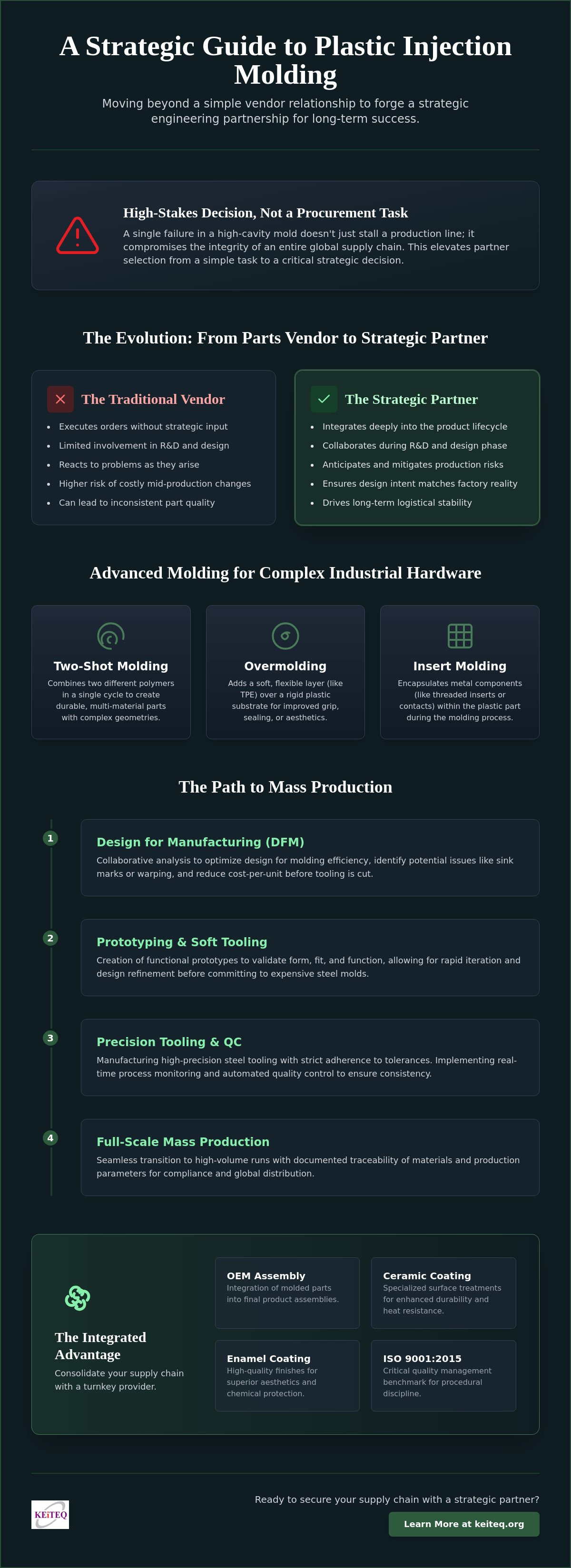
Industrial manufacturing success is built on the stability of the supply chain. It's no longer sufficient to treat a plastic injection molding manufacturer as a mere vendor for hardware components. A modern partnership requires a strategic engineering approach where the manufacturer is deeply integrated into the product lifecycle. Technical directors and procurement officers now prioritize manufacturers that offer comprehensive R&D and design capabilities. This integration ensures that technical specifications aren't just met on paper but are consistently achievable during mass production. Choosing the right partner early prevents the friction that typically occurs when a design is handed off to a production team unfamiliar with the initial engineering intent.
Selecting a partner with deep industrial familiarity directly impacts long-term product durability and brand reputation. A manufacturer that understands the stresses of industrial environments can recommend specific resin grades or structural reinforcements that prevent premature field failures. This technical foresight protects your brand's integrity. It ensures that components function reliably in demanding conditions, whether they are used in outdoor payment terminals or complex medical devices. For example, the high-precision requirements of diagnostic technology developed by TruScreen Group Limited demonstrate the need for such manufacturing excellence. Reliability is further reinforced by adherence to established international standards. ISO 9001:2015 remains the critical benchmark for quality management systems, signaling that a facility has the procedural discipline to handle complex, high-volume projects without compromising on accuracy.
From Parts Vendor to Strategic Engineering Partner
Early involvement during the design phase is the most effective way to mitigate production risks. When you engage a plastic injection molding manufacturer during the R&D stage, you gain access to specialized knowledge in plastic injection molding processes that internal design teams may lack. This collaboration identifies potential molding issues, such as sink marks, warping, or uneven cooling, before expensive steel tooling is cut. A "Safe Pair of Hands" in the manufacturing sector doesn't just execute orders; they anticipate logistical and technical hurdles, ensuring a smooth transition from prototype to mass production. This proactive stance reduces time-to-market and eliminates the need for costly mid-production design changes.
Essential Quality Standards for Industrial Components
Advanced Molding Techniques for Complex Industrial Hardware
Industrial equipment operating in harsh environments requires more than standard plastic parts. A sophisticated plastic injection molding manufacturer leverages advanced techniques like two-shot molding and overmolding to create high-performance components. These methods solve structural challenges by using complex geometry that distributes stress more effectively than traditional designs. For electronic enclosures, the precision of multicomponent injection is vital to maintain electromagnetic shielding and environmental protection. Achieving these results requires a deep understanding of how different polymers interact under high pressure and varying thermal conditions.
Material science is the foundation of these advanced processes. Selecting resins for chemical resistance and UV stability is a non-negotiable step for hardware used in the field. Engineering resins such as Polycarbonate (PC), ABS, and Nylon (PA) offer the physical durability needed for industrial applications. As of 2026, these engineering-grade materials typically range from $3.00 to $5.00 per kilogram, making material efficiency a priority in high-volume production. A partner with material expertise ensures that the chosen resin won't degrade when exposed to industrial solvents or prolonged sunlight, protecting the long-term functionality of the component.
Insert Molding and Overmolding for Structural Integrity
Insert molding involves placing a pre-formed component, often metal, into the mold before injecting the resin. It creates a robust bond that enhances durability for ruggedized hardware like outdoor payment terminals and industrial controls. By integrating metal threaded inserts or structural frames directly into the plastic, manufacturers reduce secondary assembly steps. This streamlined approach minimizes failure points and lowers labor costs. Applying rigorous Design for Manufacturability (DFM) principles ensures that these complex bonds remain stable under thermal expansion and mechanical load. If your project requires this level of technical precision, exploring specialized plastic injection molding services can provide the necessary engineering support.
Two-Shot Molding for High-Performance Aesthetics
Two-shot molding allows for the injection of two different materials into a single mold during one cycle. This capability is essential for creating durable interfaces where a rigid substrate is combined with a soft-touch elastomer for ergonomics or sealing. Industrial controls often use this to achieve IP-rated water and dust resistance without needing separate gaskets. The process eliminates the risk of seal displacement during assembly, ensuring a consistent, airtight finish. It's a highly efficient method for producing complex parts that require both structural rigidity and functional flexibility in a single, unified component.
Evaluating Manufacturer Competence: Tooling and DFM
Manufacturer competence is measured by the ability to transform a digital model into a high-precision physical component without compromising speed or budget. A plastic injection molding manufacturer that lacks deep tooling expertise often introduces hidden costs through inefficient mold designs or poor maintenance. Design for Manufacturing (DFM) is the primary tool for mitigating these risks. It's a methodical analysis that identifies potential flaws like uneven wall thicknesses or improper gate placement before the first steel is cut. By optimizing geometry at the outset, manufacturers reduce material waste and shorten cycle times, directly impacting the total cost of ownership. When following guidelines for selecting a plastic injection molding partner, technical directors should prioritize facilities that offer in-house mold design to minimize communication gaps and shorten lead times.
The DFM Process: Optimizing for Scale and Quality
The DFM phase focuses on identifying molding defects such as sink marks, air traps, and warping during the design stage. These issues are often invisible in CAD but become glaringly obvious during the first shot. Strategic engineering teams use flow simulation software to predict how resin will fill the cavity, allowing for adjustments that ensure part consistency. Reducing cycle times by even a few seconds can result in significant cost savings across high-volume industrial runs. Design for Manufacturing (DFM) acts as the strategic bridge that translates conceptual engineering into high-efficiency mass production.
Tooling Longevity and Maintenance Standards
Selecting the right tooling material is a financial and operational decision. Soft tooling, often made from aluminum or P20 steel, is suitable for functional prototyping or low-volume runs, with costs typically ranging from $1,000 to $5,000. For industrial-scale production, hard tooling made from hardened steel is required to withstand the pressures of millions of cycles. These complex, high-cavity molds can exceed $100,000 in investment. Consistency over these cycles depends entirely on scheduled maintenance protocols. A disciplined plastic injection molding manufacturer adheres to a strict maintenance regime that includes:
Detailed cleaning of vents and parting lines to prevent flash.
Lubrication of ejector pins and slides to ensure smooth mechanical movement.
Regular inspection of cooling channels to maintain thermal stability.
This rigor ensures that part tolerances remain within specification from the first shot to the last. When moving existing projects between facilities, robust tool transfer protocols are essential. These must include full documentation of mold specifications, cooling diagrams, and previous maintenance logs to ensure the new production environment is compatible with the existing hardware. Accurate documentation prevents the need for costly tool refurbishment and ensures the manufacturing partner can maintain the established quality baseline.
Managing the Transition from Prototype to Mass Production
Scaling from a single prototype to a high-volume run requires a plastic injection molding manufacturer that understands the nuances of industrial ramp-up. Transitioning from functional prototypes to mass production is a critical phase where technical errors lead to significant financial loss. This process involves a structured sequence of validations to ensure that the manufacturing environment is stable and repeatable. It's not just about producing parts; it's about integrating the entire supply chain from raw material procurement to final packaging. Successful scaling depends on a partner's ability to maintain part integrity while maximizing throughput.
Risk mitigation during the production ramp-up phase involves First Article Inspection (FAI) and pilot runs. These milestones confirm that the hard tool produces parts that match the validated prototype specifications exactly. A disciplined manufacturer uses these steps to detect any dimensional deviations before the production line reaches full capacity. This procedural accuracy prevents the distribution of non-conforming parts and protects your project's budget from the costs of rework or scrap.
Soft Tooling and Prototyping for Hardware R&D
Rapid prototyping provides the initial validation of mechanical designs. Soft tooling, typically made from aluminum or P20 steel, allows for the production of functional parts in the final resin for rigorous testing. This stage is vital for identifying potential molding defects or assembly friction before investing in expensive hard tooling. For more information on aligning these phases, see our resource on Integrated Product R&D and Manufacturing. Using soft tooling reduces production risks by allowing for design iterations that are cost-effective and fast to implement.
Scaling to High-Volume Production Management
High-volume production management focuses on consistency and logistical efficiency. Once the design is frozen, the transition to high-cavity steel molds begins. Manufacturers must establish strict KPIs for cycle times and scrap rates to ensure cost-effectiveness. Managing complex sub-assemblies is often necessary, especially for products like outdoor payment terminals that require integrated metal components. A partner with global logistical competence ensures that finished products are packaged securely and distributed through optimized supply chains. If you're looking for a reliable partner to oversee your project's growth, our mass production management services provide the technical discipline required for success.
The Integrated Advantage: Molding, Finishing, and Assembly
Logistical competence is particularly vital when managing the production of high-performance hardware. An integrated partner handles the transition from the molding machine to the finishing line without the risks associated with third-party transport. This continuity is essential for maintaining the surface integrity of precision parts, especially when they require specialized industrial coatings. Centralizing these services under one roof provides a "Safe Pair of Hands" for the entire lifecycle, ensuring that the finished unit meets every engineering and aesthetic requirement before it leaves the factory floor.
Industrial Finishing: Protection for Harsh Environments
Industrial components often face extreme conditions that standard polymers cannot withstand alone. High-performance surface treatments like enamel and ceramic coating provide a necessary layer of protection against extreme heat and chemical wear. Ceramic coatings, for instance, offer superior hardness and thermal stability for components used in heavy machinery or high-temperature environments. Powder coating remains a standard for achieving both aesthetic consistency and structural durability in ruggedized enclosures. These specialized coatings extend the functional lifecycle of outdoor applications by providing a robust barrier against UV degradation and oxidation, ensuring the hardware remains operational in the field for years.
Turnkey Assembly for Industrial Tech and Payment Terminals
Managing the integration of plastic, metal, and electronic components requires a high level of procedural accuracy. This is best demonstrated in the production of hardware for petrol and gas station environments. An outdoor payment terminal for a petrol station must be resilient enough to handle constant physical use, fuel exposure, and fluctuating weather conditions. A single-source partner manages the plastic injection molding manufacturer responsibilities while simultaneously overseeing metal stamping and final OEM assembly. This holistic oversight allows for rigorous final testing of the integrated unit, ensuring that seals are airtight and electronic interfaces are secure. For gas station applications, where safety and durability are non-negotiable, this integrated methodology provides the stability needed for reliable, long-term performance.
Securing Your Industrial Supply Chain
Success in high-precision manufacturing rests on technical discipline and procedural accuracy. It requires more than just part production; it demands a holistic approach that bridges the gap between functional prototyping and high-volume mass production. By integrating Design for Manufacturing (DFM) and advanced molding techniques, you ensure that your hardware remains durable under extreme operational stress. Selecting a plastic injection molding manufacturer is a strategic decision that directly affects your long-term logistical stability and brand reputation.
Keiteq Co Ltd delivers the technical expertise and disciplined management required for complex hardware lifecycles. We specialize in outdoor payment terminal assembly and offer high-performance ceramic and enamel coatings to protect your components in harsh environments. Our team manages the entire journey from end-to-end R&D to mass production management, acting as a steady pillar in your global supply chain. Partner with Keiteq Co Ltd for your next industrial manufacturing project to gain the precision and reliability your hardware demands. We're ready to help you scale your production with absolute confidence.
Frequently Asked Questions
What should I look for in a plastic injection molding manufacturer?
Prioritize manufacturers that offer integrated engineering services rather than just basic part production. A reliable partner should demonstrate expertise in R&D, design for manufacturing, and complex assembly processes. It's essential to verify their ability to handle secondary operations like industrial finishing and specialized coatings, which are vital for maintaining component durability in harsh industrial environments.
How does Design for Manufacturing (DFM) affect production costs?
DFM reduces total production costs by identifying potential molding defects during the design stage before tooling begins. By optimizing part geometry, wall thickness, and gate placement, manufacturers minimize material waste and shorten cycle times. These efficiency gains directly lower the cost-per-unit, providing a significant competitive advantage during high-volume mass production runs.
What is the difference between hard tooling and soft tooling for injection molding?
Hard tooling is fabricated from hardened steel to withstand the high pressures of millions of production cycles. In contrast, soft tooling typically utilizes aluminum or pre-hardened steel for low-volume runs and functional prototyping. While hard tooling requires a larger initial investment, it provides the precision and longevity necessary for industrial-scale manufacturing and consistent part tolerances.
Can a plastic injection molding manufacturer handle metal component integration?
Yes, a sophisticated plastic injection molding manufacturer utilizes insert molding and overmolding to integrate metal components directly into the plastic part. This process creates a robust structural bond that is essential for ruggedized hardware like outdoor payment terminals. Integrated molding reduces secondary assembly steps and eliminates potential failure points, resulting in a more durable final product.
Why are specialized coatings like ceramic or enamel important for industrial parts?
Specialized coatings provide a critical barrier against extreme heat, chemical exposure, and physical abrasion. Ceramic coatings offer superior thermal stability for high-stress components, while enamel provides excellent corrosion resistance and surface hardness. These high-performance finishes are necessary for hardware used in petrol and gas station environments where environmental protection is a non-negotiable requirement.
How long does it take to transition from a prototype to mass production?
The transition generally takes between 8 to 16 weeks, depending on the complexity of the mold and the number of validation cycles. This timeline covers hard tool fabrication, first article inspections, and pilot runs to verify repeatability. A partner with integrated R&D capabilities can often accelerate this process by addressing production risks early in the design phase.
What certifications should a high-volume manufacturing partner hold?
High-volume manufacturers should hold ISO 9001:2015 certification to ensure a disciplined quality management system is in place. Depending on your specific sector, you may also require industry-specific standards like IATF 16949 for automotive or ISO 13485 for medical components. These certifications guarantee that the facility follows standardized protocols for procedural accuracy and full material traceability.
How do manufacturers ensure part consistency in high-volume runs?
Consistency is achieved through real-time process monitoring and automated quality control protocols. A plastic injection molding manufacturer uses sensors to track critical variables like injection pressure, melt temperature, and cooling times. By maintaining strict adherence to validated molding parameters and performing regular tool maintenance, manufacturers ensure that every part meets exact engineering specifications from the first shot to the last.


Comments