
Strategic Hardware Mass Production Guide 2026
- 24 hours ago
- 11 min read
What if the functional prototype you just validated is actually unmanufacturable at scale? The transition to mass production remains the most volatile phase of hardware development, where minor engineering oversights evolve into catastrophic tooling expenses and assembly line stoppages. In the 2026 industrial landscape, where component costs are rising and environmental regulations are tightening, the margin for error has effectively disappeared.
Keiteq Co Ltd understands the logistical and technical pressures of moving from a functional prototype to high-volume output. This guide provides a strategic roadmap for scaling production with industrial precision, focusing on unit cost reduction and quality consistency. You'll learn how to master Design for Manufacturing (DFM) and implement quality control frameworks that withstand harsh environments. We prioritize reliability and functional trust to ensure your project moves through the factory floor with absolute stability. By aligning R&D with factory-floor realities, we help you transform hardware concepts into market-ready products without the typical risks of the industrialization gap.
Table of Contents
Defining the Transition to Mass Production in Hardware
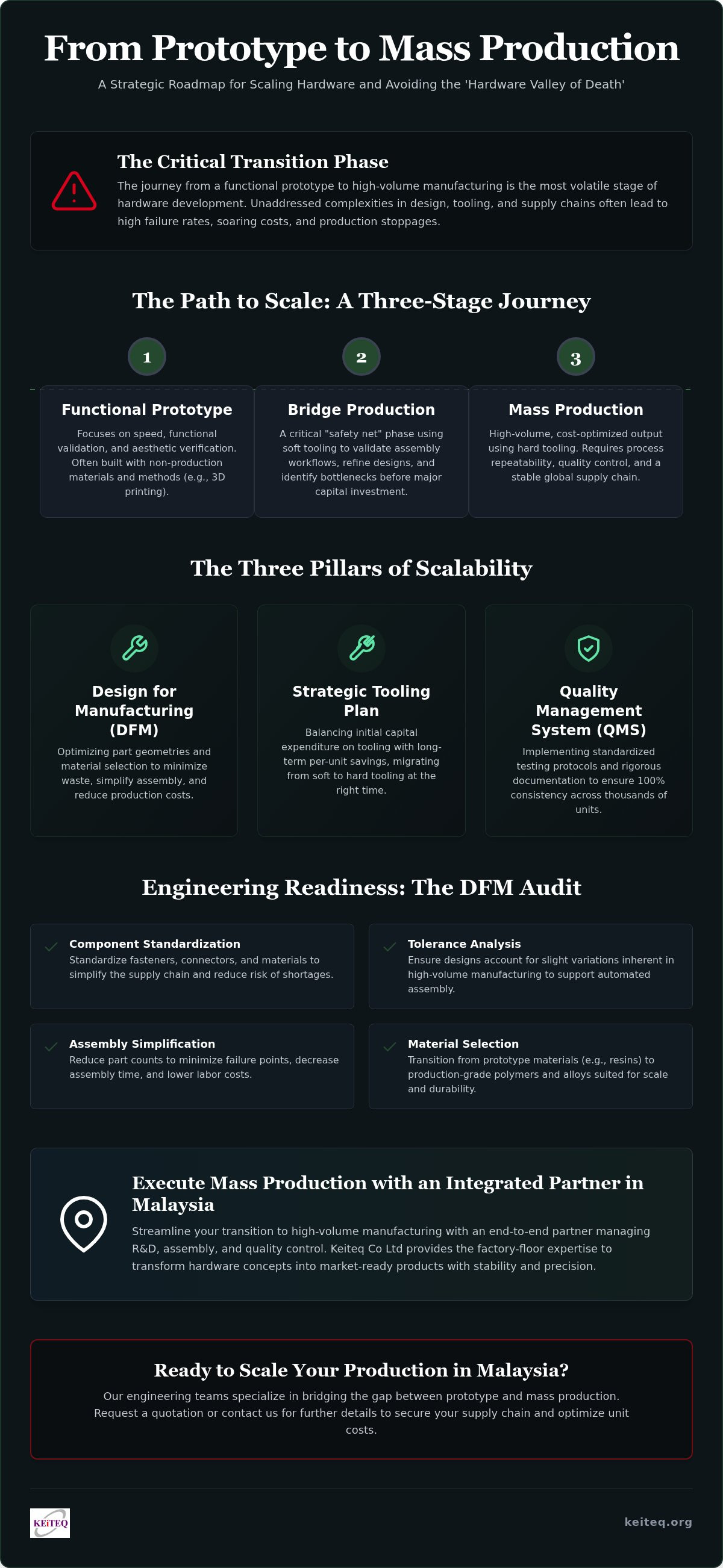
The transition to mass production represents the technical shift from low-volume validation to high-volume, cost-optimized manufacturing. This phase is frequently identified as the 'Hardware Valley of Death' for unprepared organizations. It's the point where theoretical design meets the uncompromising requirements of industrial scale. Companies often succeed in building a functional prototype but fail to address the underlying complexities of unit economics and factory floor constraints. This disconnect typically leads to high failure rates during initial production runs and unexpected tooling overheads.
Successful scaling requires a clear distinction between 'looks-like' prototypes and production-ready units. While early iterations prioritize speed and aesthetic verification, final designs must accommodate high-speed assembly and material efficiency. The primary objectives of this phase include unit cost reduction, process repeatability, and global supply chain stability. Achieving these goals ensures that the final product is not only functional but also commercially viable at scale. Without this rigorous transition, a product remains a laboratory success rather than a market-ready asset.
The Three Pillars of Scalability
Industrial scalability rests on three technical foundations. First, Design for Manufacturability (DFM) ensures that part geometries are optimized for specific production methods, minimizing material waste and assembly labor. Second, a strategic tooling plan balances initial capital expenditure with long-term per-unit savings. High-volume production typically necessitates hard tooling for durability and speed. Third, a comprehensive Quality Management System (QMS) provides the necessary oversight. These systems utilize standardized testing protocols and rigorous documentation to maintain 100% consistency across thousands of units.
Identifying the 'Bridge Production' Phase
Bridge production acts as a critical safety net between initial prototyping and full-scale manufacturing. This tactical phase allows engineering teams to validate assembly line workflows and identify potential bottlenecks before committing to major capital investments. It facilitates the refinement of prototype designs based on direct factory floor feedback. By resolving assembly conflicts and optimizing cycle times during these smaller runs, manufacturers ensure that the eventual transition to mass production occurs without costly interruptions or quality regressions.
Engineering Readiness: From Functional Prototype to DFM
Engineering readiness is the phase where design theory meets factory reality. A comprehensive Design for Manufacturing (DFM) audit serves as the first technical gate in this process. This audit identifies high-risk components that could cause production bottlenecks or high scrap rates. By standardizing fasteners and materials, engineers simplify the global supply chain, reducing the risk of component shortages that have impacted 2026 electronics production. Simplicity in the bill of materials leads to predictable lead times and lower logistical overhead.
Analyzing tolerances is equally vital. Hand-fitted prototypes often ignore the slight variations inherent in high-volume manufacturing. Moving to automated assembly requires precision that accounts for these deviations. This is why integrated product R&D and manufacturing is indispensable. It allows factory-floor insights to inform the design phase, catching errors before they require expensive tooling changes. For organizations looking to align with broader industrial standards, resources like Federal Manufacturing Programs provide frameworks for maintaining high-level supply chain integrity during the transition to mass production.
Simplifying Complex Assemblies
Reducing part counts is a primary objective during the transition to mass production. Fewer parts mean fewer failure points and faster assembly times. Consider the engineering behind outdoor payment terminal assembly. These units must be designed for both durability and easy field maintenance. Internal components should be positioned to allow clear access for automated testing rigs, ensuring that every unit meets performance specifications before leaving the facility. If your design requires complex integration, you can consult with our engineering team to optimize your assembly layout.
Material Selection for Mass Production
The shift from 3D printing resins to production-grade polymers and alloys is a significant jump. While resins are excellent for visual verification, they rarely possess the mechanical properties needed for 10,000+ unit runs. Evaluation must include material availability and lead times, especially given current market volatility. Materials must also undergo rigorous testing under environmental stress. For hardware exposed to the elements, performance under UV radiation, extreme heat, and moisture is non-negotiable. Using the right alloys or polymers ensures the long-term reliability that industrial clients expect; for instance, you can check out QuenchSea to see how these principles apply to specialized marine survival equipment.
Strategic Tooling and Process Selection for Scale
Tooling selection is the most significant capital decision in the manufacturing lifecycle. Soft tooling, typically utilizing aluminium or pre-hardened steel, supports low-volume validation and bridge production. It allows for design flexibility and rapid iterations. However, as production volumes exceed the capacity of these temporary tools, the transition to mass production requires a shift to hard tooling. Hardened tool steel molds and dies provide the thermal stability and wear resistance necessary for continuous high-speed operation. This transition is essential for achieving the repeatability and unit economics required for 2026 global markets.
Plastic Injection Molding Optimization
Gate placement and wall thickness are the primary variables in cycle time optimization. Gates must be positioned to ensure uniform cooling and minimize weld lines, which can compromise the integrity of payment terminal housings or electronic enclosures. Utilizing plastic injection molding services in Malaysia provides a strategic advantage, combining logistical proximity with advanced technical capabilities. Additionally, a proactive mold maintenance program is critical. This includes periodic stripping, cleaning, and lubrication of the tool to prevent flash and cooling channel blockages. These steps ensure that production remains on schedule and parts meet 100% of quality specifications.
Precision Metal Stamping and Diecasting
Structural integrity at scale often relies on the choice between aluminium and zinc diecasting. Zinc diecasting allows for tighter tolerances and thinner walls, making it ideal for intricate internal components. Aluminium diecasting is the preferred choice for larger, lightweight structural parts that must withstand harsh environments. For rapid sheet metal fabrication, progressive die stamping remains the most efficient method. It utilizes a series of stations to form the part in a single continuous stroke. Engaging a specialized metal stamping manufacturer is vital to ensure that the tool steel grade can withstand the high-impact forces of millions of cycles without losing dimensional accuracy. High-quality tool steel prevents premature wear and ensures that every stamped component remains within tolerance through the entire production run.
Industrial Finishing and Quality Control at Scale
Finishing is frequently the most overlooked bottleneck during the transition to mass production. While assembly lines can be optimized for speed, curing times and chemical processes are governed by fixed physical constraints. Scaling powder coating processes requires more than just larger booths; it necessitates automated conveyor systems and precise temperature control to ensure color and texture remain uniform across 10,000+ unit batches. Inconsistent finishing results in high rejection rates, which can derail a production schedule and inflate per-unit costs.
Unified oversight is the most effective way to prevent quality fragmentation. By utilizing end-to-end product manufacturing, you integrate finishing and inspection into the primary production flow. This eliminates the logistical risks and potential damage associated with transporting semi-finished goods between multiple vendors; to learn more about how specialized packaging further secures these items during transit, manufacturers should consult with industrial supply experts. By 2026, manufacturers must also account for stricter hazardous substance reporting, making the choice of compliant, high-performance coating materials a strategic necessity for global market access.
High-Performance Coatings for Harsh Environments
Outdoor industrial hardware requires specialized protection that standard paints cannot provide. Enamel and ceramic coatings are essential for equipment exposed to extreme UV radiation, moisture, and corrosive chemical cleaners. Scaling these finishes without increasing defect rates involves strict control over surface preparation and application environments. Every production batch must undergo rigorous validation, including adhesion testing and salt spray exposure (ASTM B117), to ensure compliance with international durability standards. If your hardware requires specialized protection against the elements, you can Request for Quotation regarding our advanced coating capabilities in Malaysia.
Managing the Quality Feedback Loop
A robust quality framework relies on empirical data rather than simple visual checks. Implementing Statistical Process Control (SPC) allows engineers to monitor production variables in real-time and predict potential defects before they occur. Every new production run must begin with a First Article Inspection (FAI) to verify that the tool setup matches the master specifications perfectly. When deviations are detected, documenting them through Non-Conformance Reports (NCR) drives the continuous improvement necessary for success during the transition to mass production. Automated Optical Inspection (AOI) systems further complement these manual audits by providing high-speed, 100% verification of critical component placements.
Executing Mass Production with Keiteq Co Ltd in Malaysia
Malaysia has solidified its position as a premier global hub for electronics and hardware manufacturing. The activation of the New Incentives Framework (NIF) on March 1, 2026, has shifted the focus toward outcome-based projects that reward technical excellence and economic contribution. For OEMs, this creates a stable environment for the transition to mass production, provided they align with a partner capable of navigating these new fiscal structures. Keiteq Co Ltd operates within this framework to offer an integrated approach that bridges the gap between R&D and full-scale execution. By utilizing our electronic manufacturing services in Malaysia, clients eliminate the logistical friction often found in fragmented supply chains.
Operational compliance in 2026 requires strict adherence to evolving environmental and labor standards. Keiteq Co Ltd manages the complexities of the Chemical Information Management System (CIMS) reporting, ensuring all hazardous substance data is submitted to DOSH by the March 31, 2026, deadline. We also account for the total ban on e-waste imports enacted on April 1, 2026, protecting your production cycle from regulatory disruptions. Our ability to manage the foreign worker levy, currently RM 1,850 for the manufacturing sector, ensures a stable and skilled labor pool for high-volume assembly. This logistical competence allows our clients to focus on market expansion while we handle the intricacies of the factory floor.
Full-Scale OEM Assembly and Integration
Executing a complex outdoor payment terminal build requires a manufacturing partner that understands both mechanical durability and electronic precision. Keiteq Co Ltd manages these multifaceted projects from start to finish, integrating metal stamping, diecasting, and specialized coatings into a unified assembly process. We serve as a 'Safe Pair of Hands' for your most sensitive hardware IP, maintaining strict internal security protocols throughout the production lifecycle. Streamlining these operations through a single-source partner reduces the risk of component mismatches and ensures that the final product meets every industrial specification.
The Strategic Advantage of Malaysia-Based Production
Proximity to advanced plastic injection mold Malaysia facilities provides a significant technical edge. These facilities allow for rapid tooling maintenance and process optimization, which are critical for maintaining high-speed production cycles. Malaysia's location near major global shipping lanes facilitates efficient delivery to the US and other international markets. Additionally, the industrial utility landscape remains predictable, with medium-voltage industrial users (Tariff E1) benefiting from an energy charge of 36.00 sen/kWh as of June 2026. Keiteq Co Ltd combines these regional advantages with a results-oriented management style to deliver consistent, high-quality hardware at scale.
If you're ready to secure your supply chain and scale your hardware with a professional manufacturing partner, we invite you to engage with our team. You can submit a Request for Quotation or a Request to contact us for further details regarding our specialized services in Malaysia.
Securing Your Industrial Production Lifecycle
Successful hardware ventures require a transition to mass production that is both methodical and resilient. We've established that engineering readiness and strategic tooling selection are the primary safeguards against industrialization gaps. By implementing rigorous quality feedback loops and selecting advanced finishes, you ensure that your product maintains its integrity in the field. These technical pillars form the foundation of a scalable manufacturing strategy that withstands global market volatility.
Keiteq Co Ltd provides the end-to-end management required to execute these complex transitions. From initial R&D and design to outdoor payment terminal assembly and specialized enamel or ceramic coatings, we maintain unified quality oversight. We're your dependable partner in Malaysia, offering the logistical competence and engineering talent needed for high-volume execution. Our focus remains on delivering functional trust and professional results for every hardware project.
Ready to scale your hardware with industrial precision? Request for Quotation or reach out to us for further details regarding our professional manufacturing services in Malaysia. We look forward to facilitating your next successful production run.
Frequently Asked Questions
What is the typical timeline for a transition to mass production?
The typical timeline for a transition to mass production ranges from 12 to 16 weeks for assembly and validation. However, current supply chain constraints in 2026 can extend this period significantly. Specific components, such as high-bandwidth memory, may require lead times of 32 to 40 weeks. You should also factor in an additional four weeks for international shipping and customs clearance when manufacturing in regional hubs like Malaysia.
How much does tooling usually cost for high-volume plastic injection molding?
High-volume plastic injection molding costs vary based on part complexity, material choice, and mold cavitation. Hardened tool steel molds are necessary for millions of cycles but require a higher initial investment than soft tooling. These costs are typically amortized over large production runs to achieve a lower per-unit cost. Total investment depends on the required cycle times and dimensional tolerances specified in your engineering brief.
What are the biggest risks when scaling hardware production too quickly?
The biggest risks involve high failure rates during initial runs and unmanageable tooling overheads. Rapid scaling without a bridge production phase often exposes design flaws that weren't apparent in low-volume prototypes. This leads to expensive rework or scrapped batches. Supply chain instability can also cause sudden component shortages, halting production lines and resulting in significant capital loss for organizations that don't have a diversified sourcing strategy.
How does DFM differ between prototyping and mass manufacturing?
Prototyping DFM focuses on speed and visual verification, often utilizing 3D printing or CNC machining. In contrast, mass manufacturing DFM optimizes parts for industrial processes like plastic injection molding or diecasting. This involves adjusting wall thicknesses, adding draft angles, and standardizing fasteners to simplify automated assembly. The goal shifts from proving a concept to ensuring repeatability across thousands of units during the transition to mass production.
Why should I consider Malaysia for my hardware manufacturing needs in 2026?
Malaysia offers a strategic advantage through the New Incentives Framework (NIF) and a mature industrial infrastructure. The region provides access to skilled engineering talent and professional project management at a lower overhead than Western markets. Malaysia's strict environmental regulations, such as the 2026 e-waste import ban, ensure that manufacturing partners maintain high sustainability and compliance standards. This makes it a premier choice for global electronics and hardware distribution.
What is the difference between bridge production and mass production?
Bridge production is a low-volume validation phase used to test assembly line workflows and refine designs. It acts as a safety net before committing to full-scale capital investment. Mass production is the high-volume, cost-optimized execution stage where hard tooling is utilized for maximum efficiency. While bridge production prioritizes risk mitigation and design finalization, mass production focuses on unit cost reduction and maintaining 100% quality consistency across the entire run.
How do I protect my intellectual property during the manufacturing transition?
Protecting intellectual property during the manufacturing transition requires working with a single-source partner that manages end-to-end execution. Consolidating R&D, tooling, and assembly within one facility minimizes the number of entities with access to your proprietary designs. You should also utilize comprehensive non-disclosure agreements and ensure your partner has robust internal data security protocols. This prevents IP leakage during the critical scaling process from prototype to factory floor.
What quality certifications should I look for in a mass production partner?
You should look for partners that maintain current ISO 9001:2015 certifications, with plans to transition to the ISO 9001:2026 revision. Depending on your industry, specific standards like IPC-1791E for trusted electronics or IPC-1401B for ESG management are also critical. These certifications ensure the manufacturer follows disciplined documentation and quality control frameworks. They provide the functional trust necessary for high-volume hardware production and long-term supply chain reliability.


Comments