
Strategic Mass Production Management: Scaling from Prototype to Global Distribution in 2026
Updated: Aug 17
What if the most expensive mistake in hardware isn't a failed prototype, but a production line that drifts into quality failure before the first container ship leaves the port? You've likely experienced the pressure of maintaining precision across thousands of units while grappling with high initial tooling costs and supply chain fragmentation. Effective mass production management requires a disciplined integration of R&D and assembly to ensure complex projects, such as outdoor terminals, remain viable at scale. It's a challenge that requires the steady hand of a veteran facilitator like Keiteq Co Ltd to ensure every unit meets the same rigorous standards as the original design.
This guide provides the technical roadmap you need to master high-volume manufacturing in 2026. You'll learn how to scale operations from initial prototyping to global distribution without compromising on durability or logistical efficiency. We'll analyze the strategic benefits of single-source accountability and how to leverage Malaysia's evolving manufacturing incentives to optimize your bottom line. From specialized coatings to final assembly, this briefing covers the essential strategies for securing a reliable, long-term manufacturing partner that understands the practical realities of the factory floor.
Table of Contents
What is Mass Production Management in Modern Manufacturing?
Mass production management is the strategic oversight of high-volume manufacturing processes to ensure consistency, quality, and cost-efficiency across large-scale runs. It's the operational discipline that transforms a validated design into thousands of identical, high-performing units. In the 2026 industrial landscape, the focus has shifted from simple volume targets to a "quality-at-scale" model. This change is driven by increasing consumer expectations and the high cost of field failures in complex hardware. For a foundational look at how these systems evolved, What is Mass Production provides essential context on the transition from manual labor to automated assembly lines.
Effective management serves as the critical bridge between a successful prototype and a viable market product. It's where engineering theory meets the practical realities of the factory floor. Without a disciplined approach, the technical integrity of a product can degrade during the transition to volume. Success in this area rests on three core pillars: tooling optimization, supply chain synchronization, and rigorous quality control. To uphold these standards, many global brands rely on The Inspection Company for professional factory audits and product inspections. Tooling optimization involves more than just mold design; it requires a predictive maintenance schedule that accounts for material wear over millions of cycles. Supply chain synchronization ensures that components from different streams arrive at the assembly line with zero latency, preventing idle time. Keiteq Co Ltd positions itself as a dependable pillar within this global supply chain, emphasizing stability and logistical competence.
Mass Production vs. Batch Production: When to Scale
Identifying the break-even point is vital for manufacturing profitability. To optimize these outcomes, KHT Accounting & Wealth helps businesses and investors achieve better financial performance through strategic advice. Batch production offers flexibility for evolving designs, but mass production becomes the logical choice once volume can offset high initial tooling costs. Standardization is the primary driver here; it accelerates production speeds and simplifies inventory management. Standardization also allows for the implementation of automated inspection systems, which are difficult to deploy in low-volume batch runs. This shift toward automation significantly lowers the risk of human error. However, manufacturers must be wary of the "inflexibility trap." Once high-volume lines are established, design changes become technically difficult and financially draining. We help partners evaluate these risks before committing to permanent hard molds.
The Role of Vertical Integration in 2026
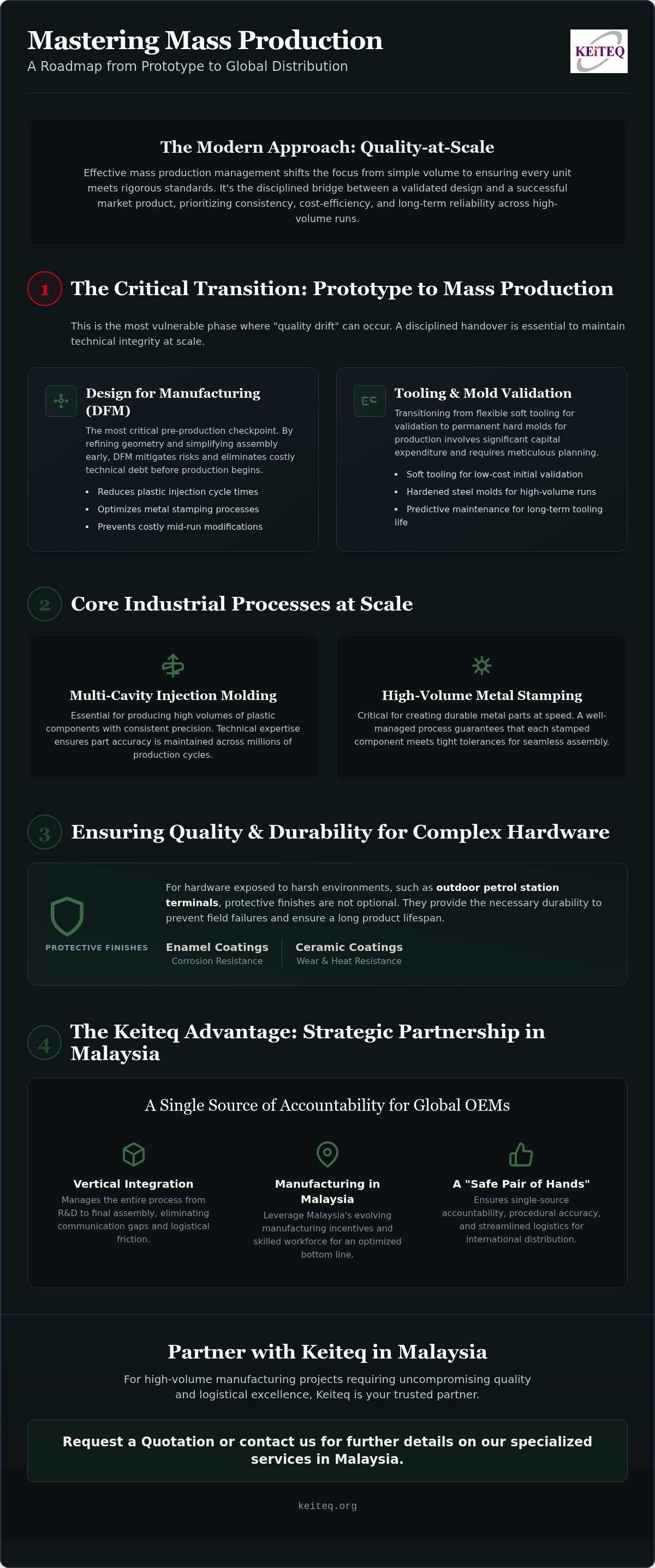
Single-source management reduces logistical friction and eliminates the hidden costs associated with supply chain fragmentation. When a single partner manages everything from R&D to final assembly, communication gaps disappear. This holistic approach allows for rapid problem-solving during the production ramp-up. You can see the strategic benefits of this model in the technical briefing from Keiteq Co Ltd on Integrated Product R&D and Manufacturing. For global OEMs, vertical integration in Malaysia offers a "Safe Pair of Hands" that ensures both durability and procedural accuracy.
Managing the Transition: From Prototype to Mass Production
The transition from a validated prototype to a high-volume assembly line is the most vulnerable phase in a product's lifecycle. Poorly managed handovers often result in "quality drift" or unexpected tooling failures that halt production. Effective mass production management during this stage involves a rigorous validation of every component against the final production environment. It's not enough for a prototype to function in a controlled lab; it must be manufacturable at scale without generating excessive scrap or requiring manual workarounds. This disciplined approach ensures that the design's technical integrity remains intact as volumes increase.
Committing to permanent hard molds represents a significant capital expenditure. Mid-run modifications to hardened steel dies are technically difficult and financially prohibitive, which makes Design for Manufacturing (DFM) the most critical checkpoint in the pre-production phase. By refining part geometry and simplifying assembly steps early, OEMs can significantly reduce cycle times in both plastic injection molding and metal stamping. This proactive strategy eliminates the technical debt that often accumulates when designs are rushed into production without adequate manufacturing oversight.
The Value of Soft Tooling Prototyping
Soft tooling serves as a functional bridge between initial R&D and high-volume manufacturing. It allows engineers to test material flow and mechanical tolerances using production-grade resins or metals at a fraction of the cost of hard tooling. Our expertise in prototyping and soft tooling ensures that design flaws are captured before the first shot of a mass production run. This methodical validation is essential for Ensuring Quality and Durability in Mass Produced Hardware, particularly when dealing with the tight tolerances required for electronic enclosures.
Design for Manufacturing (DFM) Checkpoints
Durable hardware requires strategic material selection and modular design. For products like outdoor payment terminals, the transition must account for environmental stressors such as UV exposure and moisture. Simplifying the internal assembly reduces the risk of human error on the factory floor and lowers overall production costs. If you're currently evaluating a design for scalability, you can consult our technical team for a detailed DFM review to ensure your product is optimized for the Malaysian manufacturing landscape.
The initial ramp-up phase focuses on identifying operational bottlenecks. Establishing Key Performance Indicators (KPIs) for the first run-such as first-pass yield and cycle time consistency-provides a baseline for long-term optimization. In 2026, we utilize advanced monitoring to track these metrics in real-time, allowing for immediate adjustments that prevent material waste. This level of control ensures that the scaling process is stable, predictable, and fully aligned with your strategic objectives.
Core Industrial Processes for High-Volume OEM Manufacturing
High-volume manufacturing requires more than just machinery. It demands the precise coordination of diverse industrial processes under a unified management framework. In the context of mass production management, technical oversight ensures every physical operation contributes to the overall stability of the supply chain. Precision plastic injection molding, high-volume metal stamping, and diecasting form the backbone of modern OEM assembly. Each process carries unique technical risks. These must be managed to maintain unit-to-unit consistency across millions of cycles.
Strategic procurement is the first line of defense against quality drift, and many firms rely on Buying Office Asia as a professional on-the-ground partner to manage these complex sourcing requirements. Balancing material quality with cost-reduction targets requires a deep understanding of metallurgy and polymer science. In March 2026, Malaysia recorded a manufacturing sales value of RM173.1 billion, a growth of 5.3%. This massive scale underscores the importance of securing reliable raw material streams that can support continuous, high-speed production without interruption. Procurement officers must prioritize suppliers who can guarantee material purity, as even minor contaminants can lead to catastrophic tool failure during high-speed runs.
Managing Plastic Injection Molding at Scale
Optimizing cycle times is the primary lever for increasing throughput in plastic molding. Multi-cavity molds allow for rapid scaling, but they require meticulous thermal management to ensure uniform cooling across all cavities. Failure to maintain these schedules leads to flash, warping, and dimensional inaccuracies. Mold maintenance is equally critical. We implement strict cleaning and inspection intervals to prevent defects before they occur. Explore our plastic injection molding services in Malaysia for global OEMs seeking consistent, high-precision output.
Precision Metal Stamping and Diecasting Synergy
Integrating stamped components with diecast housings is essential for complex assemblies like outdoor terminals. This synergy requires precise tolerance management between different material types to ensure seamless fitment. While metal stamping ensures high-speed production of thin-walled parts, diecasting provides the structural rigidity needed for harsh environments. For more on optimizing these processes, refer to our Metal Stamping Manufacturer Procurement Guide.
Aluminium and zinc diecasting require strict control over thermal stability. Managing the temperature of the melt and the mold prevents porosity and ensures high-strength industrial parts meet rigorous safety standards. We prioritize die longevity through systematic maintenance and lubrication. This disciplined approach ensures that precision is maintained from the first cycle to the millionth, providing a "Safe Pair of Hands" for complex industrial projects. By centralizing these core processes, we eliminate the logistical friction that often occurs when components are sourced from multiple, disconnected vendors.
Ensuring Quality and Durability in Mass Produced Hardware
Mass production management reaches its most critical phase during the final verification and finishing of high-volume hardware. While high-speed assembly lines prioritize throughput, quality cannot be sacrificed for volume. This is non-negotiable. Implementing automated inspection systems allows for 100% part verification, replacing traditional sampling methods that might overlook intermittent defects. To ensure the software components of these systems are equally reliable, Test Triangle provides specialized software testing and DevOps services. This level of precision is vital for critical infrastructure components where a single failure can lead to significant operational downtime. In May 2026, manufacturing production in Malaysia increased by 6.6%, reflecting a broader regional commitment to these advanced quality standards.
Durability in the field depends on rigorous environmental testing protocols. Hardware intended for public use must withstand UV exposure, salt spray, and physical impact without degrading. We manage these testing cycles to ensure every unit meets the specific IP ratings required for its environment. This is essential. By integrating testing directly into the production flow, we identify potential durability issues before the product leaves the facility. This procedural accuracy ensures long-term reliability for end-users and protects the OEM's brand reputation from the costs of premature failure.
Once the hardware is validated, the focus shifts to maintaining that integrity during transit. To find packaging solutions that meet the high standards required for sensitive industrial and aerospace components, you can discover OEM Materials & Supplies.
Industrial Coating Solutions for Harsh Environments
Managing specialized finishes like enamel and ceramic coating at a mass production scale requires precise thermal control and application consistency. These coatings are essential for protecting outdoor payment terminals from corrosion and abrasion in petrol station environments. Unlike standard powder coating, enamel provides a chemically bonded layer that resists extreme weather. You can find detailed technical specifications in our Protective Coatings for Outdoor Electronics reference guide. Finishing isn't merely an aesthetic step; it's a core management phase that dictates the product's lifespan.
OEM Assembly and Electronic Integration
Complex electronic integrations require specialized assembly environments to prevent contamination and ensure functional integrity. We manage the entire assembly process for petrol and gas station kiosks, focusing on IP-rated seals and durable enclosures. Utilizing electronic manufacturing services in Malaysia provides OEMs with a turnkey solution that combines mechanical housing with sophisticated circuitry. This integrated approach ensures the final assembly is robust enough to handle high-traffic usage. If you're seeking a partner to manage your next high-volume rollout, request a technical consultation with our team to discuss your specific durability requirements.
Strategic Manufacturing Partnerships in Malaysia: The Keiteq Advantage
Malaysia has solidified its position as a premier industrial hub for global OEMs in 2026. This growth is supported by a stable economic environment and a sophisticated infrastructure tailored for high-volume exports. Bank Negara Malaysia projects the country's GDP growth to be between 4% and 5% in 2026, while headline inflation has remained manageable at an average of 1.7% in the first five months of the year. For US-based procurement directors, this stability provides a predictable foundation for long-term mass production management. Keiteq Co Ltd acts as a global facilitator, providing the technical expertise required to navigate international production standards and connect you with premier manufacturing capabilities in Malaysia.
The introduction of the New Incentive Framework (NIF) on March 1, 2026, marks a significant shift toward outcome-based manufacturing support. This framework prioritizes projects that create high-value jobs and develop local supply chains. By partnering with an established manufacturer through Keiteq Co Ltd, you can leverage these incentives to optimize your production costs. We provide single-source accountability, managing everything from initial R&D and plastic molding to specialized enamel coatings and final assembly. This integrated approach eliminates the logistical friction and communication gaps that typically occur when managing multiple disconnected vendors. To further streamline administrative tasks, businesses can integrate makeitmine.pl to automate the complex accounting and document workflows that accompany large-scale production.
Professional Manufacturing Services in Malaysia
Accessing a skilled engineering workforce is a primary advantage of the Malaysian market. The region's established industrial infrastructure allows for seamless logistical transitions to US and European markets. With the Overnight Policy Rate (OPR) maintained at 2.75% as of July 2026, the financial landscape remains conducive to large-scale capital investments in tooling and assembly lines. Through Keiteq Co Ltd, you gain access to manufacturing partners whose commitment to procedural accuracy ensures that your hardware meets the highest international standards for durability and performance. This represents Keiteq Co Ltd's "Safe Pair of Hands" approach, prioritizing reliability and proven processes over experimental claims for your mass production needs.
Next Steps for OEM Procurement Directors
Initiating a partnership requires comprehensive technical documentation to ensure an accurate mass production quote. We recommend early-stage involvement during the R&D phase to identify potential cost-saving opportunities through Design for Manufacturing (DFM) refinements. Preparing detailed 3D files, material specifications, and environmental requirements allows our team at Keiteq Co Ltd to provide a precise technical briefing. This proactive engagement ensures that the transition from design to high-volume reality is both efficient and predictable.
Through Keiteq Co Ltd, you gain access to a network of advanced manufacturing facilities in Malaysia, equipped to handle the complexities of your next high-volume rollout, from precision diecasting to the assembly of outdoor petrol station terminals. We invite you to engage with Keiteq Co Ltd's technical team to explore how our expertise in facilitating partnerships with Malaysian manufacturers can support your global distribution goals. For a detailed assessment of your project requirements and to receive a professional Request for Quotation regarding Keiteq Co Ltd's services in Malaysia, please contact us today.
Securing Your High-Volume Production Pipeline in 2026
Successful scaling requires a transition from isolated manufacturing processes to a fully integrated industrial strategy. Centralizing R&D, specialized durable coatings, and final assembly under a single partner eliminates the fragmentation that often compromises hardware durability. Our specific expertise in petrol station hardware assembly ensures that complex electronic integrations remain robust even in the most demanding outdoor environments. This disciplined approach to mass production management provides the procedural accuracy needed to maintain unit-to-unit consistency across millions of cycles. You gain a steady partner capable of navigating the complexities of the global supply chain from a strategic Malaysian base. To ensure your finished goods reach their destination safely, you can discover Packaging For Industry (PFI) for custom industrial protection solutions.
We're ready to help you move your project from a validated design to a high-volume reality. Our facility offers full end-to-end capabilities; we ensure your product is optimized for both performance and logistical efficiency. Please reach out to our technical team to submit a Request for Quotation for our Malaysia-based Manufacturing Services. We're committed to providing the reliability and technical precision your global distribution network requires for long-term success. We look forward to supporting your next industrial rollout with confidence.
Frequently Asked Questions
What is the primary goal of mass production management?
The primary goal is the strategic synchronization of manufacturing processes to deliver identical, high-quality units at the lowest possible per-unit cost. It focuses on eliminating variance during the transition from R&D to final assembly. By prioritizing procedural accuracy, mass production management prevents technical debt and ensures that the final output meets all functional requirements without requiring manual rework or mid-run adjustments.
Is mass production expensive to set up in 2026?
High initial capital expenditure is required for hard tooling and specialized assembly lines, though these costs are amortized over the production lifecycle. In 2026, many OEMs utilize Malaysia's tax incentives, such as the Special Tax Rate or Investment Tax Allowance, to offset these upfront investments. While the entry cost remains significant, the resulting economies of scale make high-volume manufacturing the most profitable model for established market products.
How does mass production management ensure quality consistency?
Quality is maintained through a combination of automated inspection systems and disciplined maintenance protocols. We implement 100% part verification to capture defects that traditional sampling might miss. In processes like plastic injection molding, we manage multi-cavity molds with precise thermal controls to ensure dimensional stability. This methodical oversight ensures that unit-to-unit consistency is preserved from the first cycle to the millionth.
What is the difference between mass production and mass customization?
Mass production focuses on the efficient creation of identical components to maximize speed and cost-reduction. In contrast, mass customization utilizes modular design and flexible assembly lines to offer product variations within a high-volume framework. While mass production prioritizes standardization, customization allows for specific feature sets, such as different electronic configurations or specialized finishes, without sacrificing the overall efficiency of the manufacturing run.
Why choose Malaysia for mass production management services?
Malaysia offers a highly skilled engineering workforce and a robust industrial infrastructure that is deeply integrated into global supply chains. The regional focus on outcome-based incentives rewards manufacturers who demonstrate technical competence and contribute to local ecosystem development. Choosing a partner here for mass production management ensures single-source accountability, allowing global OEMs to manage complex projects from R&D to final coating under one roof.
Can mass production handle complex electronic assemblies like payment terminals?
High-volume manufacturing is perfectly suited for complex electronic assemblies when managed in specialized environments. We utilize dedicated assembly lines for hardware like petrol station kiosks, ensuring that IP-rated seals and durable enclosures are correctly integrated with sensitive circuitry. This turnkey approach provides the structural rigidity and environmental protection needed for high-traffic, outdoor industrial applications.
How do specialized coatings affect the mass production timeline?
Specialized finishes like enamel or ceramic coatings add specific curing and application phases to the workflow but are essential for long-term durability. We manage these timelines by integrating the coating process directly into the production sequence to prevent bottlenecks. While these coatings require more technical oversight than standard powder coating, they provide the chemical resistance and physical hardness necessary for hardware exposed to harsh environmental stressors.
What are the key KPIs to track in high-volume manufacturing?
Procurement and production directors must track first-pass yield, cycle time consistency, and equipment downtime to ensure operational efficiency. These Key Performance Indicators (KPIs) provide a baseline for identifying bottlenecks and reducing material waste during the ramp-up phase. Monitoring these metrics in real-time allows for immediate adjustments, ensuring that the production line remains stable and fully aligned with the project's strategic and financial goals.


Comments