
Strategic Product Design: 2026 Industrial Procurement Guide
- 15 hours ago
- 12 min read
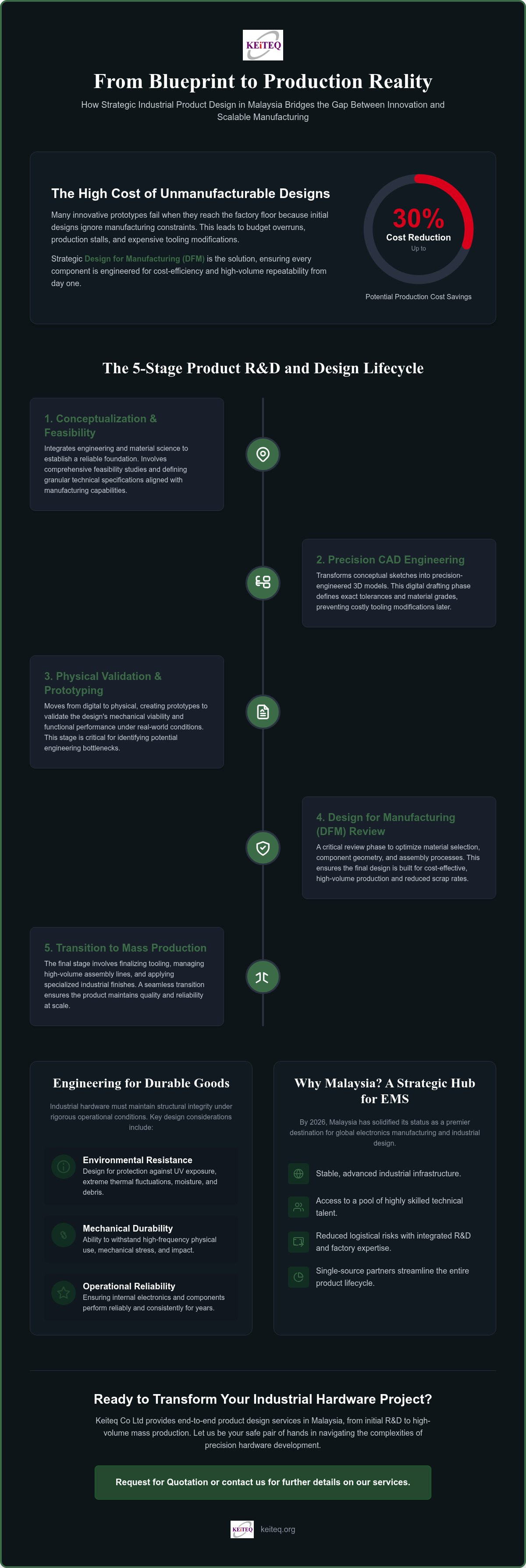
What if your most innovative prototype is actually your biggest financial liability? In the industrial sector, many companies discover that a brilliant R&D concept fails the moment it hits the factory floor because the original designers ignored manufacturing constraints. Utilizing professional product design services is no longer just about aesthetics; it's about ensuring that every component is engineered for scalability and cost-efficiency. In 2026, Malaysia has solidified its status as a premier destination for these technical requirements, where optimizing design through Design for Manufacturing (DFM) can reduce production costs by up to 30% while cutting cycle times significantly.
You likely recognize that the transition from a functional prototype to high-volume output is where most projects stall or exceed budget. This guide by Keiteq Co Ltd will show you how strategic product design services bridge the gap between initial engineering and industrial-scale manufacturing. We will examine the 2026 roadmap for industrial procurement, highlighting how a single-source partner in Malaysia reduces logistical risks through integrated R&D and factory-floor expertise. By the end of this guide, you will understand how to navigate the complexities of precision hardware development with a safe pair of hands.
Table of Contents
Understanding Product Design Services in the Industrial Hardware Sector
Industrial hardware development requires a methodology that extends far beyond visual appeal. Effective Industrial design serves as the critical intersection of mechanical engineering, material science, and manufacturing logistics. While consumer products often prioritize style, professional product design services focus on the functional reality of a component. This involves analyzing how a part withstands mechanical stress, how specific alloys react to thermal changes, and how the geometry of a part affects its movement through an automated assembly line. Keiteq Co Ltd treats robust R&D as the essential foundation for any hardware venture. Without a disciplined research phase, a product often faces high failure rates or catastrophic assembly errors that deplete capital and delay market entry.
Strategic design is a primary driver for reducing long-term manufacturing costs. By identifying potential engineering bottlenecks during the initial digital drafting phase, technical teams prevent the need for expensive tooling modifications after production has commenced. This proactive approach utilizes a service-benefit model where precision engineering directly correlates to reduced scrap rates and optimized material usage. Professional product design services ensure that every part is designed for repeatability. This consistency is vital for maintaining the high-volume standards required in the Malaysian industrial market, much like how Fong’s Engineering & Manufacturing Private Limited applies rigorous technical precision to the specialized field of medical device manufacturing. It's the difference between a fragile prototype and a manufacturable asset that performs reliably for years.
The Scope of Modern Product R&D
The modern R&D process begins with comprehensive feasibility studies and the development of granular technical specifications. For complex industrial assemblies, designers must define exact tolerances and material grades before the first mold is even cut. This methodical planning ensures that all design goals remain perfectly aligned with integrated product R&D and manufacturing strategies. By integrating these phases, companies avoid the silo effect where designers create parts that factories cannot actually build. Keiteq Co Ltd ensures that market research and technical feasibility are conducted with regional manufacturing capabilities in mind, leveraging Malaysia's advanced industrial infrastructure from the earliest stages.
Why Industrial Design Matters for Durable Goods
Durable goods must maintain structural integrity under rigorous operational conditions. Advanced material selection is a core component of this process. Engineers must decide whether a component requires the weight and strength of zinc diecasting or the cost-efficiency of high-grade plastic injection molding. For specialized hardware such as outdoor payment terminals, the design must account for several environmental factors:
Environmental Resistance: Protection against ultraviolet exposure and extreme thermal fluctuations.
Mechanical Durability: Ability to withstand high-frequency physical use and impact.
Operational Reliability: Ensuring internal electronics remain shielded from moisture and debris.
Keiteq Co Ltd integrates these functional requirements with user interface ergonomics to ensure the final product is both indestructible and intuitive. This level of engineering ensures that the hardware remains a dependable pillar within a client's broader logistical infrastructure. Utilizing regional expertise in Malaysia allows for a more integrated approach to these feasibility studies, ensuring that local manufacturing capabilities are leveraged from day one.
This commitment to human-centric engineering is equally essential for modern office environments; for instance, you can learn more about EKOBOR and their range of premium ergonomic furniture designed for professional health.
The 5-Stage Product R&D and Design Lifecycle
The industrial development process operates as a disciplined sequence that converts abstract business requirements into tangible, high-performance hardware. This lifecycle is an intelligence-driven operating model designed to eliminate technical debt before it reaches the factory floor. By following a structured 5-stage framework, product design services ensure that every component is scrutinized for mechanical viability and logistical efficiency. This process moves through conceptualization, precision CAD engineering, physical validation, and design for manufacturing (DFM) reviews, culminating in finalized mass production protocols.
From Concept to CAD
Technical sketching for industrial components serves as the first bridge between a business need and an engineering reality. During this phase, designers translate complex functional requirements into detailed engineering drawings that account for every screw, bracket, and interface. It's an iterative process. Engineers focus on optimizing part count and assembly speed to ensure the final unit is easy to build at scale. Modern product design services utilize advanced simulation software to predict material stress and performance under load. This digital stress testing allows teams to identify potential failure points in the virtual environment, saving weeks of physical troubleshooting later in the project.
The Critical Role of Prototyping
Physical validation is non-negotiable for durable goods. Utilizing prototyping and soft tooling allows engineering teams to identify design flaws that digital simulations might overlook. Functional testing of physical components provides a "safe pair of hands" approach, ensuring that parts fit together and operate as intended before the company invests in expensive hard tooling. Soft tooling bridges the gap between R&D and mass production by allowing for the creation of functional parts that verify the production process without the immediate capital expenditure of hard steel molds. This stage is where design assumptions meet the reality of physical physics. Companies looking to streamline this lifecycle often consult with our engineering team to assess project feasibility and technical constraints early in the development cycle.
Once the prototype is validated, the project moves into a rigorous DFM review. This stage ensures factory readiness by adjusting wall thicknesses, draft angles, and material specifications for high-volume output. The final stage involves establishing mass production management protocols. These protocols define the quality control standards, assembly sequences, and testing benchmarks required for consistent results. By the time the design reaches the factory floor, every variable has been accounted for, significantly reducing the risk of costly production delays or assembly errors.
Material Selection and Design for Manufacturing (DFM) Strategies
The choice between plastic and metal isn't purely a matter of cost. It's a strategic decision that dictates the long-term reliability of the final assembly. Professional product design services evaluate whether a component requires the high-strength rigidity of metal or the lightweight versatility of polymers based on mechanical performance requirements. DFM principles guide this selection by analyzing how material properties affect production speed and part durability. For instance, designing for plastic injection molding requires precise control over wall thickness and draft angles to prevent sink marks or ejection failures. Conversely, metal stamping focuses on bend radii and material thinning to ensure structural integrity in high-stress enclosures. Selecting inappropriate materials leads to premature failure; precision engineering ensures longevity.
Precision engineering at this stage also serves as a primary tool for reducing material waste. By optimizing the geometry of a part during the design phase, engineers can minimize the volume of raw material required without compromising strength. This methodical approach involves analyzing stress distribution to remove unnecessary material from non-critical areas. Such efficiency isn't just about sustainability. It directly impacts the bottom line by reducing the cost per unit and streamlining the logistical requirements for raw material procurement. Every gram of material saved across a high-volume production run translates into significant operational savings.
Plastic Injection Molding Design Considerations
Selecting the correct resin is critical for ensuring durability, UV resistance, and thermal stability. For hardware like outdoor payment terminals, engineers often specify polycarbonate or ABS-PC blends to withstand harsh environmental exposure. Leveraging plastic injection molding services in Malaysia provides a strategic advantage for cost-effective scaling. The regional expertise allows for the production of complex geometries in high-volume runs while maintaining tight tolerances. Designers must account for the cooling behavior of different resins, ensuring that draft angles are sufficient for clean part release. This attention to detail prevents surface defects and ensures that the finished product meets professional industrial standards.
Engineering for Metal and Diecasting
Precision metal stamping is the preferred method for creating high-strength internal enclosures and structural brackets. These components provide the rigid skeleton necessary for complex hardware assemblies. For intricate, high-durability external parts, aluminium and zinc diecasting offer superior dimensional stability and impact resistance. These materials allow for thinner walls than traditional casting, which reduces weight while maintaining a premium, industrial feel. Successful product design services must integrate these metal components with plastic housings into a single cohesive assembly. This integration requires a deep understanding of thermal expansion rates and fastener placement to ensure the hybrid assembly remains stable over thousands of operational cycles.
Leveraging Malaysia as a Global Hub for Product Design and EMS
Malaysia's strategic position within the global hardware supply chain is defined by its mature infrastructure and skilled engineering talent. In 2023, the electronics manufacturing market was valued at MYR 220 billion, and by 2026, the EMS sector alone reached a valuation of USD 5.67 billion. This growth is supported by significant public-private investment, including a MYR 185.8 million consortium aimed at capturing a larger share of the advanced packaging market. Strategic investments, such as Intel's MYR 12 billion advanced packaging complex in Penang, provide the high-tech foundation required for sophisticated hardware. For global enterprises and US-based companies seeking competitive advantages, **Keiteq Co Ltd** offers expert guidance to leverage Malaysia's robust ecosystem, providing access to advanced **product design services** that combine technical sophistication with cost-efficiency. This strategic sourcing ensures streamlined global distribution from Southeast Asia, mitigating logistical risks in complex supply chains.
Electronic Manufacturing Services (EMS) in Malaysia
Turnkey solutions require the seamless integration of PCB assembly with mechanical housing design. Through strategic partnerships, **Keiteq Co Ltd** offers access to premier electronic manufacturing services in Malaysia, enabling companies to manage both electronic and physical components under a unified quality control framework. The Malaysian EMS market is projected to grow at a CAGR of 5.2% from 2026 to 2032, reflecting a steady increase in technical capabilities. This integrated approach prevents common fitment errors that occur when electronics and housings are developed in isolation. Malaysian facilities maintain rigorous international compliance standards, including ISO 9001:2015 and IATF 16949 certifications, ensuring that every unit meets global safety and performance benchmarks. It's a methodical approach that prioritizes reliability for complex industrial hardware, from initial circuitry to the final protective enclosure.
Scaling with Local Expertise
Scaling from a validated prototype to full production requires a partner that understands regional nuances. **Keiteq Co Ltd** facilitates access to specialists offering plastic injection mold services in Malaysia, essential for maintaining tight tolerances during high-volume runs. Our network of local experts also navigates the complexities of regional export regulations, ensuring that finished goods reach international markets without administrative delays. Malaysia is the preferred destination for industrial hardware R&D in 2026 because it combines advanced technological investment with a proven track record of manufacturing stability. If you're ready to optimize your supply chain and leverage these global advantages, contact Keiteq Co Ltd today to discuss your specific production requirements and how we can connect you to these capabilities.
Transitioning from Prototype to Mass Production with Keiteq
Moving from a validated prototype to high-volume output is the final test of a project's engineering foundation. Professional product design services culminate in this transition; it's the point where theoretical models become physical inventory. Keiteq Co Ltd manages this phase as a single-source partner, ensuring that the mass production management protocols established during R&D are executed with precision. This stage involves finalizing the assembly line layout, calibrating injection molds, and implementing rigorous testing cycles for every batch. Consistency is the primary objective. By centralizing these operations in Malaysia, OEMs reduce the risks associated with multi-vendor handovers and fragmented logistics.
Specialized Finishing and Coating
Industrial hardware requires more than just structural strength; it needs specialized protection against chemical and environmental degradation. The application of high-performance enamel and ceramic coatings provides a robust barrier for equipment used in high-traffic or corrosive environments. These finishes offer superior hardness and heat resistance compared to standard paints. For petrol and gas station equipment, meeting strict durability standards is mandatory to prevent premature wear. Industrial powder coating adds a layer of aesthetic appeal while providing functional resistance to impacts and scratches. Professional product design services incorporate these finishing requirements early in the material selection process to ensure the final coating adheres perfectly to the substrate.
Turnkey Assembly for Specialized Hardware
Complex hardware like an outdoor payment terminal requires a highly integrated assembly workflow. Managing the outdoor payment terminal assembly process involves coordinating mechanical housings, sensitive electronics, and specialized finishes into a single, cohesive unit. This turnkey approach eliminates the common errors found in fragmented production models. Every unit undergoes functional testing to verify operational reliability before it leaves the factory floor. This ensures that the thousandth unit performs exactly like the first. By maintaining these high-volume orders within a single facility, Keiteq Co Ltd provides a "Safe Pair of Hands" for complex hardware projects, ensuring long-term durability in the harshest industrial environments.
If you're looking to scale your industrial hardware production, we invite you to engage with our team in Malaysia. Please submit a Request for Quotation or a Request to contact us for further details regarding our regional manufacturing and product design services.
Optimizing Industrial Production for 2026 and Beyond
Industrial success in 2026 depends on the seamless integration of engineering precision and manufacturing scalability. Utilizing professional product design services ensures that your hardware isn't just a functional prototype but a manufacturable asset optimized for high-volume output. By prioritizing Design for Manufacturing (DFM) and leveraging Malaysia's advanced infrastructure, you can significantly reduce production costs and assembly errors. This strategic approach minimizes logistical risks while ensuring your product meets the rigorous durability standards required for global markets.
Keiteq provides a reliable foundation for complex hardware through end-to-end R&D and mass production management. Our specialized expertise in outdoor payment terminal assembly and advanced industrial coatings, including enamel and ceramic finishes, ensures your equipment performs in harsh environments. We encourage you to leverage our Malaysia-based facilities for global supply chain stability. Please submit a Request for Quotation: Start Your Industrial Project with Keiteq in Malaysia or a Request to contact us for further details. We look forward to providing the technical discipline your project requires.
Frequently Asked Questions
What are product design services for industrial hardware?
Product design services for industrial hardware are technical engineering and R&D activities that convert a conceptual requirement into a manufacturable hardware asset. These services integrate material science, mechanical engineering, and logistical planning to ensure every component meets industrial durability standards. Unlike purely aesthetic design, industrial-grade services focus on structural integrity and repeatable production metrics to ensure the hardware performs reliably in rigorous operational environments.
Why is Design for Manufacturing (DFM) important in R&D?
DFM is critical because it identifies potential production bottlenecks and engineering flaws before expensive tooling is commissioned. Optimizing design through DFM can reduce production costs by up to 30% while significantly shortening cycle times. This methodology ensures that parts are engineered for efficient assembly, reducing material waste and preventing sink marks or mechanical failures during high-volume output. It's a proactive strategy for maintaining long-term profitability and quality.
What are the benefits of manufacturing product designs in Malaysia?
Malaysia offers a sophisticated electronics manufacturing ecosystem with a market valuation reaching USD 5.67 billion in 2026. Global OEMs benefit from high-tech infrastructure, skilled engineering talent, and strategic access to Southeast Asian shipping lanes. The region provides a stable regulatory environment and competitive cost-efficiencies for R&D, prototyping, and mass production. This makes it a dependable hub for international supply chains requiring precision and logistical stability.
How does soft tooling help in the product development process?
Soft tooling acts as a bridge between the initial R&D phase and full-scale mass production. It allows engineering teams to create functional, physical parts for validation without the immediate capital expenditure of hardened steel molds. This process is essential for identifying design flaws early, ensuring that the finalized product design services result in a factory-ready component. It provides a "safe pair of hands" approach to physical validation before committing to hard tooling.
What specialized finishes are available for outdoor electronic products?
Outdoor hardware requires high-performance coatings like enamel, ceramic, and industrial powder coating to resist environmental degradation. These specialized finishes provide a robust barrier against UV exposure, thermal fluctuations, and chemical corrosion. For equipment such as outdoor payment terminals, these coatings are mandatory to maintain functional integrity over thousands of operational cycles. These finishes are selected for their ability to meet strict durability standards in harsh industrial environments like petrol stations.
Can Keiteq manage both the design and the mass production of my product?
Keiteq provides end-to-end management from initial R&D and design through to high-volume assembly. This turnkey approach eliminates the risks of fragmented supply chains by centralizing mechanical engineering, plastic injection molding, and metal stamping under one quality control framework. Our product design services are specifically tailored to ensure a seamless transition from a validated prototype to a durable, mass-produced industrial asset. We maintain consistency from the first unit to the thousandth.
How do I request a quote for product design and manufacturing services?
You can initiate a consultation by submitting a direct Request for Quotation through our official contact portal. Our technical team in Malaysia will review your engineering drawings and functional requirements to provide a comprehensive project assessment. For more specific inquiries regarding our regional manufacturing capabilities or assembly services, please submit a Request to contact us for further details. We prioritize direct communication to facilitate efficient lead generation and project scoping.


Comments