
Turnkey Manufacturing Services: A Strategic Guide to Industrial Production in 2026
Managing five different vendors for a single industrial component isn't just inefficient; in 2026, it's a structural risk to your bottom line. As Malaysia's manufacturing sales reached RM172.7 billion in May 2026, the increasing complexity of global trade has made supply chain fragmentation a primary cause of logistics bottlenecks and quality inconsistencies. Most procurement officers realize that juggling separate contracts for R&D, plastic injection molding, and metal stamping often leads to high overhead and delayed market entry. You need a more cohesive strategy to maintain a competitive edge in a volatile market.
By transitioning to integrated turnkey manufacturing services, you consolidate the entire production lifecycle into a single, accountable partnership. This guide explores how a unified approach simplifies complex supply chains through a disciplined and methodical methodology. We'll examine the strategic advantages of combining product design with precision molding, specialized assembly, and advanced coating technologies. Discover how this model guarantees quality across plastic and metal stages while significantly reducing lead times for your industrial hardware.
Table of Contents
What Are Turnkey Manufacturing Services in the 2026 Industrial Landscape?
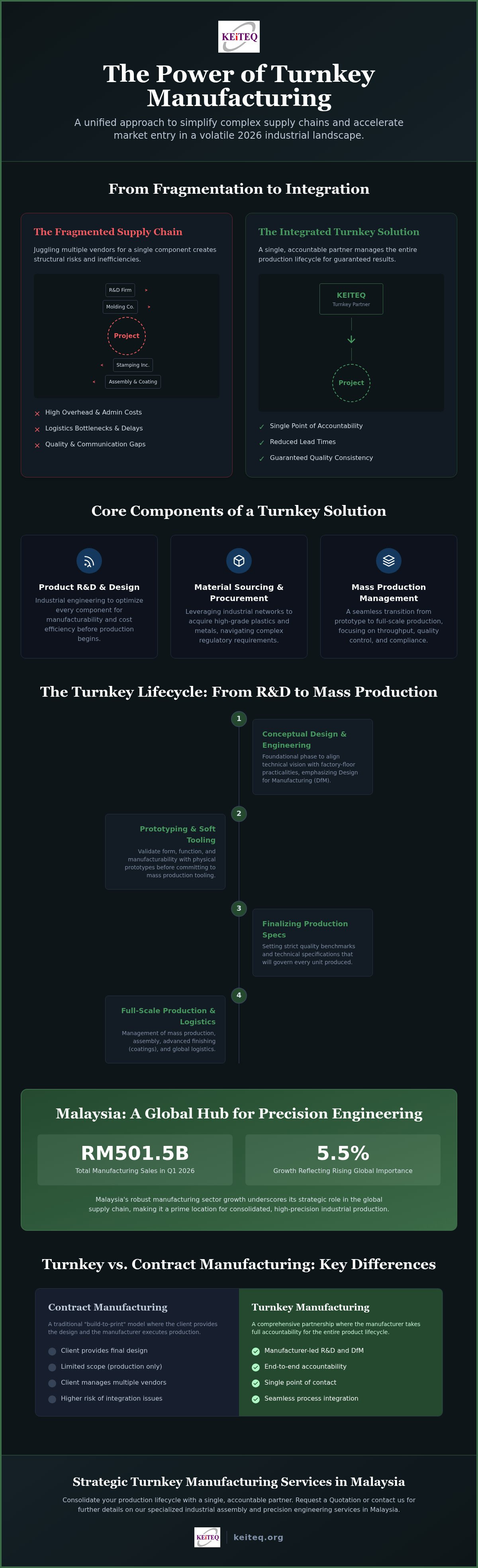
Turnkey manufacturing services provide an end-to-end production model where a single partner oversees every phase from initial R&D to final assembly. While a standard Contract manufacturer might only handle a specific production run based on provided blueprints, a turnkey partner accepts total accountability for the product's entire lifecycle. This model eliminates the technical friction often found when transitioning between design firms and factory floors. It's a strategic choice for OEMs who require high-precision industrial hardware without the burden of managing fragmented supply chains.
In 2026, the industrial environment is characterized by persistent supply chain volatility and elevated input costs for materials like steel and aluminum. Malaysia's manufacturing sector recorded total sales of RM501.5 billion in Q1 2026, reflecting a 5.5% growth that underscores the region's rising importance as a global production hub. To manage this scale effectively, OEMs are prioritizing vendor consolidation. Adopting a single point of responsibility reduces administrative overhead and minimizes the risk of quality inconsistencies that occur when different component suppliers don't communicate.
The Core Components of a Turnkey Solution
A robust turnkey solution integrates three critical stages to ensure market readiness and functional trust. First, Product R&D and Design focuses on industrial engineering; it ensures that every component is optimized for manufacturability and cost efficiency before the first tool is cut. Second, Material Sourcing and Procurement leverages established industrial networks to acquire high-grade plastics and metals while navigating complex 2026 regulatory requirements. Finally, Mass Production Management involves a seamless transition from prototype to mass production. This integration eliminates the delays caused by handing off technical data to an external factory that did not participate in the design phase.
Contract Manufacturing vs. Turnkey: Key Differences
The distinction between these models lies in the depth of the partnership and the scope of accountability. Traditional contract manufacturing is often build-to-print; the client provides the design and the manufacturer simply executes the physical production. In contrast, turnkey manufacturing services involve manufacturer-led execution. The partner takes the lead on project management, quality control, and compliance. While the initial scope is broader, the long-term ROI is superior because it removes the hidden costs of logistics bottlenecks. It transforms production from a constant management challenge into a stable, methodical process governed by professional standards.
The Turnkey Lifecycle: From Product R&D to Mass Production
Successful industrial production is not a series of isolated events. It's a continuous lifecycle that requires precise coordination. Successful manufacturing begins with Integrated Product R&D and Manufacturing. This foundational phase ensures that the technical vision aligns with the practicalities of the factory floor. While some U.S. manufacturing programs emphasize domestic supply chain resilience, global OEMs often leverage turnkey manufacturing services to bridge the gap between initial ideation and large-scale output.
The transition from a concept to a finished product follows a disciplined four-phase approach:
Phase 1: Conceptual design and industrial engineering for scale.
Phase 2: Prototyping and soft tooling to validate form and function.
Phase 3: Finalizing mass production specifications and quality benchmarks.
Phase 4: Full-scale mass production management and logistics.
Each phase is interdependent. Finalizing mass production specifications involves setting strict quality benchmarks that govern every subsequent unit. Phase 4 then transitions into full-scale mass production management and logistics, where the focus shifts to throughput and compliance. This end-to-end oversight is what defines premium turnkey manufacturing services.
Design for Manufacturing (DfM) Excellence
Design for Manufacturing (DfM) is the practice of designing parts specifically for ease of manufacturing. Early design intervention prevents costly errors during mass production by identifying material limitations or assembly bottlenecks before tooling begins. Integrating metal and plastic components into a unified assembly plan requires deep expertise in tolerances and material behavior. For example, plastic housings must account for the thermal expansion of internal metal chassis to prevent mechanical failure. If you are looking to optimize your hardware design, you can consult with our engineering team to ensure your blueprints are production-ready.
Prototyping and Soft Tooling Strategies
Using soft tooling prototyping allows manufacturers to test market-ready samples without the capital investment of permanent steel molds. This strategy is essential for hardware development in industrial tech, where rapid iteration validates mechanical integrity. In regional hubs like Malaysia, where precision engineering is a core strength, these workflows are highly optimized. Coordinated design-to-production workflows reduce time-to-market by ensuring that the prototype data transfers directly to mass production tools with zero loss in precision. In 2026, where hardware lifecycles are shorter, this speed is a critical competitive advantage.
Integrated Industrial Processes: Plastic, Metal, and Diecasting
Integrated production environments offer a distinct technical advantage by combining plastic injection molding and metal fabrication within a single, coordinated workflow. This synergy is essential for complex industrial hardware where aesthetic housings must perfectly interface with structural internal frames. By utilizing turnkey manufacturing services, you eliminate the tolerance stack-up issues that frequently occur when components are sourced from geographically dispersed vendors. A single partner manages the fit and finish across all material types, ensuring that plastic and metal stages align with professional standards. This level of integration is particularly vital as Malaysia's manufacturing sector employed 2.4 million workers in May 2026, reflecting a stable and highly skilled workforce capable of executing these multi-disciplinary processes.
Precision Plastic Injection Molding
Selecting an experienced plastic injection molding manufacturer is a critical decision for industrial-scale projects. Success in this area depends on rigorous technical considerations, such as wall thickness uniformity and the correct application of draft angles to facilitate part ejection. These parameters are not merely design choices; they are fundamental to preventing sink marks, warping, and structural weaknesses in aesthetic housings. Managing high-cavity molds is another core capability required for mass production efficiency. It allows for high-volume throughput while maintaining the tight tolerances necessary for intricate internal components. Proper material selection at this stage directly impacts the physical durability and chemical resistance of the final product, especially for hardware exposed to industrial environments.
Metal Fabrication and Diecasting Synergy
Structural integrity often relies on the specialized expertise of a metal stamping manufacturer. High-volume metal stamping provides the necessary precision for chassis, brackets, and support structures that house heavy electronic assemblies. For parts requiring even greater mechanical complexity and strength, aluminium and zinc diecasting offer superior performance. Aluminium diecasting is particularly effective for weight reduction and thermal management in high-power applications. Zinc diecasting is the preferred choice for smaller, intricate components that require extremely tight tolerances and high impact strength. This multi-material capability ensures that every component of the industrial assembly is optimized for its specific functional role. In 2026, this integrated approach to turnkey manufacturing services is the most reliable way to maintain quality while managing the elevated input costs of raw materials like copper and steel.
Advanced Finishing and Assembly for Outdoor Hardware
Finishing represents the final layer of technical defense for industrial hardware. For equipment deployed in uncontrolled environments, protective coatings for outdoor electronics are critical for longevity and functional reliability. Turnkey manufacturing services that conclude with mechanical assembly without addressing surface protection fail to account for the environmental stressors of 2026. These stressors include high UV exposure, salt spray, and industrial chemical corrosion. Integrated finishing ensures that every component is shielded against premature failure before it leaves the factory floor. This methodical approach to surface treatment is a hallmark of a disciplined production lifecycle.
High-Performance Industrial Coatings
Selecting the correct coating requires a detailed analysis of the intended application. Enamel and ceramic coatings serve as primary solutions for high-heat and chemically harsh environments. Ceramic coatings provide superior heat and wear resistance. For general-purpose outdoor enclosures, industrial powder coating offers superior abrasion resistance and professional aesthetics. Meeting strict durability standards for unattended outdoor kiosks is a technical necessity. These coatings prevent oxidation and maintain the mechanical integrity of both metal and plastic surfaces under constant use. A single point of responsibility in turnkey manufacturing services ensures that the coating process is compatible with the underlying material properties, preventing adhesion failures or surface degradation.
Outdoor Payment Terminal Assembly
Engineering outdoor payment terminal assembly for fuel retail environments requires a high level of electromechanical expertise. These terminals must operate with absolute reliability in petrol and gas stations where they are exposed to fuel vapors and extreme temperature fluctuations. The assembly process involves integrating electronics, high-brightness displays, and secure payment peripherals into robust enclosures. These enclosures are designed to meet rigorous weatherproofing and vandal-resistance standards. Quality control protocols at this stage are exhaustive. They include ingress protection (IP) testing and impact resistance validation to ensure the hardware survives years of unattended service. If your project requires these specialized capabilities, you can contact our technical team for a detailed briefing on our assembly standards for outdoor payment terminals.
Strategic Turnkey Manufacturing Services in Malaysia
Malaysia has solidified its position as a critical node in the global supply chain. In May 2026, manufacturing sales reached RM172.7 billion, representing an 8.9% increase from the previous year. The electrical and electronics sector led this growth with a significant 26.4% sales jump. This momentum makes the region an ideal location for high-precision turnkey manufacturing services. By centralizing operations here, OEMs benefit from a mature ecosystem that supports everything from initial design to mass production. The region's S&P Global Manufacturing Purchasing Managers' Index (PMI) reached 50.7 in July 2026, indicating a steady expansion and a stable environment for long-term industrial partnerships.
The regulatory environment in Malaysia has also evolved to prioritize safety and professional compliance. As of June 2024, the amended Occupational Safety and Health Act (OSHA) 1994 governs all workplaces, requiring strict adherence to safety standards for pressure vessels and machinery. This disciplined regulatory framework ensures that your production partner maintains a safe and efficient floor. Such stability is a key component of reliable turnkey manufacturing services, providing the functional trust required by global procurement officers.
Why Malaysia for Your Next Industrial Project?
The region offers access to a highly skilled engineering workforce and advanced industrial infrastructure. Strategic logistics positioning allows for efficient global distribution to U.S. and European markets. This is particularly advantageous for electronic manufacturing services in Malaysia, where technical directors value the balance of cost-efficiency and compliance with international quality standards. The local business environment is specifically structured to support complex hardware OEM partnerships through technology-integrated capital investments. Furthermore, the workforce composition requirements ensure that at least 25% of employees are in managerial or technical roles, guaranteeing a high level of expertise on the factory floor.
Partnering with Keiteq for Global Success
Keiteq bridges the gap between stringent U.S. design requirements and the specialized production efficiency found in Southeast Asia. We leverage deep regional expertise for plastic injection mold Malaysia projects, ensuring that complex tooling meets global precision benchmarks. Our 'Safe Pair of Hands' approach provides a disciplined framework for mass production management, removing the risks associated with managing multiple overseas vendors. We act as your primary facilitator, navigating the practical realities of the factory floor while maintaining corporate-level accountability.
Consolidating your production in Malaysia through a single point of contact reduces lead times and guarantees consistent quality across the entire lifecycle. Whether your project involves outdoor payment terminal assembly or precision diecasting, we provide the logistical competence required for global distribution. Please submit a Request for Quotation to begin your next turnkey manufacturing journey or a Request to contact us for further details regarding our regional offerings.
Securing Your Industrial Supply Chain for 2026
The transition toward consolidated production is a strategic necessity for OEMs navigating the technical complexities of 2026. By adopting integrated turnkey manufacturing services, you eliminate the risks of supply chain fragmentation and ensure a seamless transition from initial R&D to final assembly. This methodical approach guarantees that every component meets rigorous benchmarks for precision and durability. It reduces administrative overhead while providing a single point of accountability for your entire production lifecycle.
Keiteq serves as a dependable pillar for global brands, offering specialized expertise in petrol and gas station hardware. Our facilities in Malaysia provide integrated plastic and metal production alongside advanced enamel and ceramic coating capabilities. These high-performance finishes are essential for the functional longevity of hardware exposed to chemically harsh or high-heat environments. We bridge the gap between design requirements and production efficiency, acting as a safe pair of hands for your most complex industrial projects.
Take the next step in optimizing your regional production strategy. We invite you to Request for Quotation for our Turnkey Manufacturing Services in Malaysia or submit a request to contact us for further details regarding our industrial capabilities. We look forward to facilitating your global success through disciplined manufacturing excellence.
Frequently Asked Questions
What is included in a typical turnkey manufacturing service agreement?
A standard agreement for turnkey manufacturing services covers the entire production lifecycle from initial engineering to final delivery. It includes product R&D, material procurement, specialized plastic molding, metal stamping, and mass production management. Unlike fragmented contracts, these agreements consolidate logistics and quality assurance under one entity. This ensures that technical specifications are maintained from the initial design phase through to final assembly and packaging.
How does turnkey manufacturing differ from contract manufacturing?
The primary difference lies in the scope of responsibility and project leadership. Contract manufacturing typically follows a build to print model where the client provides all designs and manages the supply chain independently. Turnkey manufacturing services accept total accountability for the project execution. The manufacturer leads the engineering, sources all necessary materials, and oversees the complete assembly. This reduces the client's administrative burden and minimizes technical friction.
Can a turnkey manufacturer help with product design and R&D?
Yes, integrated R&D and industrial design are core components of a professional turnkey solution. Manufacturers provide Design for Manufacturing (DfM) expertise to ensure blueprints are optimized for mass production efficiency. This process identifies potential molding or stamping issues before capital is committed to permanent tooling. Early intervention reduces material waste and ensures that intricate internal components fit perfectly within their structural housings.
What are the benefits of manufacturing outdoor payment terminals in Malaysia?
Malaysia offers a highly skilled engineering workforce and a mature ecosystem for electronic manufacturing services. In May 2026, the country's manufacturing sales reached RM172.7 billion, driven largely by the electrical and electronics sector. This scale provides OEMs with cost efficient production without compromising on international quality standards. The region's strategic logistics positioning also facilitates seamless global distribution to major markets in the U.S. and Europe.
How do industrial coatings like enamel or ceramic improve product lifespan?
High performance coatings provide a critical barrier against environmental stressors in uncontrolled settings. Ceramic coatings offer superior heat and wear resistance, which is essential for hardware in high temperature industrial environments. Enamel coatings protect against chemical corrosion and UV degradation in fuel retail settings. These treatments prevent oxidation and maintain the mechanical integrity of metal and plastic surfaces. This significantly extends the operational life of outdoor equipment.
What is the typical lead time for transitioning from prototype to mass production?
Lead times depend on the complexity of the hardware and the tooling strategy employed by the partner. Utilizing soft tooling for prototyping can significantly compress the development cycle by allowing for rapid validation of form and function. Once the design is finalized, transitioning to hard tooling for mass production typically takes several weeks. Coordinated turnkey workflows ensure that technical data transfers seamlessly between stages, reducing the delays common in multi vendor relationships.
Why is vendor consolidation important for industrial hardware OEMs?
Vendor consolidation eliminates the supply chain fragmentation that leads to quality inconsistencies and logistics bottlenecks. Managing a single point of contact reduces administrative overhead and simplifies the procurement process. It ensures that all components, whether plastic or metal, are engineered to work together within tight tolerances. This unified oversight accelerates time to market and provides a more stable cost base in a volatile global economy.
How does Keiteq ensure quality control across different manufacturing processes?
Keiteq utilizes a disciplined quality management system that spans the entire production lifecycle. We implement rigorous inspection protocols at every stage, from initial material sourcing to final assembly. For specialized products like outdoor payment terminals, we conduct exhaustive weatherproofing and vandal resistance testing. This integrated approach ensures that every unit meets professional standards for durability and functional reliability before it leaves our Malaysian facilities.


Comments