
Zinc Diecasting Services: Precision Manufacturing and Industrial Scalability in 2026
Updated: Aug 30
The global die casting services market is projected to reach $61.0 billion in 2026, yet technical directors still face the persistent challenge of high failure rates in complex geometries. It's difficult to find a partner that can maintain precision while scaling to industrial volumes. Utilizing specialized zinc diecasting services is no longer just about part production; it's about ensuring that every component meets rigorous durability standards without requiring extensive secondary machining.
You probably recognize the friction that occurs when there's a lack of integration between initial design and mass production. This disconnect often leads to costly delays and compromised structural integrity in harsh environments. This article demonstrates how precision zinc diecasting integrates with expert R&D to deliver high-durability components for global industrial applications. We'll examine the strategic advantages of seamless production transitions and the benefits of utilizing a stable, expert manufacturing hub in Malaysia to achieve consistent, high-precision results for your 2026 hardware requirements.
Table of Contents
What Are Zinc Diecasting Services and Why Do They Matter?
Industrial manufacturing in 2026 relies on the ability to produce high-precision metal parts at scale. Professional zinc diecasting services provide a specialized solution by injecting molten zinc alloys into steel molds under high pressure. This zinc die casting process is favored for its ability to produce intricate geometries that maintain exceptionally tight tolerances. Zinc's high fluidity at low melting temperatures allows for the creation of complex features that other metals don't achieve without extensive secondary machining. This efficiency is critical in a global market where reducing waste and cycle times directly impacts bottom-line results.
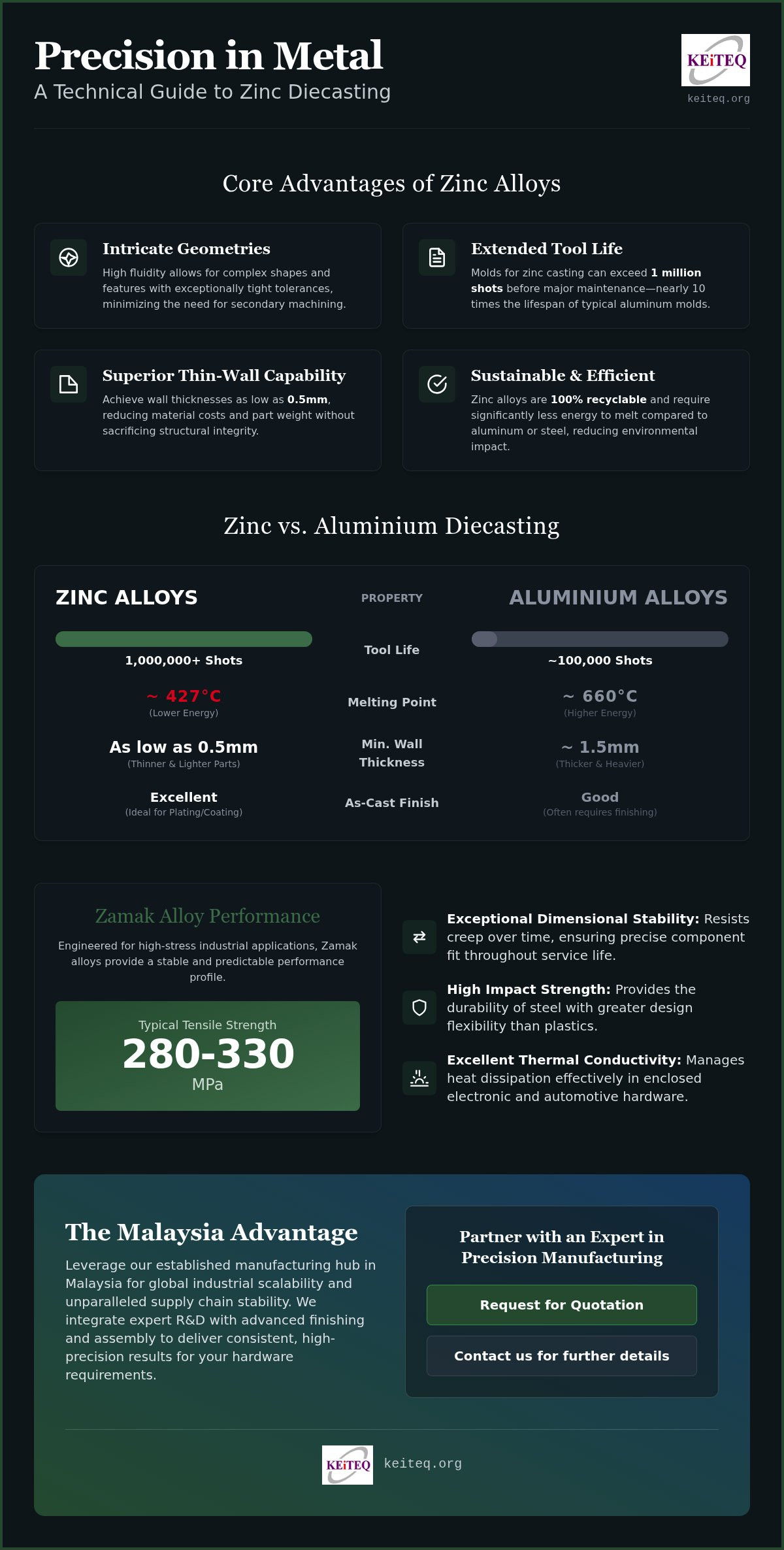
The 2026 industrial landscape prioritizes both procedural accuracy and material sustainability. Zinc alloys are 100% recyclable, and their low melting point, approximately 427 degrees Celsius, requires significantly less energy compared to aluminum or steel casting. This makes zinc a primary material for organizations committed to sustainable production cycles. Beyond environmental benefits, the high strength and excellent thermal conductivity of zinc make it the preferred choice for components that must withstand mechanical stress while managing heat dissipation in enclosed environments.
The Core Advantages of Zinc Alloys in Manufacturing
Zinc alloys offer mechanical properties that simplify the manufacturing of complex hardware. One significant advantage is superior thin-wall capability. Zinc can be cast with wall thicknesses as low as 0.5mm, which reduces material costs and part weight without sacrificing structural integrity. Additionally, zinc's low melting point leads to extended tool life. Molds used for zinc casting can often exceed one million shots before requiring significant maintenance, which is nearly ten times the lifespan of aluminum molds. Keiteq Co Ltd leverages these advantages to provide professional zinc diecasting services that ensure stable, long-term production for global OEMs. For sensitive electronics, zinc also provides natural EMI shielding and vibration damping, ensuring the protection of internal components within industrial enclosures.
Zinc vs. Other Manufacturing Methods
Selecting the appropriate production method is vital for industrial scalability. Compared to CNC machining, zinc diecasting is more efficient for high-volume production because it produces near-net shapes in seconds, drastically reducing material waste. While some projects may require the specific properties of a plastic injection molding manufacturer, industrial hardware often necessitates the superior impact resistance of metal. Zinc provides the durability of steel with the design flexibility typically associated with plastics. This makes it the ideal material for hardware that must endure harsh physical environments, such as automotive sensors or outdoor payment terminal housings, where plastic would likely degrade or fail under heavy stress.
Technical Specifications: Zinc Alloys and Material Performance
Achieving long-term reliability in industrial hardware starts with precise alloy selection. While many manufacturing processes offer generic material options, professional zinc diecasting services rely on a specific family of alloys known as Zamak. These materials are engineered to provide high-impact strength and exceptional dimensional stability. In complex assemblies, even a micron-level shift in part dimensions over time can lead to mechanical failure. Zinc alloys resist this dimensional creep, ensuring that components fit perfectly throughout their entire service life, even under constant mechanical load.
Mechanical performance is measured through tensile strength, yield strength, and Brinell hardness. Standard zinc alloys typically exhibit a tensile strength of approximately 280 to 330 MPa. This level of durability is essential for the industrial scalability required in sectors like automotive and telecommunications. When hardware must withstand high-vibration environments or physical stress, zinc provides a predictable and stable performance profile that lighter metals or plastics don't match. This predictability allows engineers to design parts with thinner walls without sacrificing the component's structural integrity.
Zamak Alloys: The Industry Standard for Precision
Zamak 3 is the most frequently specified alloy due to its excellent balance of physical and mechanical properties. It offers the best combination of ductility and strength for most industrial applications. However, for projects requiring higher creep resistance and increased hardness, Zamak 5 is the preferred choice. It contains approximately 1% copper, which enhances its tensile strength and hardness. Other specialized options include Zamak 2, which offers the highest strength in the Zamak family, and Zamak 7, a high-purity alloy designed for increased fluidity in complex, thin-walled casts. At Keiteq Co Ltd, we prioritize material purity. Our quality control protocols in Malaysia ensure that every batch of alloy meets stringent international standards, preventing the contamination that leads to intergranular corrosion. If you have specific technical requirements, you can speak with our engineering team to determine the optimal alloy for your specific project.
Zinc's Performance in Harsh Industrial Environments
Outdoor hardware must perform under extreme thermal stress and moisture exposure. Zinc possesses high thermal conductivity, which helps dissipate heat from internal electronics in devices like outdoor payment terminals. While zinc is naturally corrosion-resistant, industrial environments often require additional layers of defense. Integrating zinc components with protective coatings for outdoor electronics ensures long-term survivability. Our manufacturing hub in Malaysia specializes in applying advanced finishes like enamel and ceramic coatings, providing a robust barrier against salt spray, UV exposure, and chemical abrasion.
Zinc vs. Aluminium Diecasting: A Comparative Framework
Choosing between these two metals often hinges on the specific mechanical requirements of the hardware. While aluminium is lightweight, professional zinc diecasting services offer higher precision for complex components. Zinc's higher density is often mitigated by its superior fluidity, which allows for thinner wall architectures than what is achievable with aluminium. According to the International Zinc Association, zinc alloys provide greater impact strength and ductility, making them the preferred choice for parts that must withstand mechanical stress in tight assemblies where space is limited.
The casting process itself varies significantly between the two materials. Zinc utilizes the hot-chamber process, where the injection mechanism remains submerged in molten metal. This configuration allows for faster cycle times and improved thermal efficiency compared to the cold-chamber process required for aluminium. Tooling longevity is a major cost factor in high-volume industrial production. Because zinc has a lower melting point, it significantly reduces thermal fatigue and erosion on the steel molds. A zinc diecasting mold can often produce over one million shots, whereas an aluminium mold might last only 100,000 to 150,000 cycles. This longevity drastically lowers the long-term cost per unit and reduces the frequency of expensive tooling replacements.
When to Choose Zinc Over Aluminium
Zinc is the superior choice for small, intricate parts where dimensional accuracy is paramount. If a design requires complex internal geometries or a high-performance surface finish, zinc is the better option. It's much easier to plate or coat zinc components with specialized finishes like enamel or ceramic compared to aluminium. This makes it ideal for consumer-facing hardware where aesthetics must match durability. Choosing zinc also reduces secondary machining costs because the "as-cast" finish is often precise enough for final assembly. It's a "safe pair of hands" approach for projects that don't allow for the tolerance variations common in other casting methods, much like the exacting standards required in property maintenance and security hardware management provided by Key Qualities.
Similarly, for those managing large-scale construction or renovation projects, Trade Tech Windows & Doors provides the same focus on material quality and precision through their specialized uPVC and aluminium glazing solutions.
Material selection influences your entire supply chain strategy and total procurement cost. To gain a broader perspective on managing industrial material assets, you can check out Carbide Kings for a strategic guide on tungsten carbide scrap market trends. While zinc is heavier, its production speed and mold durability often lead to lower overall budgets for mass production. Integrating these processes with a reliable metal stamping manufacturer can further streamline your assembly. Keiteq Co Ltd manages both aluminium and zinc diecasting from our hub in Malaysia, providing a single point of contact for diverse hardware needs. This dual capability ensures that whether you need the lightweight profile of aluminium or the precision of zinc, your production remains consistent and scalable. Our Malaysia facilities are positioned to handle these logistical complexities, ensuring that material choice translates directly into operational efficiency.
Reliable hardware production requires a proactive approach to engineering. It's not enough to have a functional design; it must be a manufacturable one. Professional zinc diecasting services provide the technical oversight needed to translate complex hardware requirements into high-yield production runs. Design for Manufacturability (DFM) is the core of this transition. By analyzing part geometries early, engineers can reduce secondary machining requirements and lower the overall cost per unit. The integrated R&D approach at Keiteq Co Ltd acts as a "safe pair of hands," bridging the gap between a digital concept and a physical cast. Strategic placement of gates and overflows ensures that the molten alloy flows uniformly, eliminating structural weaknesses and ensuring every component meets industrial standards.
Key Design Considerations for Zinc Diecasting
Precision in zinc diecasting relies on specific geometric rules. Draft angles are a primary consideration. They facilitate the clean ejection of the part from the mold without surface damage. While zinc's high fluidity allows for minimal draft angles, uniformity remains essential for consistent results. Similarly, maintaining wall thickness uniformity prevents common defects such as porosity and shrinkage during the cooling process. When a part requires additional structural strength, designers should incorporate ribs and bosses. These features provide the necessary rigidity for industrial hardware without the weight penalty of solid, thick-walled sections. This balance of strength and efficiency is a hallmark of disciplined engineering in our Malaysia-based facilities.
Prototyping and Tooling Strategies
Validation is a non-negotiable step in the transition to mass production. Utilizing prototype and soft tooling allows engineers to test the mechanical performance and fit of a component before committing to expensive hard tooling. This phase de-risks the entire project. It ensures that the final mold is optimized for long-term production runs with minimal maintenance. The R&D-driven methodology at Keiteq Co Ltd supports this transition, moving seamlessly from design validation to end-to-end product manufacturing. This integrated workflow is particularly beneficial for complex industrial hardware, such as outdoor payment terminals, where environmental durability is a priority. If you're ready to move from concept to production, you can contact our design team for a technical review of your project.
Advanced Finishing and Global Assembly: The Keiteq Co Ltd Malaysia Advantage
The casting process represents the physical realization of a design, but industrial longevity is secured during the finishing and assembly stages. Professional zinc diecasting services at Keiteq Co Ltd extend beyond the mold to include advanced surface treatments that prepare components for the most demanding environments. In Malaysia, we provide a centralized hub where casting, specialized coating, and final assembly converge. This integration reduces the logistical risks associated with fragmented supply chains and ensures that every part is handled with a "safe pair of hands" throughout its production lifecycle.
Specialized Coatings for Industrial Durability
Surface finishing isn't an aesthetic luxury; it's a functional requirement for hardware exposed to chemical abrasion or extreme weather. Keiteq Co Ltd specializes in high-performance enamel and ceramic coatings, which provide a robust barrier against corrosion and thermal stress. These coatings are particularly critical for industrial tech where standard paint finishes would degrade prematurely. Additionally, our powder coating services offer high impact resistance and aesthetic uniformity for large-scale production runs. By managing these processes in-house at our Malaysia facility, we ensure that every part meets stringent international quality standards before proceeding to final assembly.
Malaysia: A Strategic Hub for Global OEMs
Consolidating manufacturing within a single regional hub provides significant cost and time advantages for global OEMs. Keiteq Co Ltd leverages its established presence to offer a turnkey solution, from the initial cast to complex outdoor payment terminal assembly. This integrated approach allows for the seamless inclusion of components from our electronic manufacturing services in Malaysia and plastic injection molding services in Malaysia.
The ability to manage multi-material assemblies, where precision zinc parts interface with sensitive electronics and durable plastic housings, is a core strength of our Malaysia operations. This synergy ensures that every finished product is a cohesive, high-durability unit ready for global deployment. Our role as a global facilitator is to provide a steady and reassuring presence for your production needs, ensuring that scalability doesn't come at the expense of precision or reliability. By centralizing these diverse capabilities, we provide a methodical and highly organized path from raw material to finished hardware.
To explore how our integrated production model can support your 2026 hardware goals, please submit a Request for Quotation or a Request to contact us for further details regarding our industrial services in Malaysia.
Strategic Hardware Scalability for 2026
Success in modern industrial production requires a transition from fragmented vendor management toward integrated, high-precision solutions. The technical advantages of zinc—including superior dimensional stability, impact resistance, and energy efficiency—provide a robust foundation for complex hardware components. When these physical properties are combined with disciplined Design for Manufacturability (DFM) and advanced surface treatments, the result is a component capable of withstanding extreme environmental stress. Professional zinc diecasting services at Keiteq Co Ltd provide the procedural accuracy needed to ensure that every part meets its design intent throughout the entire mass production lifecycle.
By leveraging our specialized manufacturing hub in Malaysia, global OEMs can achieve significant logistical advantages and production consistency. Our "safe pair of hands" approach ensures that specialized hardware, such as outdoor payment terminals, is assembled with the highest level of technical competence. Keiteq Co Ltd remains a steady partner in your global supply chain, providing the stability and expertise required to navigate the intricacies of international production. We invite you to engage with our engineering team to secure your hardware requirements for the coming year.
For high-precision manufacturing solutions at industrial scale, Request for Quotation or Request to contact us for further details regarding our specialized zinc diecasting services in Malaysia.
Frequently Asked Questions
What are the primary benefits of using zinc diecasting for industrial parts?
Zinc provides high precision, superior thin-wall capability, and excellent ductility. It allows for the production of intricate geometries that require tight tolerances, often eliminating the need for expensive secondary machining. Its high strength and thermal conductivity make it ideal for mechanical components in demanding sectors. Additionally, zinc is 100% recyclable, meeting 2026 sustainability standards. These professional zinc diecasting services ensure that complex hardware remains durable while fulfilling strict performance requirements for global industrial applications.
How does zinc diecasting compare to aluminium in terms of cost?
Zinc often provides a lower cost per part over the long term despite having a higher raw material density than aluminium. The primary savings come from mold longevity; zinc molds typically last up to ten times longer than their aluminium counterparts. Because zinc has a lower melting point, it reduces thermal shock on the steel tooling. This durability results in significant cost efficiency for high-volume production. Zinc's precision also reduces the need for secondary machining operations.
Can zinc diecast parts be used in outdoor environments?
Zinc diecast parts are highly effective for outdoor environments when they are paired with specialized surface treatments. While zinc has natural corrosion resistance, industrial applications like outdoor payment terminals require additional layers of defense. We apply advanced coatings to protect against UV exposure, moisture, and salt spray. These treatments ensure that hardware remains functional and aesthetically consistent in harsh climates. This makes zinc a reliable choice for long-term outdoor deployment in global markets.
What is the typical tool life for a zinc diecasting mold?
A typical zinc diecasting mold can produce over one million shots before requiring major maintenance or replacement. This extended tool life is a direct result of zinc's low melting temperature, which minimizes wear on the steel dies. In contrast, aluminium molds often require significant repair after only 100,000 cycles. This stability makes zinc the preferred choice for mass production where consistency and logistical competence are critical for maintaining a steady, efficient supply chain.
How does Keiteq integrate R&D with zinc diecasting services?
Keiteq integrates R&D by providing technical oversight during the design phase to ensure manufacturability. Our engineers analyze part geometries to optimize gate placement and overflow strategy, preventing porosity and structural failures. This "safe pair of hands" approach bridges the gap between digital concepts and physical production. By identifying potential issues early, our zinc diecasting services help clients transition smoothly from complex hardware designs to high-yield mass production without compromising on dimensional accuracy.
What types of specialized coatings are available for zinc components?
We provide a comprehensive range of specialized coatings, including enamel, ceramic, and high-performance powder coating. Enamel and ceramic treatments offer extreme heat and chemical resistance, which is vital for industrial tech and fuel retail hardware. Powder coating provides impact resistance and aesthetic consistency across large production batches. These advanced surface finishes are applied in our Malaysia facility to ensure compliance with international industrial standards and to maximize the longevity of cast components.
Why is Malaysia a preferred location for zinc diecasting and assembly?
Malaysia is a preferred location due to its established industrial infrastructure and cost-effective production environment. Our facility leverages regional expertise in electronic manufacturing services and plastic injection molding to provide holistic assembly solutions. This centralized location allows for efficient logistics and supply chain management across global markets. By operating in Malaysia, we offer a stable, professional environment for high-precision manufacturing and large-scale industrial assembly, acting as a dependable global facilitator.
Does Keiteq provide prototyping services before mass production?
Yes, Keiteq provides prototyping and soft tooling services to validate designs before moving to mass production. This phase allows technical directors to test the mechanical fit and performance of a component, which effectively de-risks the entire project. Prototyping ensures that any necessary design adjustments are identified early, saving significant time and resources. This methodical approach is part of our commitment to delivering reliable, high-durability hardware that meets rigorous industrial specifications.


Comments