
Expert Cleanroom Assembly & Injection Molding in Malaysia
Updated: Sep 6
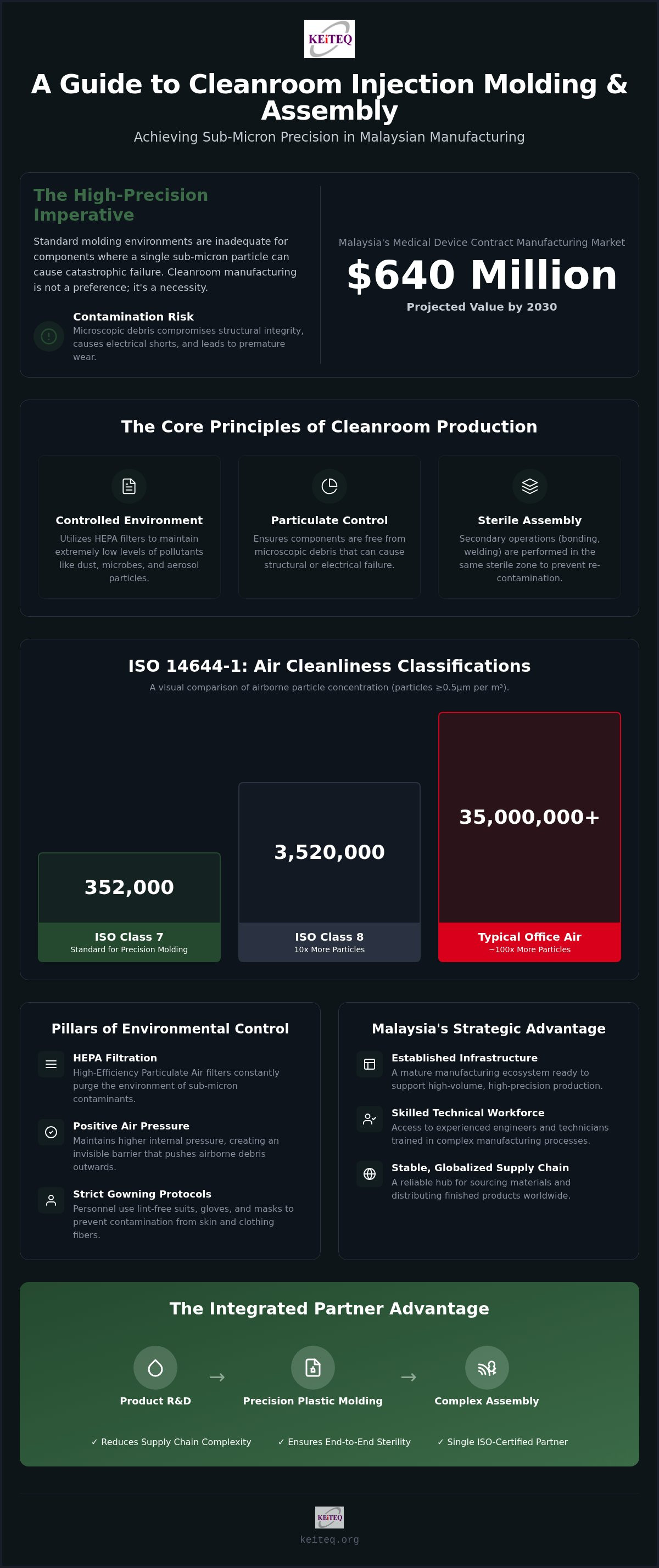
Malaysia’s medical device contract manufacturing market is projected to reach $640 million by 2030, but this growth is irrelevant if your production line can't eliminate sub-micron contamination. You already know that standard molding environments aren't sufficient for high-precision components where a single particle can cause total failure. Selecting a partner for cleanroom assembly injection molding Malaysia requires a disciplined approach to ISO compliance and procedural accuracy.
It's a common challenge to maintain consistency when moving from a successful prototype to full-scale mass production. This article details how to navigate the technical requirements of ISO 14644-1:2015 and the strategic advantages of the Malaysian regulatory landscape. You'll learn how to identify an ISO-certified partner that provides a stable, end-to-end manufacturing solution. We provide the clarity you need to secure sterile assembly processes that meet global standards and protect your supply chain.
Table of Contents
Understanding Cleanroom Injection Molding and Assembly Requirements
ISO Standards and Environmental Control in Cleanroom Manufacturing
Critical Applications for Cleanroom Plastic Injection Molding
Why Malaysia is the Strategic Hub for Cleanroom Assembly in 2026
Keiteq: Your Integrated Partner for Cleanroom Solutions in Malaysia
Understanding Cleanroom Injection Molding and Assembly Requirements
Cleanroom injection molding is a specialized manufacturing process executed within a strictly controlled environment. Unlike standard production floors, these zones utilize High-Efficiency Particulate Air (HEPA) filters to maintain low levels of environmental pollutants such as dust, airborne microbes, and aerosol particles. Implementing cleanroom assembly injection molding Malaysia ensures that sensitive components remain free from contamination from the moment the resin enters the hopper until the final product is sealed. This level of control isn't just a preference; it's a technical necessity for industries where microscopic debris can lead to total product failure.
Standard molding environments often harbor microscopic debris that is invisible to the naked eye. While these particles don't affect consumer goods, they are catastrophic for high-precision industrial hardware. Adhering to Cleanroom standards allows manufacturers to stabilize the production atmosphere. This ensures that every cycle yields a part with consistent chemical and physical properties, effectively bridging the gap between prototype quality and mass production reliability.
The Critical Need for Particulate Control
Microscopic dust isn't just a surface issue. It can compromise the structural integrity of a component by creating inclusions during the cooling phase. In electronic applications, a single conductive particle can bridge two circuits, leading to immediate failure or a significantly reduced lifespan. For mechanical parts, grit acts as an abrasive, causing premature wear in moving assemblies. To mitigate these risks, procurement officers prioritize plastic injection molding services in Malaysia that offer dedicated cleanroom facilities. This level of control is vital for high-precision industrial sensors where accuracy is non-negotiable and environmental variables must be eliminated.
Beyond Molding: The Importance of Sterile Assembly
Molding a sterile part is only the first step. If that part is transferred to an uncontrolled environment for secondary operations, the initial cleanliness is lost. Integrated cleanroom assembly involves the bonding, welding, and testing of components within the same sterile zone. This approach prevents contaminants from being trapped between mated surfaces during processes like ultrasonic welding or adhesive bonding. It creates a seamless transition from the molding machine to the final assembly line.
Many advanced projects require the fusion of plastic housings with sensitive internal electronics. Sourcing electronic manufacturing services in Malaysia that include cleanroom assembly provides a streamlined, end-to-end solution. This integration reduces supply chain complexity and ensures that cleanroom assembly injection molding Malaysia delivers a finished product that meets the most rigorous industrial specifications. By maintaining a continuous chain of sterility, manufacturers protect the functional trust of their global partners.
ISO Standards and Environmental Control in Cleanroom Manufacturing
Compliance with ISO 14644-1:2015 is the foundation of high-precision manufacturing. This standard classifies air cleanliness by particle concentration, providing a universal language for procurement officers and engineers. High-efficiency particulate air (HEPA) filters and positive air pressure systems work in tandem to purge the production environment. By maintaining a higher internal pressure than the surrounding facility, these systems create an invisible barrier that pushes airborne debris away from critical molding surfaces. This mechanical discipline is essential for cleanroom assembly injection molding Malaysia, where consistency across mass production runs is a primary objective.
The human element remains the greatest risk to environmental integrity. Personnel must follow stringent gowning protocols, including the use of lint-free suits, gloves, and masks. These measures prevent the shedding of skin cells and clothing fibers into the controlled zone. Verifying that these protocols effectively maintain sub-micron cleanliness often requires advanced imaging technology, such as the scanning electron microscopes provided by Electron Optics Instruments, LLC. Discipline on the factory floor ensures that the technical investments in filtration aren't undermined by procedural lapses.
ISO Class 7 is the standard requirement for precision molding and sterile assembly. In this environment, the concentration of particles sized 0.5 microns or larger is limited to 352,000 per cubic meter. For comparison, ISO Class 8 allows up to 3,520,000 particles, while a typical office environment contains billions. Determining the correct class depends on your product's sensitivity. High-value sensors and optical components usually demand the tighter controls of Class 7. If you're unsure which classification fits your project, consult with a technical specialist to review your specifications.
Maintaining Environmental Integrity
Physical barriers are as important as air filtration. Specialized plastic injection mold Malaysia facilities utilize air showers to strip particles from personnel before they enter the cleanroom. Pass-through boxes allow for the transfer of raw materials and finished parts without breaking the room's seal. This infrastructure is a core part of Malaysia's medical device ecosystem, which supports global OEMs through rigorous adherence to international quality management systems.
Continuous monitoring is mandatory. Sensors track temperature, humidity, and pressure differentials in real-time. Even a slight deviation in humidity can cause static discharge, attracting dust to molded parts. Temperature fluctuations can lead to material warping, compromising the tight tolerances required for cleanroom assembly injection molding Malaysia. Professional facilities provide documented logs of these variables, ensuring total transparency and procedural accuracy for every production lot.
Critical Applications for Cleanroom Plastic Injection Molding
Cleanroom environments aren't exclusive to the medical sector. The rapid expansion of 5G infrastructure and electric vehicle production in Southeast Asia has increased the demand for zero-particulate manufacturing. Adhering to ISO 14644-1 cleanroom standards is now a baseline requirement for high-end electronics. Implementing cleanroom assembly injection molding Malaysia serves as a critical safeguard for components where even a 0.5-micron particle can cause a short circuit or signal interference. This precision is vital for the electrical and electronics sector, which represents the fastest-growing application for plastics in Malaysia with a projected 3.96% CAGR through 2031.
The semiconductor industry particularly benefits from these controlled environments. As chips become smaller and more complex, the packaging that houses them must be equally precise. Even a minor particulate inclusion in a plastic housing can lead to heat dissipation issues or mechanical stress. By centralizing production in a Malaysian hub, OEMs can leverage a highly skilled workforce and established logistics to maintain these tight tolerances across millions of units. This stability reduces the risk of field failures and protects the brand reputation of global technology leaders.
High-Precision Electronics and Sensors
Optical sensors and laser-guided systems require absolute clarity. Any inclusion of dust during the molding of lenses or sensor housings results in refraction errors. This precision extends to industrial hardware exposed to harsh environments. For example, outdoor payment terminal assembly relies on cleanroom-molded internal components to ensure that sensitive card readers and touchscreens don't fail due to internal debris. By molding these parts in a controlled zone, manufacturers eliminate latent defects that only appear after the product is deployed in the field. This disciplined approach ensures functional trust in critical financial and industrial infrastructure.
Medical and Biotech Component Manufacturing
Malaysia is strategically moving from basic consumables to producing high-value devices like pacemakers and electro-diagnostic equipment. This shift requires strict ISO 13485:2016 compliance, which is now harmonized with U.S. FDA regulations as of February 2026. Bio-compatible materials demand specialized handling to prevent cross-contamination that could lead to adverse patient reactions. Utilizing professional plastic injection molding services in Malaysia allows OEMs to validate their designs in a sterile environment before moving to mass production. This holistic approach ensures that surgical tools and diagnostic housings meet the rigorous safety standards required for global export. The Malaysian government targets RM50 billion in medical device exports by 2030, reinforcing the need for cleanroom assembly injection molding Malaysia to maintain international quality benchmarks.
Why Malaysia is the Strategic Hub for Cleanroom Assembly in 2026
To see how these rigorous sterile standards are applied to specialized research instruments and delivery systems from ReadyPep, read more.
Similarly, the high standards of precision engineering required in the healthcare sector are exemplified by RIHA Industries, which specializes in the design and manufacture of advanced patient transfer systems and bed movers for hospital environments.
Malaysia is no longer a secondary manufacturing site; it's a primary global hub for precision engineering. In 2025, the Malaysian government approved RM4 billion in new medical device investments across 46 projects. This capital influx supports the expansion of high-tech facilities required for cleanroom assembly injection molding Malaysia. Global OEMs are increasingly moving operations to Malaysian industrial zones, often coordinating with regional experts like Fong’s Engineering & Manufacturing Private Limited to capitalize on a mature ecosystem that bridges the gap between R&D and mass production. The country's established infrastructure allows for rapid scaling while maintaining the rigorous particulate controls discussed in previous sections.
The maturity of the Malaysian plastics sector is evidenced by its estimated USD 4.19 billion market size in 2026. This scale allows for a robust secondary supply chain, providing access to specialized tooling and raw material suppliers. Manufacturers here don't just offer capacity; they offer technical depth in high-performance engineering plastics used in 5G and electric vehicle infrastructure. By utilizing plastic injection molding services in Malaysia, companies secure a partner capable of managing the entire production lifecycle within a single geographical region. This reduces the logistical friction often associated with fragmented supply chains.
Logistical and Strategic Advantages
Proximity to major international shipping lanes and world-class ports like Port Klang and Port of Tanjung Pelepas ensures efficient global distribution. This logistical strength is a cornerstone of the "China Plus One" strategy. Global OEMs use Malaysia to diversify their supply chains, reducing geopolitical risk while maintaining the high production standards required for sterile components. The country’s legal framework provides strong intellectual property protection, which is vital for proprietary industrial hardware and medical designs.
The cost-efficiency of operating in Malaysia remains high when compared to other regional hubs with similar technical capabilities. You get the benefit of a sophisticated industrial infrastructure without the overhead costs found in more saturated markets. To explore how these regional advantages can optimize your specific project, contact our technical team for a briefing regarding our Malaysian operations.
Keiteq: Your Integrated Partner for Cleanroom Solutions in Malaysia
Keiteq Co Ltd operates as a global facilitator for OEMs requiring disciplined manufacturing execution in Southeast Asia. Our integrated model consolidates product R&D, industrial design, and mass production under a single management umbrella. This structure eliminates the technical friction and communication gaps often found when coordinating between multiple vendors. By maintaining specialized cleanroom assembly injection molding Malaysia facilities, we provide a stable, end-to-end manufacturing solution for complex industrial and specialized hardware. Our "Safe Pair of Hands" philosophy ensures that every project benefit from a seasoned veteran's approach to procedural accuracy and logistical competence.
Consolidating R&D and manufacturing reduces supply chain complexity. It allows our engineering teams to design for manufacturability from the earliest stages. This foresight prevents costly revisions during the transition to high-volume production. We prioritize reliability and functional trust; we provide the steady, assertive presence required to navigate the intricacies of international production cycles.
From Prototype to Mass Production
The journey from an initial concept to a market-ready product requires a seamless transition from prototype development to cleanroom mass production. Keiteq manages this process through rigorous mass production management protocols. We utilize soft tooling in the early phases to validate part geometry and material performance before committing to hard steel molds. This methodical sequence ensures that the quality achieved during the prototyping phase is replicated across high-volume runs. Our commitment to cleanroom assembly injection molding Malaysia means that ISO standards are maintained consistently; we don't allow for the variability that compromises high-precision components.
Specialized Assembly for Industrial Hardware
Our expertise extends beyond simple molding to include complex outdoor payment terminal integration. These projects require a synergy of multiple manufacturing capabilities, including metal stamping, aluminium diecasting, and precision plastic injection molding. By providing these services under one roof, we ensure that tolerances between different materials are perfectly aligned. This holistic approach is essential for hardware like petrol station payment terminals, which must withstand environmental stress while maintaining internal sterility. Keiteq remains dedicated to Malaysian manufacturing excellence, offering a dependable pillar for global supply chains.
We invite you to engage with our technical team to discuss your regional production requirements. To begin the process, please submit a Request for Quotation or a Request to contact us for further details regarding our services in Malaysia.
Optimizing Your Global Production Strategy in Malaysia
Successful execution in high-precision industries depends on the elimination of environmental variables and the reduction of supply chain complexity. As established, cleanroom assembly injection molding Malaysia provides the necessary particulate control and procedural accuracy required for sensitive industrial hardware. By integrating ISO-certified manufacturing processes with end-to-end R&D and mass production management, OEMs can ensure quality consistency from the initial prototype to high-volume distribution. This disciplined approach is particularly vital for specialized hardware like outdoor payment terminals, where durability and internal sterility are non-negotiable.
Malaysia remains a premier hub for companies seeking a stable, cost-efficient, and technically advanced manufacturing partner. It's a strategic location that offers the logistical competence and skilled expertise needed to navigate the evolving regulatory landscape of 2026. For professional manufacturing solutions in the region, please Request for Quotation or a Request to contact us for further details regarding our services in Malaysia. We look forward to facilitating your next successful production cycle.
Frequently Asked Questions
What is the difference between ISO Class 7 and Class 8 cleanrooms?
ISO Class 7 cleanrooms are significantly cleaner than Class 8 environments. Class 7 allows a maximum of 352,000 particles per cubic meter at 0.5 microns, while Class 8 allows up to 3,520,000 particles. This ten-fold difference in air cleanliness is achieved through higher air exchange rates and more rigorous HEPA filtration. Selecting the correct class is essential for cleanroom assembly injection molding Malaysia, ensuring particulate requirements are met without incurring unnecessary operational costs.
Why should I choose Malaysia for cleanroom injection molding instead of China?
Malaysia offers a strategic "China Plus One" advantage for global OEMs seeking supply chain diversification. The country provides a highly skilled, English-speaking technical workforce and robust intellectual property protection. While China offers scale, Malaysia’s mature industrial zones provide a stable environment for complex cleanroom assembly injection molding Malaysia. Proximity to major shipping lanes and an established medical device ecosystem makes it a reliable choice for mitigating geopolitical risks.
What industries require cleanroom assembly for their products?
Several high-stakes sectors require sterile production environments to ensure functional trust. This includes the medical device industry for surgical tools and the semiconductor sector for sensitive component packaging. High-precision electronics, such as 5G infrastructure and EV components, also demand zero-particulate zones to prevent electrical failures. Specialized industrial hardware, such as the internal electronics for an outdoor payment terminal, relies on this level of control for long-term field reliability.
Can Keiteq handle both product design and cleanroom manufacturing?
Keiteq manages the entire product lifecycle from initial R&D and design to full-scale mass production. We consolidate industrial engineering and manufacturing under one management umbrella to eliminate technical friction. Our capabilities include precision plastic injection molding, metal stamping, and specialized diecasting. This integrated approach allows our team to refine designs for manufacturability before moving into the cleanroom, ensuring a seamless transition from a prototype to high-volume production runs.
How does Keiteq ensure quality control in a cleanroom environment?
We ensure quality through a combination of mechanical barriers and procedural discipline. Continuous monitoring systems track temperature, humidity, and air pressure differentials in real-time to prevent static discharge or material warping. Personnel follow strict gowning protocols to eliminate human contamination risks. As a seasoned partner in the industry, Keiteq uses HEPA filtration and positive air pressure to purge the environment, maintaining the stability required for high-precision industrial sensors.
What certifications should a cleanroom molding partner in Malaysia hold?
A reliable partner must hold ISO 14644-1 certification for air cleanliness. For medical device manufacturing, ISO 13485:2016 is the global standard, which as of February 2026 is fully harmonized with U.S. FDA regulations. These certifications prove the facility adheres to international quality management systems. You should also verify that the facility complies with local Department of Occupational Safety and Health (DOSH) standards for mechanical and electrical safety within industrial cleanrooms.
How does cleanroom assembly impact the final cost of a product?
Manufacturing in a controlled environment carries higher operational costs due to energy-intensive filtration and specialized gowning requirements. However, this investment is offset by a significant reduction in latent defects and field failures. For high-precision components, the cost of a single contamination-related failure often exceeds the incremental expense of cleanroom production. It's a strategic investment in physical durability that protects your brand’s reputation and reduces long-term warranty claims.
What is the lead time for setting up a custom cleanroom molding project?
Lead times depend on the complexity of the component and the required tooling specifications. The process typically begins with product R&D and design, followed by prototyping and soft tooling to validate the part geometry. Once the design is finalized, fabrication of hard steel molds and cleanroom line setup can take several weeks. Keiteq’s end-to-end management streamlines these phases, ensuring your project moves efficiently from the design boardroom to the factory floor.
For professional manufacturing solutions in the region, please Request for Quotation or a Request to contact us for further details regarding our services in Malaysia.


Comments